I have had occasion recently to review my own book of short stories, Revolutionary Baby. There was a suggestion that it might be serialised on a literary/writing platform currently gaining popularity. Some people still like reading and writing old-fashioned stories which reflect life in a pre-digital pre-influencer pre-Trumpian world, dwindling though this number might be. In this process I received some rather surprising feedback: my stories were accused of “man-bashing”. I was taken aback. As far as I was aware, my stories had been written from a ordinary female viewpoint and reflected an awareness and consciousness which any woman of my era would share.
None of my male characters were vicious or evil or deliberately cruel. They certainly were not violent or criminal or sadistic, unlike a high percentage of male characters who now occupy the fictional arena in ever-increasing numbers, thank you Bret Easton Ellis. If they displayed unkindness, self-obsession, lack of awareness or a failure to understand the women they were involved with, this was nothing remarkable. They, too, were creatures of their time. I feel fond of all of my male characters, in different ways, but I did need to convey the impact that their often thoughtless behaviour had on the women in my stories. In some cases they hardly connected with women at all and mainly hurt themselves.
It occurred to me that before considering any kind of serialization I should write an analysis of what happens in each of the stories and insert a trigger warning or even an apology for any misunderstanding that a male reader might experience as a forward. But on the other hand, there is no obvious evidence that any men have actually read the book, so perhaps that would be entirely superfluous.
This led me to ponder the fragmentation now occurring in literary and even more so popular fiction. Many of literary women of my acquaintance, most of whom would describe themselves as feminists, make a point of not reading books written by men. The question of the gender identity of the author, and ditto of the audience, has become a sore point among many commentators online, in literary magazines, in articles on book prizes and awards. There seems to be emerging a kind of gender-ghetto mentality where each identity is writing for others who share it. The striking emergence of queer fiction is an example. Some of the most interesting writing is coming from authors inhabiting a distinctively queer identity world. Is everyone reading this? Or mainly others similarly self-identified? I noted that women writers are mainly read by other women. No doubt there are exceptions today in strictly literary circles. But what is actually going on here? Does anybody know? Is anyone keeping track of these questions?
I love this piece. It seems like a simple narrative but there is so much deepwork here. He writes about his own writing. He knows his topic. He is trying to write something that doesn’t want to be written. He is in a Citadines apartment in Paris, near Les Halles, all set to direct his errant creativity, until the occurrence of an inexplicable body horror: an eruption, a carbuncle, a papule which swells and grows without explanation on his inner thigh. He describes his confusion, trying to seeking medical care in a place where you don’t have the normal supports. You can feel his rising anxiety as the Thing throbs and expands until it bursts in a surge of blood and pain. And pus no doubt.
It was 2023. He was trying to finish a novel which he had been writing and rewriting, each time reaching a certain length (137 pages) until he had to throw it away and start again. Only after his grisly wound was drained was he able to return to his writing which suddenly became something different. His novel, Minor Black Figures, emerged,due to be published in October 2025.
I spent six weeks in Paris in 2024, staying in an old rental apartment. The entire city was going mad in preparations for the Olympics. I was working on a half-drafted novel, a kind of auto-fiction about my experiences in Paris in the early 1980s. It was about woman stuff and the post 70s painting scene and the rise of anti-theory and the “New Philosophers”. But I was too sick to write it, or it was making me sick. I was dizzy all the time and felt constantly confused. I couldn’t manage the stairs and corridors of the metro. The book I had planned refused to co-operate. Too many characters appeared and kept on doing contemporary things, like try to work out how to buy a travel pass from a digital dispenser in an apparently abandoned metro station. Instead of writing my novel I had a major panic attack in Le Petit Palais, a glorious art gallery full of lesser known paintings from the past three centuries.
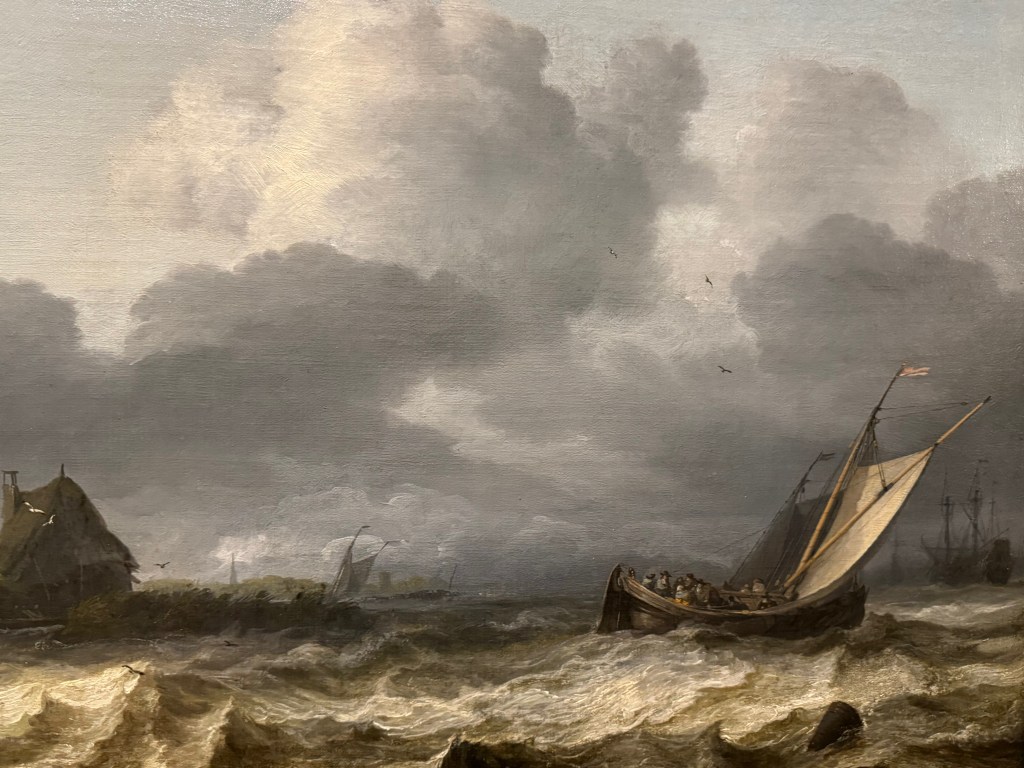
Le Petit Palais, Paris, May 2025.
There were endless corridors of incredible old paintings. This was one of my favourites. I stood in front of it, wondering at how in the 17th century a virtually unknown painter had produced this picture from his own imagination (since there were no photographs then, remember, no image libraries, no Pixabay) and here it was four centuries later in Paris and so was I, and I couldn’t step away from it.
Allaert van Everdingen. L’Orage (The Storm): oil on linen, 1650.
But suddenly I knew I had to lie down, and there is nowhere to do that in Le Petit Palais. I started to panic. My partner shepherded me around with rising anxiety. I said we had to leave at once. Outside, a set of metal barriers had appeared and no vehicles were allowed to stop in front of the building, or anywhere near it. Police were patrolling up and down. Where to go? What to do? I panicked even more. After what seemed like hours we managed to get back to the apartment. I decided I had to just stay home for a while and not go near that book I had come here to write.
It definitely did not want to be written. It was full of my usual preoccupations about mothers and daughters and trauma and inter-generational rivalries. After a time I decided I had to find a doctor. It was so easy! An amazing midnight home visit by a local doctor provided a diagnosis of a mystery virus and consequent high blood pressure. He gave me a script for some magic pills which were procured next morning from the Green Cross pharmacy across the square. I felt better but still couldn’t write anything other than my diary.
After that, I went back to Sydney and thought maybe my book should be about having a panic attack in Paris. It could still be about that early 1980s era, but instead of a “normal” novel it would be a memoir of the present superimposed on a certain past which may, or may not, have existed in its recollected form. I realised I could salvage my original title, Paris Vertigo, which was perfect for this purpose. It could be any length: a Substack piece, a novella, a novelistic memoir. Not a poem, though.
It would probably push aside my daily diary writing, which in any case is no longer daily, and never has anything very interesting in it because I never have time to write it properly. I am so over-committed. So why not add one more probably unachievable task? Brandon Taylor’s Paris story inspired me to think it might be possible.
BELOW: The lobby of the Hotel de Nice, where some of PARIS VERTIGO takes place.
I have been struggling for years with a problem which has held me back from my literary destiny (ha ha). Fortunately, Joan Didion suddenly if posthumously stepped onto the dancefloor of the writers’ parlour. She died in December 2021, aged 87. Her raw diaries are about to be cooked in April. A segment of her unpublished work, consisting of journal entries addressed to her late husband John Gregory Dunne, will be published. There is a history to the discovery of these diaries and the decision to publish them without further edits but I won’t go into it here. The book titled Notes to John include reflections on her experiences as she attempts to make sense of her husband’s sudden death, her weird and frustrating relationship with her daughter Quintana Roo and her difficulties with work, alcohol, depression and anxiety. Her interactions with her psychiatrist reflect on this.
She left these diaries perfectly arranged so it is reasonable to assume she wanted them to survive and therefore to be read. Don’t we all who keep diaries secretly hope there is some enduring place for them? For many writers, especially women, diaries have been an inseparable part of their identity. Quite a few writers now publish their own diaries, or extracts from them, or cite them in their memoirs.
I know there are “issues” with Joan Didion. She is seen as conservative, pro-Republican, reliant on men, ideologically suspect. I’ve been seeing her more clearly through Lili Anolik’s book Didionand Babitz (2024) and will probably write more about it shortly. For now, though, it is something in Joan Didion’s early work that is on my mind – something I read once and then forgot about, which has just resurfaced.
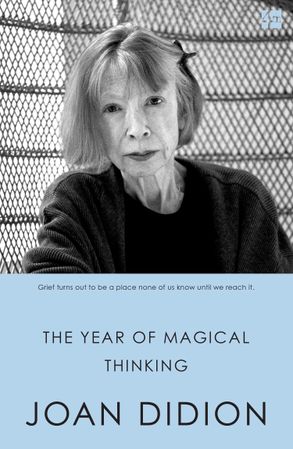
Mostly it was her book The Year of MagicalThinking (2005) which became important to me. She wrote it after the sudden death by heart attack of her husband, at a time when her adult daughter was suffering a severe illness. The atmosphere of her book enfolded me when I first began to write my own mortality memoir Regret Horizon (still unpublished). My mother died in 2008. She didn’t die suddenly but weakened slowly and defiantly until passing away in hospital at 93 after an accident with her dentures. My book turned out nothing like Didion’s: I surprised myself by writing an almost ethnographic account of my mother’s final year of life, my own mismanagement of it, and the immediate consequences of her death.
Later her book Blue Nights (2011) reflected on her life with her daughter, who was born at almost exactly the same time as my first child (in early 1966) and died in 2005 aged 39. I was still trying to draft my book. I didn’t want to go into my relationship with my own children, although that necessarily suffused the story and I couldn’t repress it altogether.
In the recent burst of pre-publicity surrounding her diaries I came across reference to something which hit me with one of those “OMG yes” moments.
Her first collection, Slouching Towards Bethlehem, was published in 1968. In her essay “On Keeping a Notebook” she talked about writing not as a means of recording facts but a way of capturing moments in all their specificity, giving a kind of enduring existence to the flickering and pulsing of emotion and impression before they disappeared altogether. She wrote about the need to recognize the people we used to be.
I read that essay around 1970 while trying to deal with the notebooks I had written while “in the field” doing research in First Nations communities in remote Arnhem Land, carrying out a project for a higher degree. The topic of my research was supposed to be “the women’s point of view” in an indigenous community still closely embedded in the pre-invasion way of life. I tried to do the right thing, to keep accurate accounts of behaviour and conversation, to find out what women thought about traditional marriage arrangements and social organization and struggled to find a way to write that was somehow scientific and objective and academically acceptable. Given that there were no existing examples of such a project that I knew of, I had no guidelines to follow.
I very soon discovered I could not possibly write this kind of thing. Instead, I was writing notes which were more like diaries because of the way I experienced the events I needed to write about. My two-year-old son was with me. I was a mother. There was no way around that, no “objective” position available. The things that happened as day followed day and the dry season became the wet season and I slowly learnt the indigenous language and spent most of my time with other mothers and children created a personal life for us in that community, and outside it as well. This existence seemed to have nothing to do with the “professional” persona through whom I was supposed to be demonstrating my academic and objective research capacities which was the reason for us being there in the first place.
Any anthropologist who did old-school fieldwork in those times experienced something like this, but it was particularly powerful for me, a very young woman, a mother with a small child. Moreover not long I arrived “in the field” I discovered I was pregnant with a second child, conceived just before I left Sydney where my husband was pursuing his own activities. In “researching” women’s lives in that community I became a different self. I was given an identity, with people assigned as my kinfolk and expectations of my behaviour arising from those relationships. My “fieldnotes” became more and more a diary, and I realised that the writer was neither the person living in that community in those moments, nor the person who came from a prestigious University far away in the city. The actual writer was an intermediary being who came into existence at night as the cockroaches scuttled across the concrete floor in the flickering light of a kerosene lamp and my son slept in the old caravan next door.
Time passed, my pregnancy progressed, I had to go back to Sydney for the birth.
Later, trying to make sense of this writing which was neither and both field-notes and diary, a new and different writer emerged. This person had to reflect on the embodied feelings, the conditions of daily existence, the conversations, the rituals shared, the moments remembered, an entirely discontinuous reality which now lay bizarrely in the past. It seemed almost impossible that this was the same person now writing an academic thesis in sunny Sydney, a new baby in a basket and a husband dealing with his own traumas.
What I finally wrote was very distant from the original research proposal. It turned out to be about child-bearing and child-rearing, something most professional anthropologists were completely uninterested in. It was published to almost complete silence. In the confusing times which followed, I wrote academic works. I went to a different “field”, this time with my husband and two young children, and the problem of writing and identity was even worse, capped off by the fact that my son set fire to our tent and caravan, thus incinerating eight months of fieldnotes and diaries.
Much much later my academic career was nearing its end. My mother was dying, and so was my ex-husband. I had to write about, that year and its aftermath. I wrote bits and pieces, draft after draft, various chapters, discarded, rewrote, but couldn’t bring the project to an end. I began a final edit and still didn’t like it. I needed the book to change. I didn’t know who this writer was either and didn’t like any of the versions of her who came forward as “author”.
Then suddenly I rediscovered this quote from Joan Didion’s “On Keeping a Notebook”, from the 1968 collection Slouching Towards Bethlehem.
“I think we are well advised to keep on nodding terms with the people we used to be, whether we find them attractive company or not. Otherwise, they turn up unannounced and surprise us, come hammering on the mind’s door at 4 a.m. of a bad night and demand to know who deserted them, who betrayed them, who is going to make amends.”
I’d had so many bad nights but had not considered that it was those irritating people I used to be hammering at the door. These entities all seemed to have a hand in my book, toiling over paragraphs, edited out superfluities, then put more in. They were all trying to write my book. Outlook and expression and desire, indeed the very reasons for the writing, seemed to be constantly changing. All writers understand that the “author” is not the ”writer”, but what if there are several of them vying for dominance? Perhaps all “authors” suffer from MPD. Except for writers of rapid release genre fiction, who will now be the instruments of AI. But that is another topic.
I had turned it all outwards: I thought it was the real people in my life making demands on me, and I was trying to write this memoir to make amends to them. But it wasn’t them I had to make amends to, it was the old entities who had occupied the placeholder “me”. How Joan Didion, at such an early age (she would she would have been 34 in 1968), could have come to this blasting insight seems amazing. Now Joan is back in my life I am re-reading her with different ears and eyes and maybe I will find out. And if I can keep on good enough terms with those other denizen/components of the authorial entity, I will be able to finally let the book go – publish it, or let it perish.
Some recent notes on Joan Didion:
Nathan Heller. “What we get wrong about Joan Didion”. The New Yorker, 25 Jan 2021.
Karina Longworth (Substack podcast): “Lili Anolik on Joan Didion + John Wayne”. 30Jan 2025.
Cerys Davies. “Joan Didion’s diary of post-therapy notes is going to be published”. LA Times, 5 February 2025.
Daniel Lavery. “A Sneak Peek at the Upcoming and Never-Before-Read Joan Didion Diaries”. The Chantner. Substack. 18 February 2025.
Marissa Vivian. “Hemingway: What Her Words Reveal About the Ethics of Publishing her own Diary”. Substack. 8 February 2025.
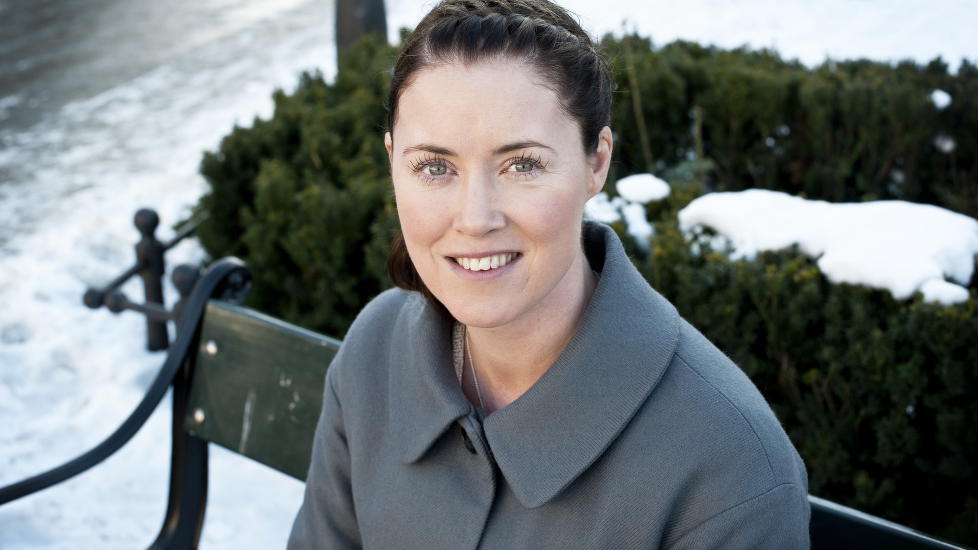
Dear Readers, this is just a quick note to let you know that if you looked me up on Google you very likely came across a compelling photo of a stunning women with a penetrating, somewhat sad gaze. As the text below it says “Annette Hamilton” you may have been misled into thinking either that I was committing a very heinous sin of disguise, presenting my persona in an entirely misleading way, or that somehow I had undertaken a full head and neck transplant which as far as I know even Drs Dubrow and Nassif could not manage (if you are a fan of Botched you will know who I am talking about).
No, this is a photo of writer Anna Wiener (37) author of Uncanny Valley, a book I strongly recommended in a post in March 2020 (see Posts).
I still recommend her book as a wonderful example of auto-ethnography, but with everything that has happened in the US over the past 4-5 years it can’t help being a bit past-the-moment. She now writes for the New Yorker as a tech correspondent – her latest pieces are “On video game engines” for The New York) and “On office memoirs” for The New Yorker. The photo above comes from her website.
There are plenty of photos of Annette Hamilton on this site and I think you’ll agree there is no mistaking the two.
As a possibly irrelevant aside, you may come across reference to an Annette Weiner (note different spelling). Annette and I did in fact share a number of elements of personal experience which would make this mistaken identity far more cogent.
Annette Weiner, former Dean of the Faculty of Arts, NYU
Annette Weiner was an outstanding and well-known anthropologist; born 1933 in Philadelphia, she died in 1997 in Greenwich Village, of cancer, at the age of 64. She had an extraordinary career, as Kriser Distinguished Professor of Anthropology, chair of the department and dean of the Graduate School of Arts and Sciences at New York University. She wrote a dissertation on the contribution of women to the economy of Trobriand society.
Annette Weiner was a very generous, kind and fun-loving soul who allowed me to stay in her New York apartment on several occasions. We also met up in Paris, but things did not go well between us there and our friendship collapsed under the weight mainly of my bad behaviour. But, as they say, that’s another story! Perhaps to be told in an upcoming auto-fictional memoir, Paris Vertigo, although that’s not on the immediate writing horizon. I have always regretted what happened between us, although it was probably inevitable. How much of “the truth” I can tell in that book remains to be seen. But please do not mistake me for Annette Weiner either!
While still musing (fretting, angsting, brooding) about the memoirs (Outsidethe Frame) I noticed a recent comment in The Guardian by Alex Clark (Sat 23rd June 2018). There are booms in things that we in slow old Australia sometimes don’t know about for ages, or they are overlooked in the very few outlets where local readers find out about what books to read eg The WeekendAustralian Review (sorry, Stephen Romei, we love you anyway). The hot new thing, Clark says, is autofiction. Another recent comment asks plaintively, “Why have novelists stopped making things up?” here.
So it’s a big trend, and it’s led me into a further vortex of reading and thinking about the question of life-writing, or whatever it is, and the enormous burst of genre-busting (like bunker-busting) which seems to have suddenly become possible. The old divide “fact/fiction” is wobbly and feeble, although nobody has told whoever writes the Amazon categories.
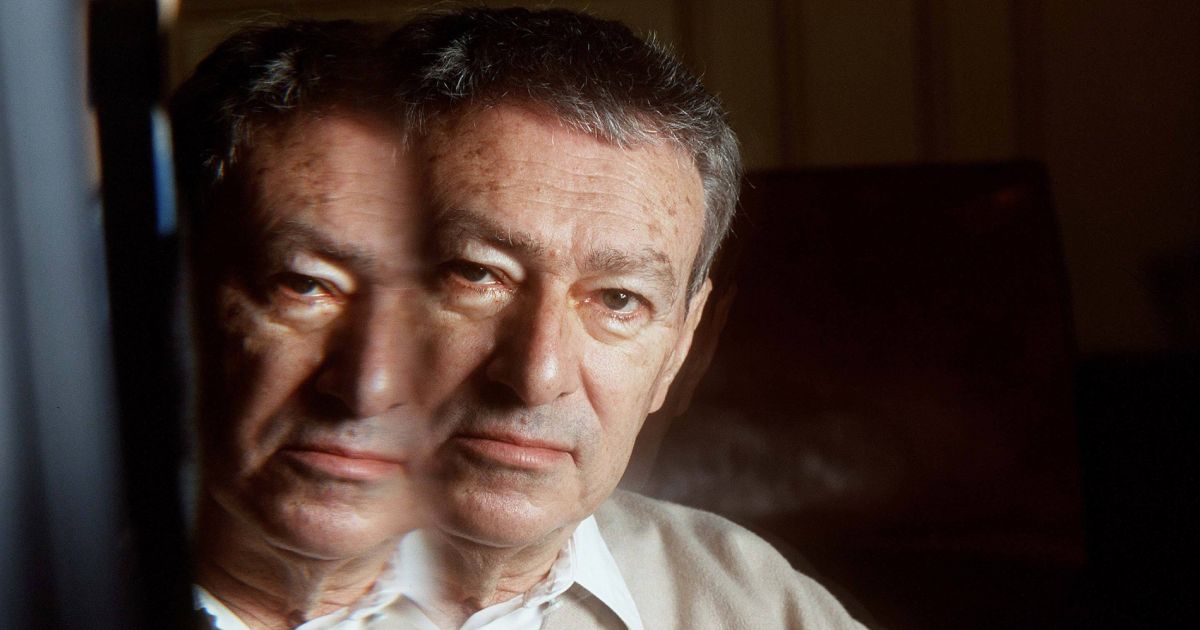
Autofiction is in the space between fact and fiction but goes a bit further. Its origins lie with French writer Serge Doubrovsky, whose 1977 novel Fils (Son) did away with traditional elements including plot and character development. It might or might not have been “telling the truth”.
Serge Doubrovsky, originator of auto-fiction – “Fils” and “Le Monstre”. None of his books seem to have been translated into English.
Lately the autofiction trajectory has ramped up and it’s getting really really complicated because all kinds of writers are writing about others living and dead and they are all in a kind of gang and once you start with one of them you finish up with a whole crowd. It’s like inviting a new acquaintance over for a drink and they ask if they can bring their mate and the mate bring some other mates and they all know everything about each other and are planning a sleep-over and you didn’t know any of them before today.
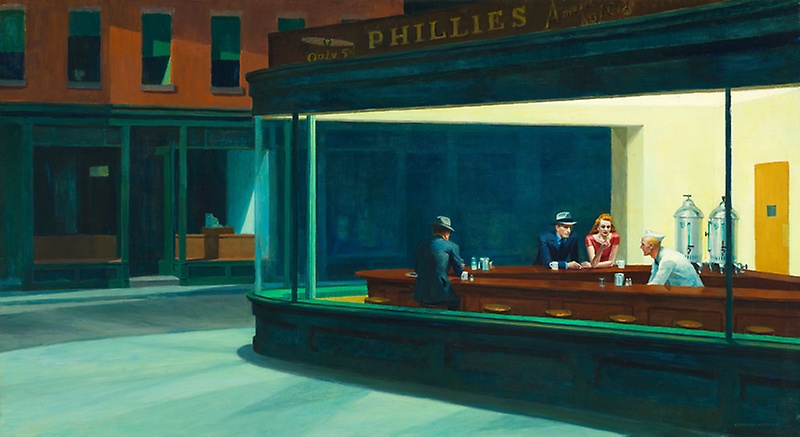
Olivia Laing has written a couple of personal non-fiction narratives, the kind of book where the author takes a personal experience and turns it into a form of sociology/history. In The LonelyCity (2016) she wrote about Edward Hopper’s Nighthawks and Andy Warhol’s Time Capsules, among other art works which offer insight into urban alienation.
Edward Hopper’s “Nighthawks” – most famous visual meme for urban alienation?
I came across this book while researching Hopper who I had studied for my painting degree. She draws heavily on the classic biographies – Gail Levin’s fantastic book on Hopper, for example. I then discovered Laing had published The Trip to Echo Springs: Why Writers Drink (2013). Are there really good excuses for the bad behavior of great artists, or, as Sarah Ditum says in the New Statesman (20th June 2018) is all that artistic stuff is a lot of hokum and they are just regular drunks who happen to be writers?
The poet John Berryman, late 1960s. After numerous stints in rehab he suicided in 1972. Photograph: Terrence Spencer/Time & Life Pictures/Getty Image
But now Laing has somehow fused herself with the late Kathy Acker, and written Crudo. published by Picador in July 2018. It is about the summer of 2017, you know, Trump, Mosul, Grenfell, celebrity deaths. But the story is Laing’s own, about her marriage to poet Ian Patterson, and about another book, the new biography AfterKathy Acker by Chris Kraus. The narrator Laing identifies herself as “Kathy” and has somehow appropriated the life of Acker, who died horribly of untreated breast cancer aged 50 in 1997. Kathy Acker is having a big surge with millennial girls/women after years of non-recognition. She wrote, among other things, Blood and Guts in High School and Great Expectations, both recently reissued by Penguin.
Kathy Acker: rediscovered after twenty years?
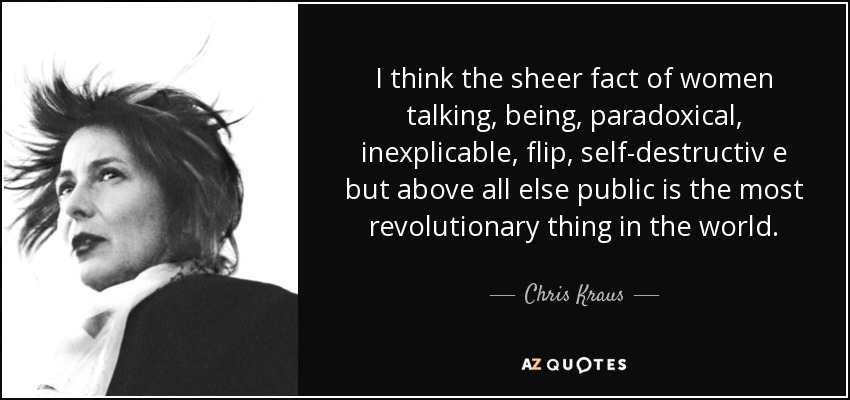
What the hell is going on? If you felt confused by what I just said about Laing’s book you’ll be even more so when you come to another autofiction booming in reprint, written by that self-same Chris Kraus.
This is a seriously weird piece of work. I Love Dick may sound like a pornographic come-on (excuse me!) but instead it purports to be (or is?) a whole lot of different sorts of writing put together by failed film-maker Chris Kraus and her husband, French theorist Sylvère Lotringer. Chris forms a sudden and irresistable passion for Dick, an English theorist who arrives in Los Angeles via Melbourne and fancies himself as a cowboy. She doesn’t name him in the book, but he’s outed by the New York Times (I think) as Dick Hebdige, author of that most famous 70s sociology book, Subculture: the Meaning of Style. I taught cultural anthropology courses using that book for years. Hebdige went on to write on contemporary art, design, media, mods, reggae, postmodernism, improvisation and Takashi Murakami. No wonder Kraus and probably Lotringer fell madly in love with him. Chris pretty much started stalking him, in a literary kind of way.
Dick Hebdige, cultural theorist and object of passion.
A little research reveals that he was appalled and issued a legal “cease and desist” order which was ignored completely. Poor man, he is still teaching in California and who knows how he faces up to those rows of eager students all of whom know he is “Dick” and that he has been “loved”. Even worse for him now with the Amazon Prime mini-series, where “Dick” has been turned into a cultural studies/art cowboy who makes gigantic sculptures in the Texas desert. Kevin Bacon plays Dick.
I Love Dick is kind of a story, it has a beginning, middle and end. Kraus and Lotringer are definitely real people. They probably did write all those letter and make all those phone calls. But here’s one clue as to why this is such a weird read, because it includes a lot of faxes, and faxes are so … well …. yesterday or, to be more precise, last century and indeed look up the publication history and you will find that this book was published originally in 1997 by Semiotext(e), a well known French-theory inspired journal/magazine/publisher which, guess what, was run by Lotringer and is still going today, releasing all kinds of strange and interesting books about Foam, Morocco, Versace and has also just published Chris Kraus’s new book on Kathy Acker. So we’re back in a circle.
Now I Love Dick has been republished by Tuska Rock Press, an imprint of Profile Books, London, with the catchy subtitle: ‘The Cult Feminist Novel, Now a ….” But the Kindle version cuts off what it now is, so we can imagine all the things it might be, like an independent movie made by Kraus herself? Probably not a Netflix series, but then, you never know. There’s an Afterword by Joan Hawkins – there are several people who could be her, one an academic, one a psychotherapist. Hawkins calls Kraus’s writing “theoretical fiction”. This is because theory becomes part of the plot, where debates over theory form an intrinsic part of the narrative. Well, that covers things nicely.
It is an 80s story, although set in the 1990s, by which time everyone, filmmakers, theorists, academics and famous former roués were all expected to have become tamed and obedient to the emerging neo-puritanism bursting open the last seams of the millennial sofa to get rid of all that old-school libertarian stuffing. These characters still say “dig” – as in, “people who dig each other’s references”. Well!
As a veteran of French theory I am kind of thrilled to see it resuscitated even if it is in a quasi-romantic/pornographic pretend novel. And now Kraus’s earlier totally neglected book has been republished, or just published, not sure which, and it is about the same couple before they met Dick although they have different names so it’s a kind of prequel. In Torpor the couple in 1989 or 1990 go to Romania to adopt an orphan. I’m loving it.
It’s very exciting to be thinking about where these various forms of fictive narrative or narrative fictions or Me-Moirs are really going. Sadly though it has shown me that what I am writing might be far too archaic and old-fashioned being full of plot and narrative and cliff-hangers at the end of chapters and efforts at transparency and truth-telling. Even bothering to write this much about your own life is pretty radical when you are as old as I am and have no idea if anyone will ever read it. Although there is theory in my books, it is not so obvious that it will annoy anyone and probably no-one will even notice. But I am a bit sad about it too. I’d love to be writing something crazy and unacceptable and scary and disgraceful and dripping with it, a self-saucing theory-fest.
Last time I wrote a bit about the memoir I am currently reading, by Tara Westover. This led me to reconsider other memoir writers who have been especially influential (and otherwise) in my current project. I think it’s incredibly important to remain aware of the link between what you are reading and what you are writing. There are thousands of memoirs around, a lot of them extremely boring. But memoirs of writers … especially of writers who mainly write memoirs … it’s a whole area of literary scrutiny which seems weirdly appropriate in the present era of compulsory self-curation. So here are some thoughts about three recent literary memoirists who have had a big influence on my recent work.
JOAN DIDION.
Joan Didion’s book about her husband’s death The Year of Magical Thinking (2005), and her later book about the death of her daughter, Blue Nights (2011), were important for me in understanding how differently writers can inhabit and explain their inner worlds. The story itself is heart-wrenchingly painful. From a young, happy creative woman with a loving family life, Didion suffers the ravages of time and random chance, far beyond what she ever could have imagined, with painful dignity. The passage of time itself seems almost a character in her books, enhanced by the publication in various places of photographs (though not in the books themselves). I have been wondering about whether to put lots of photographs in mine. I love looking at other people’s snapshots of themselves and their families and friends as I am reading their memoirs. On the other hand, sometimes the imagination is the best illustrator.
Joan Didion with her husband Greg Dunne and daughter Quintana
Joan Didion, after the death of her husband
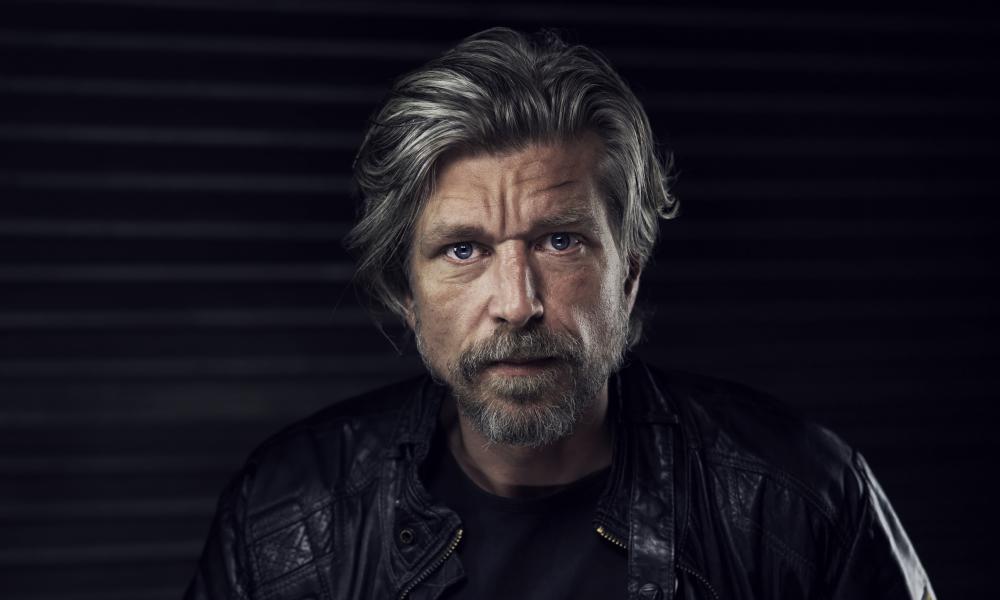
KARL OVE KNAUSGAARD: MY STRUGGLE
Karl Ove Knausgard – publicity still
Knausgaard showed me that I didn’t need to follow a temporal sequence but could produce component volumes of different lengths and time periods in episodically random order. His first was A Death in the Family (2009 in the English publication sequence) and he was writing it round about the same time as I was writing my own maternal mortality story. His revelations about his father, which caused a violent storm in his native Norway, were pretty gruesome. I had nothing of that kind to contribute. My mother had done some pretty awful things like most of us do, but she was nothing like the kind of horror he described his father to be. If anyone was a horror, it was me. Sixty-three at the time, I still thought I had to excel in my career. I still thought I was much more important than anybody else. This was not the frame of mind to be in when trying to help a 93 year old woman through the last year of her life.
Like most English-language readers I was gripped by Knausgard’s second volume, A Man in Love (2013) about his relation with his second wife and their family. The texture of everyday existence and his internal monologues as he did his best to live in ideologically correct Sweden and please his feminist wife, the only man taking his little child to pre-school singalongs where he spent the time lusting after the kindie teacher – what happens when you want to be a writer but aren’t allowed to – a typical woman’s story, now being written by a man who had acceded to feminist expectations. A lot of women writers seem to have approached Knausgaard only to go away again. There is something challenging about entering so deeply into this man’s mind which feels strangely disconcerting. We think we know how men think but it’s weird to have it confirmed in such detail. Good feminists aren’t supposed to enter this terrain at all, or so it seems, but I found it liberating. Knausgaard exemplifies a masochistic hysterical masculinism which seems to have become a default position for many hetero male writers today.
NOT AN INSPIRATION:
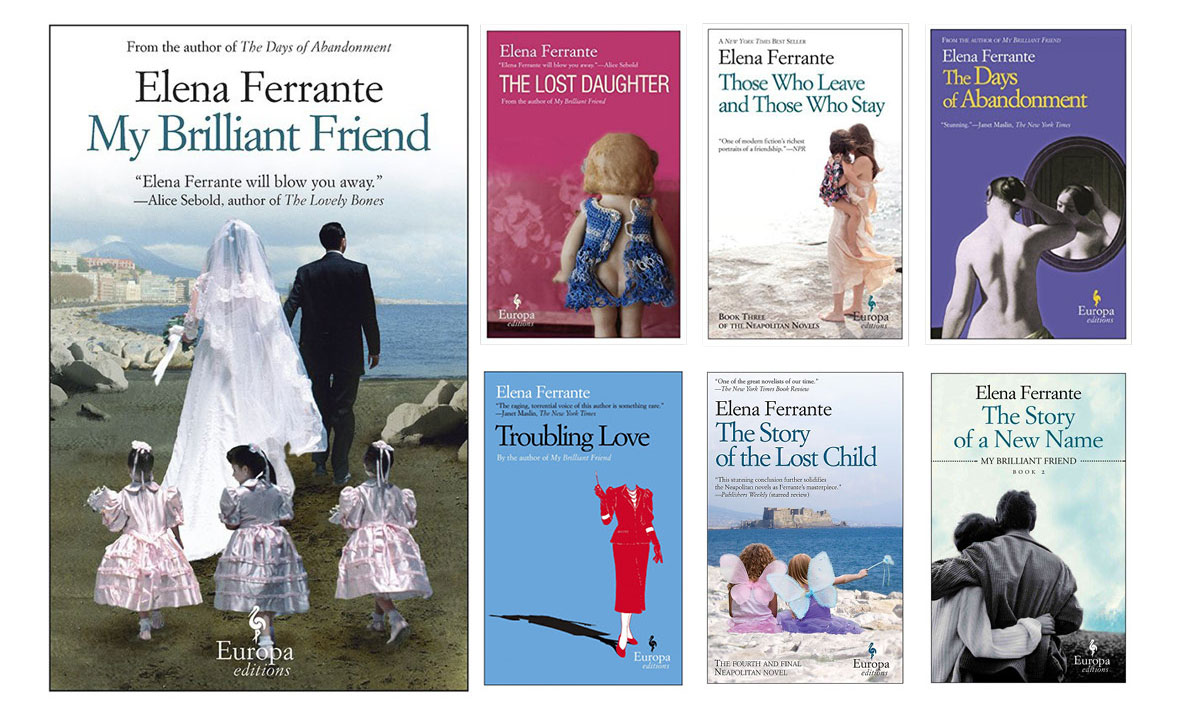
Elena Ferrante (well, that is not “who she really is”; all l the hoo-haa has been quite absurd, unless you subscribe to the Author as Sacred Object school of literary thought) is very popular with women readers. Everything she has written seems to me completely fake. I really and truly cannot read it. I have started one book, then another, tried going into the middle of the first one, then the end of the third and I don’t get it. Just look at those covers: Mummies and little girls in silly clothes, dollies and fairies, nakedness in the mirror, and a headless woman in a bright red dress. Really!
One of these days I will try again. If Knausgaard is the masculine consciousness of the twenty-first century, Ferrante might be the feminine counterpart and not in a good way. Women seem to read books in order to identify themselves with the narrator, and in line with a lot of feminist theoretical work from the 1970s and 1980s, she works from the classic masochistic feminine position. It is so depressing that a great many women still seem to find this compelling.
Everyone who writes is supposed to read all the time. I certainly do that, in part because of increasingly chronic insomnia. But reading too much (and watching too much Netflix) gets in the way of actually writing. So I am cutting right back. But at the recent Sydney Writer’s Festival (the one sponsored by Varuna at Katoomba, and only for one short day unfortunately) I heard Tara Westover talk about her just-published memoir educated and I had to buy the book and read it at once. Not finished yet, and will write more about it soon, but am loving it so far, and finding it inspires me with confidence about the value of life-writing. I love the fiction universe of course, the worlds created there, but the actual real world is pretty amazing!
As mentioned last time, memoirs are at the front of my priority list at the moment. I realise in retrospect that I have been reading memoirs now for several years. Westover’s book is about a young woman who is raised in a fundamentalist Mormon household on a mountain in Idaho. The thing is, she never went to school – shock horror – and yet became a highly successful writer, historian and academic at the top universities in Britain. I haven’t found out exactly how she accomplished this, but I kind-of relate to it. Of course I did go to school, and my family was hardly survivalist or fundamentalist, but the ethos of my early life was pretty similar: anti-Government, pro-self reliance, no emphasis on education, the constant awareness that you weren’t like other people who took city life and money and happiness for granted. And of course, being in Australia in the 1950s meant something different: the shadow of World War Two, family disruptions, deaths and secrets and silences.
I have read – what? – maybe thirty or forty memoirs about growing up in communes or remote communities or outside the mainstream world. In many ways I was doing the same until the mid-1970s and then, strangely, I slid back into it, but that older life never leaves you, and I think, from what Tara was saying in her talk, it has never left her either.
And today I am reflecting on the strangeness of it: reading other people’s life stories allows you in some way to rescue or re-inhabit your own.
Jenny Sages Portrait of Helen Garner. National Portrait Gallery, Canberra.
The best thing about getting older is realising that others are getting older at the same rate, especially your favourite writers. They’ve been writing for years and years, and you’ve been reading away alongside. In traditional publishing it means that they write and you read at different moments of the Zeitgeist, so you experience them in different ways according to where you both are. Helen’s recent book of essays Everywhere I Look felt both familiar and dazzlingly fresh. Preoccupied with my current volume of memoirs, this and the publication of Bernadette Brennan’s study of Helen’s work (more on which in another post), sent me scurrying off to rediscover her work in the present moment, 2017.
A lot is now available on Kindle. I had purchased her print books over many years but most had gone off into the mysterious places books go when you move your stuff around a lot. Now I could repurchase and reread all at once. Yes, it is a Kindle binge. A wonderful short novella about a trip to the Antarctic was the first surprise: I had never heard of it before. I reread The First Stone and This House of Grief and The Spare Room and then I came to Joe Cinque’s Consolation, which I had never read before..
What can I say? Absolutely riveting, so moving, so saturated with a personal truth which is at the same time a collective experience of being “us”, people in Australia, experiencing things in different ways, and it is these differences which Helen tries to clarify and explore but in the end the mysteries of human behaviour defeat explanation or even understanding.It is great that Helen is getting the praise she deserves in the US at last. Reading some of the reviews on Kindle is sobering, though. They are not negative, rather, puzzled, a bit confused. Why is it that some writing travels seamlessly through English-language markets while other books falter? Why was The Dry such a hit in the US? Why does Liane Moriarty work everywhere?
I hope a lot of people discover and rediscover Helen Garner now. Nobody could have guessed back in Monkey Grip days what she would become. If you could give a medal to an Australian writer, Helen should be first on the dais.
Sometimes books appear and you know right away you want to read them. Nikki Gemmell is already a very well-known writer, with a lively career as a magazine journalist as well as ten plus full-length books, the best known being her first, The BrideStripped Bare. I have to confess it is the only one I have read. I’m not quite sure why. Her books seem to fall between a few stools: genre fiction, literary fiction, self-help, essay.
But her new book, After, is definitely in my territory. Memoir, true story, traumatic experience, mothers and daughters. I’ve already written my own version, about the death of my mother and my ex-husband within three weeks of each other back in 2008. I wrote it not long after but haven’t been able to bring myself to go back and edit it, let alone publish it. But it is on my list and should be finished by mid-year. I don’t think it will be much like Nikki’s book.
Nikki’s mother chose to die; mine didn’t. My mother never intended to die, ever, and the stupid accident which killed her could easily have been avoided. She was 93; she might conceivably even be alive today if she hadn’t lost her dentures. But that is my story, this is about Nikki’s, sort of, but not really, because I haven’t read it.
Tomorrow we are going to hear her talk about her book at a “meet the author” event in Katoomba, courtesy of the wonderful Gleebooks in Blackheath and Varuna Writer’s Centre. I have been looking forward to it. It’s so much better when you have read the book being discussed. So I did what I always do, and looked for it in a Kindle version from Amazon. Yes, it was there, so that was good, until I looked at the price. $14.99. In hardcover it’s $22.50. There doesn’t seem to be a paperback. What? Yes, it’s Harper Collins’ strategy to get you to buy the hardcover, or at least to stop you buying the e-book. Who would pay $15, even if it’s a great book and you really want to read it? And who is getting the lion’s share of the inflated e-book price? You can bet it’s not Nikki. No, for those who do pay for the e-book, Harper Collins will get the major part of it, even though their production cost for putting it up on Amazon as an e-book is probably near zero, since all the editing was done for the print version, the marketing costs cover both, and tweaking an already existing cover design for Kindle is so easy a kindergarten child could do it these days.
Sorry, Nikki, but I guess I won’t be reading your book for quite a while. I can put my name down for it at the local library, or maybe I will find some friend who has bought the hardcover. But I will not buy any more hardcover (or print) books unless they absolutely cannot be obtained any other way and I really really need them. And although I’m sure your book will be great, I just won’t support greedy publishers who expect readers to cough up absurdly high prices just to keep their existing legacy business model going. Just a reminder: when you “buy” an e-book you don’t really “buy” it in the traditional sense. It isn’t yours. The company who release it can remove it at any time. You can’t lend it to anybody else. You can’t give it away as a present. You are just hiring it. A price above $10.00 is wholly unjustifiable.
I suppose it is ethically dangerous, or at least raises certain issues, to introduce characters in a TV series who are so obviously based on “real people”. The super-famous Swedish writer who appeared on Younger, clearly based on Karl Ove Knausgaard, didn’t look like him and didn’t behave like him, or at least the version of him one can deduce from reading his books and watching his Youtube videos here or here. He is an altogether smoother, yet somehow more smarmy character. Did Kelsey just go for him because he was so famous?
Kelsey and the Swedish writer
Introducing his wife to the narrative was an interesting move, as a way of getting rid of him from the plot. They made her out to be old-looking, skinny and hysterical. The real Mrs Knausgaard, Linda, is something else altogether.
Linda Bostrom Knausgaard
Linda and Karl Ove
She has written her own book, Welcome to America (but it is only in Swedish, no translation so far) and the only interview with her I could find was also in Swedish, without subtitles, here. Wow! I really want to read this book. I love books written by authors’ (and artists’) wives. One of the weirdest is the book written by French ultrabad-boy Michel Houllebecq’s mother – another post on that shortly.
In “Younger” the Swedish writer’s fling with Kelsey, one of the main girl-publisher characters in the series, is brought to a decisive end by the major tanty Mrs. False-Knausgaard put on in a restaurant, even though she got it wrong and thought it was our heroine Liza who was doing the dirty deed- and exit stage left for both of them. Poor Kelsey was left with that hideously boring and repulsive Thad. It was a bit amusing when she decided to buy him a super-expensive (and ugly) watch as a kind of “I’m sorry” present, and even more amusing when she decided not to give it to him but he gave her a super-expensive bracelet which she oohed and aahed over until she grasped what it mean … that he’d been having a bit on the side too, although in his case it was with a lap-dancer. Much tackier than a tasteful Swedish author.
Still, it was a shame to see these character go. At least he seemingly wrote real and engaging literature, something the readers could really get into. And it would have been such a great sub-plot if the girls had discovered his wife wrote books too, and decided to publish hers instead of his. Dream on … that is a step way too far for a popular US TV series.
The books the girls have been trying to deal with since have been less and less worthwhile. One, the plot of which covered intergenerational trauma, turned out to be completely plagiarised by a lady writer desperate to be published, no matter how, and after that the books have got worse and worse, the highpoint of tacky being the “list” of 69 things women supposedly think about when performing a certain deeply subordinate sexual act on men. Yuck! Why would Kelsey have championed that book?
For any frustrated and confused writer who can’t understand why they can’t find a traditional publisher for their work, this series is a godsend. How could anybody want to be published by people like these? If this is the publishing industry, no wonder actual writers can’t get published.













 Annette Hamilton - Writer