I have had occasion recently to review my own book of short stories, Revolutionary Baby. There was a suggestion that it might be serialised on a literary/writing platform currently gaining popularity. Some people still like reading and writing old-fashioned stories which reflect life in a pre-digital pre-influencer pre-Trumpian world, dwindling though this number might be. In this process I received some rather surprising feedback: my stories were accused of “man-bashing”. I was taken aback. As far as I was aware, my stories had been written from a ordinary female viewpoint and reflected an awareness and consciousness which any woman of my era would share.
None of my male characters were vicious or evil or deliberately cruel. They certainly were not violent or criminal or sadistic, unlike a high percentage of male characters who now occupy the fictional arena in ever-increasing numbers, thank you Bret Easton Ellis. If they displayed unkindness, self-obsession, lack of awareness or a failure to understand the women they were involved with, this was nothing remarkable. They, too, were creatures of their time. I feel fond of all of my male characters, in different ways, but I did need to convey the impact that their often thoughtless behaviour had on the women in my stories. In some cases they hardly connected with women at all and mainly hurt themselves.
It occurred to me that before considering any kind of serialization I should write an analysis of what happens in each of the stories and insert a trigger warning or even an apology for any misunderstanding that a male reader might experience as a forward. But on the other hand, there is no obvious evidence that any men have actually read the book, so perhaps that would be entirely superfluous.
This led me to ponder the fragmentation now occurring in literary and even more so popular fiction. Many of literary women of my acquaintance, most of whom would describe themselves as feminists, make a point of not reading books written by men. The question of the gender identity of the author, and ditto of the audience, has become a sore point among many commentators online, in literary magazines, in articles on book prizes and awards. There seems to be emerging a kind of gender-ghetto mentality where each identity is writing for others who share it. The striking emergence of queer fiction is an example. Some of the most interesting writing is coming from authors inhabiting a distinctively queer identity world. Is everyone reading this? Or mainly others similarly self-identified? I noted that women writers are mainly read by other women. No doubt there are exceptions today in strictly literary circles. But what is actually going on here? Does anybody know? Is anyone keeping track of these questions?
I love this piece. It seems like a simple narrative but there is so much deepwork here. He writes about his own writing. He knows his topic. He is trying to write something that doesn’t want to be written. He is in a Citadines apartment in Paris, near Les Halles, all set to direct his errant creativity, until the occurrence of an inexplicable body horror: an eruption, a carbuncle, a papule which swells and grows without explanation on his inner thigh. He describes his confusion, trying to seeking medical care in a place where you don’t have the normal supports. You can feel his rising anxiety as the Thing throbs and expands until it bursts in a surge of blood and pain. And pus no doubt.
It was 2023. He was trying to finish a novel which he had been writing and rewriting, each time reaching a certain length (137 pages) until he had to throw it away and start again. Only after his grisly wound was drained was he able to return to his writing which suddenly became something different. His novel, Minor Black Figures, emerged,due to be published in October 2025.
I spent six weeks in Paris in 2024, staying in an old rental apartment. The entire city was going mad in preparations for the Olympics. I was working on a half-drafted novel, a kind of auto-fiction about my experiences in Paris in the early 1980s. It was about woman stuff and the post 70s painting scene and the rise of anti-theory and the “New Philosophers”. But I was too sick to write it, or it was making me sick. I was dizzy all the time and felt constantly confused. I couldn’t manage the stairs and corridors of the metro. The book I had planned refused to co-operate. Too many characters appeared and kept on doing contemporary things, like try to work out how to buy a travel pass from a digital dispenser in an apparently abandoned metro station. Instead of writing my novel I had a major panic attack in Le Petit Palais, a glorious art gallery full of lesser known paintings from the past three centuries.
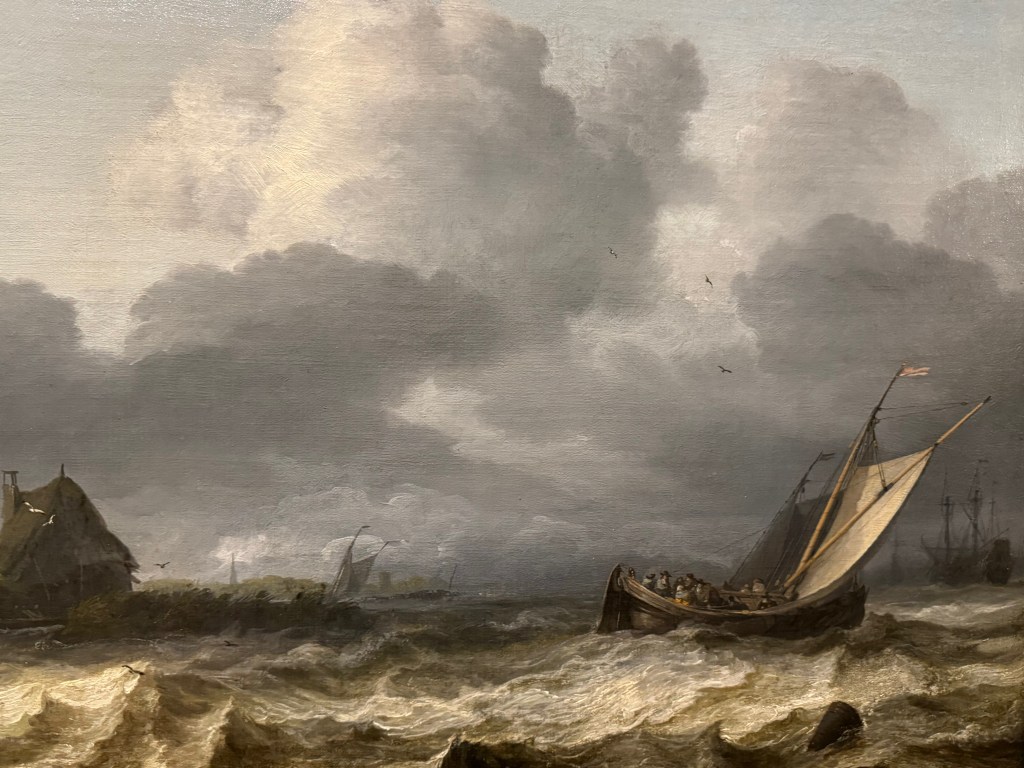
Le Petit Palais, Paris, May 2025.
There were endless corridors of incredible old paintings. This was one of my favourites. I stood in front of it, wondering at how in the 17th century a virtually unknown painter had produced this picture from his own imagination (since there were no photographs then, remember, no image libraries, no Pixabay) and here it was four centuries later in Paris and so was I, and I couldn’t step away from it.
Allaert van Everdingen. L’Orage (The Storm): oil on linen, 1650.
But suddenly I knew I had to lie down, and there is nowhere to do that in Le Petit Palais. I started to panic. My partner shepherded me around with rising anxiety. I said we had to leave at once. Outside, a set of metal barriers had appeared and no vehicles were allowed to stop in front of the building, or anywhere near it. Police were patrolling up and down. Where to go? What to do? I panicked even more. After what seemed like hours we managed to get back to the apartment. I decided I had to just stay home for a while and not go near that book I had come here to write.
It definitely did not want to be written. It was full of my usual preoccupations about mothers and daughters and trauma and inter-generational rivalries. After a time I decided I had to find a doctor. It was so easy! An amazing midnight home visit by a local doctor provided a diagnosis of a mystery virus and consequent high blood pressure. He gave me a script for some magic pills which were procured next morning from the Green Cross pharmacy across the square. I felt better but still couldn’t write anything other than my diary.
After that, I went back to Sydney and thought maybe my book should be about having a panic attack in Paris. It could still be about that early 1980s era, but instead of a “normal” novel it would be a memoir of the present superimposed on a certain past which may, or may not, have existed in its recollected form. I realised I could salvage my original title, Paris Vertigo, which was perfect for this purpose. It could be any length: a Substack piece, a novella, a novelistic memoir. Not a poem, though.
It would probably push aside my daily diary writing, which in any case is no longer daily, and never has anything very interesting in it because I never have time to write it properly. I am so over-committed. So why not add one more probably unachievable task? Brandon Taylor’s Paris story inspired me to think it might be possible.
BELOW: The lobby of the Hotel de Nice, where some of PARIS VERTIGO takes place.
On various writers’ sites it is suggested that one should self-tether to a regular writing schedule to produce, let’s say, a thousand words a day. This routine is recommended so that the current work might be finished some time before the arrival of the Four Horsemen of the Apocalypse (I think at least one of them is here already, but I diverge). As it is, I write at least a thousand words a day before breakfast in diaries, notebooks and Word files and on Evernote, generally in response to my reading during the 3.00 am Insomnia Shift. Or to incessant Nietzschian nightmares of the Eternal Return (the ghost of some book I tried to write years ago but abandoned). These words don’t count though.
Just once did I try this recommendation. It was late 2023 and early 2024. I wrote one thousand words first thing each day for Book One of a new series. I couldn’t believe how effective this strategy was. The words piled up quickly and a complete manuscript appeared. The author didn’t seem to be the same “me” as the previous incarnation and undoubtedly needed a new name. What would it be? Before that could be decided I had to pause because I had neglected so much else (having pressed the “hold” button so firmly) and then I was sucked into the usual vortex. The book, and the series, have languished since.
In fact none of my grand projects is ever really finished. Some almost achieve line honours but fall because I can’t stand doing yet more edits or I have found a new angle I want to put into Chapter X or something requiring extensive research has inserted itself into my consciousness at the very moment I was opening the edits file.
I am sick of my own unfinished books, and this means I am sick of their author as well, I want to shut her up and move forward into new scenarios which I can feel shaping themselves through various still incoherent images. They suggest to me a space far more appropriate than this merry-go-round posthuman nightmare dominated by nostalgic and anemoiac hangovers. (This observation led me to consider the appropriate cocktails for this condition, leading to the development of the FORLORN NOSTALGIA and the RAISETHE ALARM – see forthcoming Cocktail Post).
In the meantime I decided to bring these almost-finished projects to an end and gave myself a deadline of the end of summer (this is Australia, so that is around February) after which I would totally devote myself to my my futuristic post-apocalyptic picaresque adventure/thriller/romance series.
But the effort of finishing old stuff feels insuperable and pointless. It is like trying to complete a very complex piece of embroidery on a linen tablecloth you inherited from your grandmother. You promised you would do it, but now your grandmother is dead and so is your mother and nobody is even vaguely interested in embroidery and who uses linen tablecloths anyway they would only get filthy from the takeaway juices dripping through the cardboard box you now eat from after the food is delivered in a paper bag by some anonymous person who leaves it at the front door. You don’t even need to pay by credit card anymore.
So you won’t need a ladies’ reticule to keep your credit cards in.
Lady’s Embroidered Reticule: English Public Domain Media Search
I guess my question is: is it a waste of time to keep going on the old stuff? Or should it be put aside somewhere on a USB stick in a plastic box where it will be forgotten and ultimately sent to the tip leaving no trace anywhere in the sentient universe? At least if these various blocks of narrative turn into “books” they might live on for a while in a library – maybe. Thus do I console myself for all these years of wasted effort.
Remember back in digital prehistory when Facebook was first a Good Thing? You had “friends” and you could post stuff and they could see it and vice-versa, and as I recall it lasted on your feed for longer than five minutes. It was great for groups interested in the same subject, yes, but it was also great for whatever circles of people you were connected to or inserted in. I don’t know exactly when that changed but now, apart from a couple of still-effective writers groups and one or two painting sites, most of the time all I seem to get is ads for bunion treatments and dodgy looking products introduced by persons in white coats who drone on at length about one of the many infirmities you share. Of all my “friends”, most of whom were actual real people who I knew, and/or relatives, I hear little or nothing. Maybe they have defriended me. I know some of the relatives did. Or maybe they just don’t use Facebook any more.
So when I began to hear about Substack I thought well maybe this was a good way to keep in touch with people you knew, or would like to know, or who knew you, and I imagined lively discussion groups focussing on the usual weird stuff I enjoy thinking about but find it hard to share in the normal run of things lined up at the supermarket or chatting to some bored relative, if you can still find one willing to talk on the phone (therefore must be over 60). So I joined up and only later realised that the primary intention is to get people to pay money to read whatever the writer is wittering on about. Perhaps I haven’t gone into it enough, and perhaps I am not sufficiently committed to supporting the writing of others, but I really can’t see paying regular monthly subscriptions for the privilege. I know this shouldn’t have anything to do with television or streaming services but I can’t help reflecting that I already have to pay dollars and dollars to access Netflix, Stan, Binge etc. and they are seemingly limitless. And the Substack feeds seem limitless but all the same somehow. While I sympathise with the writers for wanting to be paid, I can’t help thinking there is a more important need for places to talk to each other. Sadly, Substack is not it.
Although I mistakenly signed up for two different Substacks with two different email addresses, I am now trying to cancel them. I didn’t sign up to any paid subscriptions so that’s good. But I did want to write things people might read, outside the strict limits of what this blog and site are about, so I thought I would make up my own little Substack thingie and call it a FEUILLETON and put it in my regular POSTS every once in a while. And it will of course be absolutely free to anyone who goes to this website. I haven’t set up a Newsletter so maybe this will do.
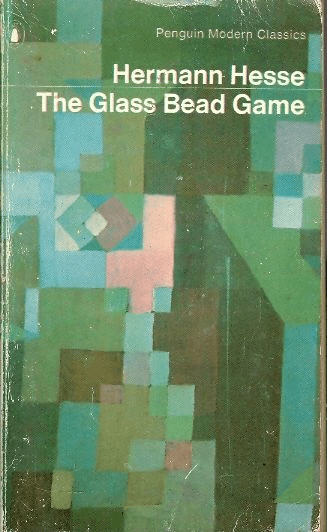
The next post will give more on the history and context of the FEUILLETON. Introduced into popular cultural circuits via Herman Hesse’s book The Glass Bead Game, very influential among proto-intellos in the 1950s and 60s, it turns out to be a very powerful way to think about the effects of contemporary information circuits. More soon.
He’s a miserable looking fellow, unfortunately. Likewise so many of those serious Germanic thinkers. But they do seem to dominate the philosophy of the last century.
Hermann Hesse, 1877-1962
I like to think of that Monty Python sketch where they are all playing football.
“I believe that books build better humans, and I am on a mission to help everyone find the book they didn’t know they were looking for.
I created Shepherd to add magic and serendipity to online book discovery.
When I look for a new book online, it feels soulless. Online bookstores sell books like toothpaste or powdered gravy mix. Something about that is profoundly wrong.
Books are magic.
Books are imagination fuel.
Books change how we see the world.
Books change the direction of our lives.
Books transport us across time and space.
Books let us see the world through another person’s eyes and emotions.
I believe they are one of the biggest net positives in the world. “
I was one of the authors contacted by Ben, invited to contribute to the “three favourite books” of 2023. The Shepherd project aims to provide a new way to help readers find books they otherwise might not come across, using the usual digital approaches eg via an Amazon search. But the Shepherd project aims to be much more than that. Check out the website at shepherd.com and follow the various links on the site. Ultimately, this book discovery site should enable a much richer mix of possible book-searches and the discovery of all kinds of new and exciting writing from an unlimited variety of sources: traditional, independent, online only via a website, and others. Click below to see my three book choices.
I found it very hard to decide which books were my favourites. I have very eclectic tastes, obviously, and the choices I ultimately made reflected some of my reading practices during 2023. This was a difficult year for my own writing, trying to do final edits on Revolutionary Baby, to make decisions about whether or not to publish Radiant Sands, who to send the final draft of my memoir Regret Horizon to, and other issues I was wrestling with. I realised I had read well upwards of thirty books during that year, including quite a few paperbacks from Australian authors published by Australian publishers. Then there were the very many books I dipped into thanks to my membership of Kindle Unlimited. I found it very hard to finish most of these. In part, I joined Kindle Unlimited to get a sense of what the contemporary indie writers were doing. I will write a post soon about what I discovered, if I have the heart for it.
Meantime, I am supporting Shepherd as a financial member, although you don’t have to do this to use its program, as I think anything which will re-open the wide world of books and writing beyond the current restrictions imposed by Amazon algorithms and such must be a Very Good Thing!
Most of my stories and books were begun before writing software even existed and certainly before it became ubiquitous. I don’t know how long programs like Grammarly and Scrivener have been around, because until recently it never occurred to me that I would ever want to use them. But in the past couple of years I became aware that almost everyone in the independent publishing world now regards writing software as part of their professional toolkit. Online forums, blogs, and writers’ groups take it for granted that everyone uses some program or other. Now suddenly AI has arrived and may soon make existing software programs irrelevant because “it” will write the books using algorithms, based on everything that has been published so far.
Before AI was on the horizon I couldn’t help wondering if writing software would help me produce my many belated volumes more efficiently. I downloaded a couple of test programs and couldn’t believe how they worked and what was going on. Here was a new field of cultural commerce aimed at a the thousands of people who now want to be writers – ironically at a moment when reading is becoming a less and less popular activity. Self-publishing in the Amazon environment has resulted in literally millions of books now being available all competing for pitifully small returns to the authors who, unbelievably, often set zero price for their works. Writers even complain that Amazon won’t let them offer works “permafree” as if giving your books away is a good strategy for an effective writing career – but that’s another issue.
What is an author? I grew up thinking an author wrote their own books. The authors I was brought up on – Thomas Hardy, Joseph Conrad, D.H. Lawrence, Marcel Proust, Franz Kafka, Virginia Woolfe, Ernest Hemingway, John Steinbeck, E.M. Forster, Aldous Huxley, F. Scott Fitzgerald, Jack Kerouac, Simone de Beauvoir, to name a few – wrote their works in pen or pencil on paper or in notebooks and edited them several times over by hand before and after they were even typed. Just look at their manuscripts. At some time or other when book production became a major industry publishers began to insist on using editors, who were trained in the technicalities of writing. Editors had a big role in getting a new book to the market. I don’t know what an editor did or might have done to Jack Kerouac’s original manuscript.
Kerouac”s On The Road manuscript is a 120-foot long scroll consisting ofa series of single-spaced typed twelve-foot long rolls of paper that have been scotched taped together. Kerouac found this method more conducive to his style of writing.
Now independent writers are told that they must work with an editor, or editors, through three or four phases of preparing their book for the chaotic world of self-publishing and pay the cost themselves. It seems generally accepted that editors reshape and often rewrite many of the most popular books published today. And this is without considering the role of ghost-writers. At least these characters are human beings.
Getting one’s book substantially rewritten or revised by an editor is a very expensive process. New authors may find themselves paying hundreds or even thousands of dollars before they push the “publish” button. But then along came writing software which promised to take the worst errors away, so the editorial costs would be reduced (although not eliminated).
Writing software works by submitting writing to a standardized matrix which prescribes a limited approach to sentence construction, grammar and expression. When you actually use the software and find out what alternatives and options are being offered you realise how limited the results will inevitably be. I discovered that writing programs such as Word now have semi-editing functions within their own software which encourages authors to corrects spelling and applies rules which puts commas in, or deletes them, according to some arcane formula developed somewhere in “creative writing” schools presumably.
I am unable to compare different forms of writing software because I stopped trying to use them almost immediately (although I do use the checker functions on Word which has its uses). The mass-production of contemporary writing is going on apace with endless reproduction of the same structures, story arcs, sentence design, and impoverishment of vocabularies. Presumably all these books are being scanned and turned into AI programs so that even more similar books can be produced, this time without authors, or rather, with hallucinated authorial names standing in for pure machine algorithms.
I have long been wondering whether there will be a place in future for books certified to have been written by authors who are actual human beings and edited likewise. At the same time, though, there are powerful currents now swirling around the cultural zones which have no respect for books and writing at all.
“Kanye West has revealed that he feels an aversion to literature, comparing books to Brussels sprouts and explaining that he sees evolved forms of communication as crucial to his vision of an optimised future.
The revelation came in a new episode of the podcast Alo Mind Full, where the rapper joined Alo Yoga co-founder Danny Harris and host Alyson Wilson to “paint a sonic picture of what’s on his mind”. ‘
The replacement of books and writing by visual and graphic communication brings us back to ancient societies using images and pictograms, or not bothering to record things at all other than in poetry and song. Which might not be such a bad thing!
I’ve attached myself to a number of author’s groups lately, a couple on Facebook and some semi-professional commentary services (which you pay for). To my surprise the Facebook groups have been a great source of interest and support, in a strangely tangled way. One of the groups often publishes reports by Amazon authors showing how much money they have made in the past few months while the world goes completely insane. This is amazing but also galling when you realise that what is now selling so hugely is aimed at highly specific genre audiences of which the average literary author would not have heard in a million years. My latest find is Reverse Harem Romance (RHR). Wait a bit and I will write more about it soon. What a discovery!
However this morning – a beautiful cool spring morning in the blossoming Blue Mountains, I started thinking about how the various levels of lockdown and state-mandated or recommended forms of isolation have affected the average writer and reader. Thinking of an image, I recalled Caspar David Friedrich’s famous painting, Wanderer Above the Sea of Fog, 1818, whch seemed to represent exactly the way things seem to be right now. I have used a bit of it in the banner headline above.
Over the next few weeks I thought of writing about this strange reality, the sense of being stranded before an unknown world which swirls upwards and threatens to engulf you even while you are still thinking and working and trying to ignore it.
Certainly working: I am struggling to finish the editing, organisation and fussbudgeting involved in publishing my two books of short stories and the memoir, all in the genre of semi-auto-ethno-fiction. Not to mention the putting together and final editing of two other semi-ethno-factual projects, a cookbook based on Australia history and a personal narrative/collection about the Hawkesbury River, my heartland place.
The intensity of work that has been going on as COVID-19 stretches on and bids fair to hit the twelve month mark (or more) has raised some deeply personal issues about retreat, aloneness, isolation, the loss of family, solitude in loved places, and a state of enthusiastic defiance which says: no, even now, with a horrendous potential death drowning in my own fetid lung juices clearly a possibility, even so, I won’t stop, I won’t stop writing and I won’t stop reading and I hope you won’t either.
The last time I saw my lovely granddaughter Lily Luna was in Melbourne in June 2019, when I took many photographs, none so prescient as the one below, a representation of the future which is now with us, the Melbourne Lockdown. Meanwile Lily is stranded in Thailand with her fiance Alfie and we have no idea when we will see each other again.
The new technologies of communication were supposed to open the literary landscape to everything and make all things possible, but instead the world of writing/reading has been sinking ever deeper into a bog or maybe it’s a quicksand. There needs to be a new way of reading and writing, assuming there is still time in this bizarre and quite possibly doomed century.
Not so long ago I assumed that soon writers and readers would be able to meet each other wherever they chose, around whatever books they preferred. Independent publishing seemed to open up the possibility that everyone could be an author and every reader could find a book (and author) they liked and could afford. Books would become easy and fast to produce. Gatekeepers and cultural brokers from identical backgrounds would no longer determine what was published. To some extent a bit of this vision has come true, but far less than what might have been. The infinite potential of the new technologies has been squandered and a new two-tier publishing world has emerged.
The two publishing worlds have accommodated one another. The Trad Pubs have happily regrouped and concentrated themselves into mega-corporate enterprises, swallowing up small publishers like sardines, cramming writing once again into little boxes marked by gatekeepers ever more vigilant and responsive to the needs of their local ecosystem with its critics, fashions and fame. The so-called “Indies” are dominated by rules and expectations in part set by the publishing industry itself, requiring ever-greater expenditure on processes which independent authors once expected to do themselves.
Many books are no longer even written by their authors. Professional writers do what used to be called “the writing”. Editors do the rest. The degree of uniformity is astonishing. Sentences have shrunk to the minimum. Subordinate clauses have gone to the woodshed. The semi-colon and colon have largely been outlawed. Nobody would ever publish footnotes in a fictional book, or include photos unrelated to the text. In most cases there are hardly any photos at all, even in autobiographies and biographies. Copyright law makes sure song lyrics or poems by someone else cannot be included in a book. Content editors make sure the text conforms to specific “arcs”. Everyone expects three acts and a “hero” protagonist. Writers who still want to author their own books are enjoined to go to courses and learn to write so every book in each genre is as far as possible the same as every other one, apart from title and author name. Cover art, even font-styles, converge around genre expectations.
In Trad Pub the global space is once again divided up into “territories” defined by nation-states. What should have been a free flow of ideas and exchanges across an open planet has fallen into a morass of dot com suffixes with financial consequences attached. Trad Pub still pretends to be terrified of Indie, but it shouldn’t be, because Indie has been more and more mimicking Trad Pub and Trad Pub is making good profits from selling in the online market. Court cases secured publishers’ rights to set absurdly high prices for ebooks while Indie writers continue to destroy their own viability by setting lower and lower prices and indeed give a lot of their writing away for free.
Trad Pub retains the aura of superiority in cultural value. Literary writing conforms to certain expectations about ideology and positioning. Certain themes are “big”, especially if they are to do with those who are ‘Other’ to the publishing enterprise itself. It is sustained by hordes of English majors and over-educated humanities people willing to work for miniscule wages for the privilege of serving the interests of these grossly inflated transnational companies. Some books are mired in complex moral issues, most recently the question of cultural appropriation, when mostly white members of the cultural majority try to write about the experiences of the “less fortunate”. But in truth most of these books, whether worthy or unworthy, are being supported by the publication of one or two or three blockbusters every year from famous authors. If the books can be sold into movie markets or developed for long-form TV series then their success is assured via the feedback loop between viewing and reading.
In the Indie world, genre is King, Queen, Bishop, Knight and Deity. Editors, cover-designers, blurbists and the rest ensure that writers conform to the genre. If you write one book in that genre then woe betide you it you don’t write a series of others, with matching title livery and often the same characters. This is popular mass-market writing, everyone agrees, and there is no room for literary fancies or trans-genre mucking around. In Trad Pub they only want one book a year from their writers, if that, but in Indieland they want two, three, four or more one after the other. Mass production for a mass readership. Now readers don’t even want to read. The big thing is audiobooks so readers become listeners, mainly because the level of literacy in the general population has fallen so low.
Where is writing outside the norm? The most encouraging signs come from small local independent publishers who find all kinds of new (and old) writing worthy of publishing. It is fortunate that many writers can get back their rights to their own works from publishers who have gone out of business, or whose contracts were limited. The new publishing technologies mean these books, long unheard of and forgotten, can be republished and brought to new readers. But what about the countless writers who want to do something different but are being railroaded into the latest trends via K-Lytics and feel obliged to write shape-shifter romances featuring panthers, lions and mongoose (mongeese?) There needs to be a space where they can be published even if they aren’t going to score on the peculiar algorithms used by Amazon and the rest. Books used to appeal to small groups of readers. People didn’t expect to make $50,000 a year or more by writing pot-boilers, although now it seems to be a career path. But it’s all about money and ranking these days, whether Trad or Indie.
Meanwhile I am pushing onwards trying to find some path between the two even though I increasingly think it’s a truly thankless venture.
Last time I wrote a bit about the memoir I am currently reading, by Tara Westover. This led me to reconsider other memoir writers who have been especially influential (and otherwise) in my current project. I think it’s incredibly important to remain aware of the link between what you are reading and what you are writing. There are thousands of memoirs around, a lot of them extremely boring. But memoirs of writers … especially of writers who mainly write memoirs … it’s a whole area of literary scrutiny which seems weirdly appropriate in the present era of compulsory self-curation. So here are some thoughts about three recent literary memoirists who have had a big influence on my recent work.
JOAN DIDION.
Joan Didion’s book about her husband’s death The Year of Magical Thinking (2005), and her later book about the death of her daughter, Blue Nights (2011), were important for me in understanding how differently writers can inhabit and explain their inner worlds. The story itself is heart-wrenchingly painful. From a young, happy creative woman with a loving family life, Didion suffers the ravages of time and random chance, far beyond what she ever could have imagined, with painful dignity. The passage of time itself seems almost a character in her books, enhanced by the publication in various places of photographs (though not in the books themselves). I have been wondering about whether to put lots of photographs in mine. I love looking at other people’s snapshots of themselves and their families and friends as I am reading their memoirs. On the other hand, sometimes the imagination is the best illustrator.
Joan Didion with her husband Greg Dunne and daughter Quintana
Joan Didion, after the death of her husband
KARL OVE KNAUSGAARD: MY STRUGGLE
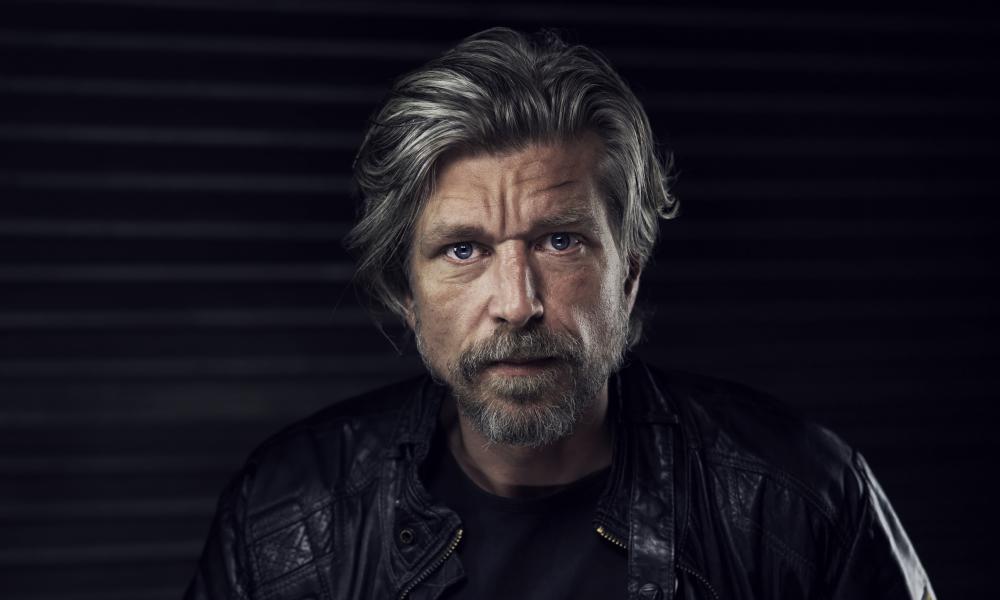
Karl Ove Knausgard – publicity still
Knausgaard showed me that I didn’t need to follow a temporal sequence but could produce component volumes of different lengths and time periods in episodically random order. His first was A Death in the Family (2009 in the English publication sequence) and he was writing it round about the same time as I was writing my own maternal mortality story. His revelations about his father, which caused a violent storm in his native Norway, were pretty gruesome. I had nothing of that kind to contribute. My mother had done some pretty awful things like most of us do, but she was nothing like the kind of horror he described his father to be. If anyone was a horror, it was me. Sixty-three at the time, I still thought I had to excel in my career. I still thought I was much more important than anybody else. This was not the frame of mind to be in when trying to help a 93 year old woman through the last year of her life.
Like most English-language readers I was gripped by Knausgard’s second volume, A Man in Love (2013) about his relation with his second wife and their family. The texture of everyday existence and his internal monologues as he did his best to live in ideologically correct Sweden and please his feminist wife, the only man taking his little child to pre-school singalongs where he spent the time lusting after the kindie teacher – what happens when you want to be a writer but aren’t allowed to – a typical woman’s story, now being written by a man who had acceded to feminist expectations. A lot of women writers seem to have approached Knausgaard only to go away again. There is something challenging about entering so deeply into this man’s mind which feels strangely disconcerting. We think we know how men think but it’s weird to have it confirmed in such detail. Good feminists aren’t supposed to enter this terrain at all, or so it seems, but I found it liberating. Knausgaard exemplifies a masochistic hysterical masculinism which seems to have become a default position for many hetero male writers today.
NOT AN INSPIRATION:
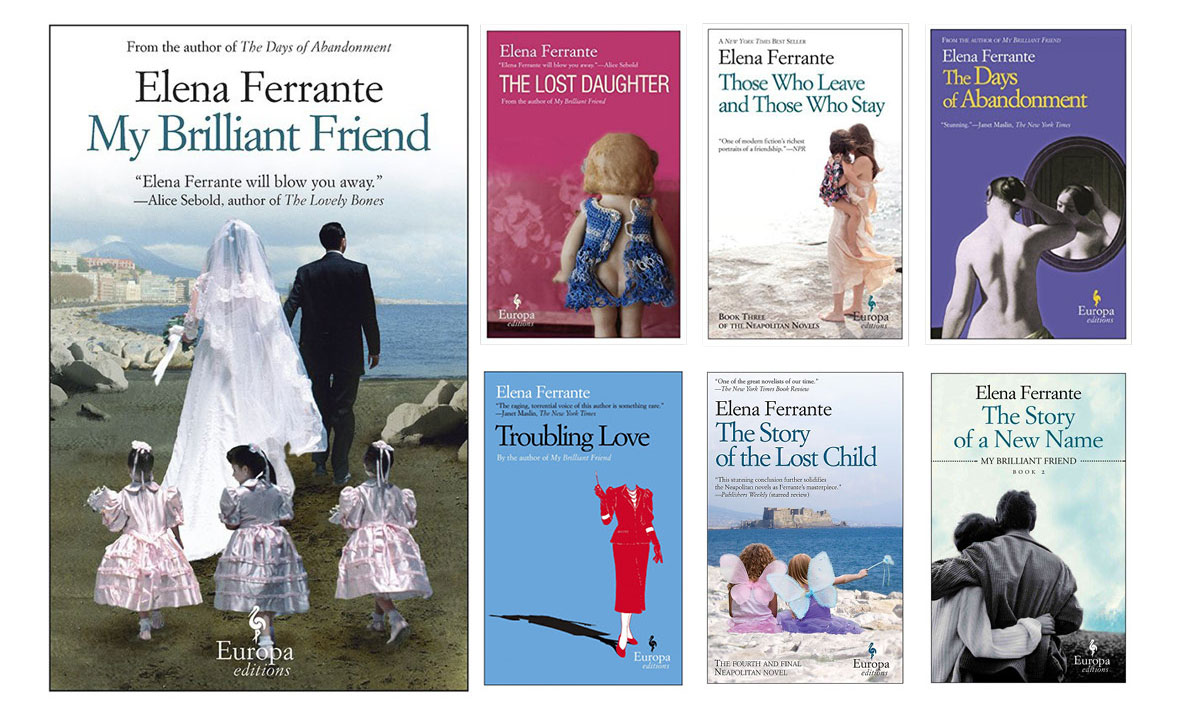
Elena Ferrante (well, that is not “who she really is”; all l the hoo-haa has been quite absurd, unless you subscribe to the Author as Sacred Object school of literary thought) is very popular with women readers. Everything she has written seems to me completely fake. I really and truly cannot read it. I have started one book, then another, tried going into the middle of the first one, then the end of the third and I don’t get it. Just look at those covers: Mummies and little girls in silly clothes, dollies and fairies, nakedness in the mirror, and a headless woman in a bright red dress. Really!
One of these days I will try again. If Knausgaard is the masculine consciousness of the twenty-first century, Ferrante might be the feminine counterpart and not in a good way. Women seem to read books in order to identify themselves with the narrator, and in line with a lot of feminist theoretical work from the 1970s and 1980s, she works from the classic masochistic feminine position. It is so depressing that a great many women still seem to find this compelling.
Jenny Sages Portrait of Helen Garner. National Portrait Gallery, Canberra.
The best thing about getting older is realising that others are getting older at the same rate, especially your favourite writers. They’ve been writing for years and years, and you’ve been reading away alongside. In traditional publishing it means that they write and you read at different moments of the Zeitgeist, so you experience them in different ways according to where you both are. Helen’s recent book of essays Everywhere I Look felt both familiar and dazzlingly fresh. Preoccupied with my current volume of memoirs, this and the publication of Bernadette Brennan’s study of Helen’s work (more on which in another post), sent me scurrying off to rediscover her work in the present moment, 2017.
A lot is now available on Kindle. I had purchased her print books over many years but most had gone off into the mysterious places books go when you move your stuff around a lot. Now I could repurchase and reread all at once. Yes, it is a Kindle binge. A wonderful short novella about a trip to the Antarctic was the first surprise: I had never heard of it before. I reread The First Stone and This House of Grief and The Spare Room and then I came to Joe Cinque’s Consolation, which I had never read before..
What can I say? Absolutely riveting, so moving, so saturated with a personal truth which is at the same time a collective experience of being “us”, people in Australia, experiencing things in different ways, and it is these differences which Helen tries to clarify and explore but in the end the mysteries of human behaviour defeat explanation or even understanding.It is great that Helen is getting the praise she deserves in the US at last. Reading some of the reviews on Kindle is sobering, though. They are not negative, rather, puzzled, a bit confused. Why is it that some writing travels seamlessly through English-language markets while other books falter? Why was The Dry such a hit in the US? Why does Liane Moriarty work everywhere?
I hope a lot of people discover and rediscover Helen Garner now. Nobody could have guessed back in Monkey Grip days what she would become. If you could give a medal to an Australian writer, Helen should be first on the dais.








 Annette Hamilton - Writer