Is there really a future for independent publishing in Australia?

Ever get the feeling that independent publishing, which promised so much, is heading down the vortex, especially for Australian authors? When it all started rolling it seemed like writers would be able to reach readers without all the intermediaries deciding who and what would be allowed through the hallowed gates of author-dom.
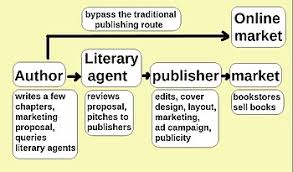
selfpub diagram wikiIt looked as if new technology would link writers and readers all over the world and open up the artificial geographic zones which for half a century had been creating unnecessary boundaries around the best new writing. Readers were forced to pay absurdly high prices in some areas, including Australia, to accommodate the outdated business model. You might have thought the response would have been to change the business model, but no, that didn’t happen, and now things seem to be in some kind of weird spiral.

In the US E-books are still selling, and selling well. In number they far outweigh trad pub titles, and just recently they have superseded print books in dollar value. Of course many of these sales are for traditionally published books from established publishers, who bring out an e-book edition along with their print editions. It is very hard to get accurate figures separating the different market components out.

US eBook_Sales_to_Surpass_Printed_Book_Sales_in_2017_n

When Indie publishing took hold, a network of new support mechanisms evolved to help authors bring their work to an eager public. Traditional publishers went on doing exactly as they had been doing (but added in e-book versions) and everyone else was free to try things out in all kinds of ways while Amazon  provided the all-important technological platform.

For a while Amazon set the prices of the e-books from the traditional publishers. But after a legal case spear-headed by global giant Hachette Amazon was forced to raise the prices of the e-book versions  so they did not  compete with print books: take a look at the price box next to the Big Five published book you want to buy on your Amazon site and you will see “The price was set by the publishers”. This has pushed e-book prices higher for “good” books from all the global players who have eaten up the smaller niche publishers at least in the English-language market.

BigFivePublishers

Meanwhile millions of other books are left wallowing about at the lowest possible end of the price scale in the hope that someone, anyone, will buy a copy. The unregulated indie market has turned out to be a ghastly place full of bad writing, creepy fantasies, idiotic space-nonsense, buff six-packs and bizarre arrays of erotica. There are many notable exceptions, of course, but anyone who takes a close look at what is going on in the Amazon indie market better not be a serious reader who thinks books have something to do with improving society and culture.

In Australia, the e-book revolution hardy took hold although Australians are known as early adopters of new technologies. Try asking around among friends and workmates and see how many actually have and use a Kindle. The answer, if you are an indie author, is super-depressing. It seems everyone longs for the olden days.
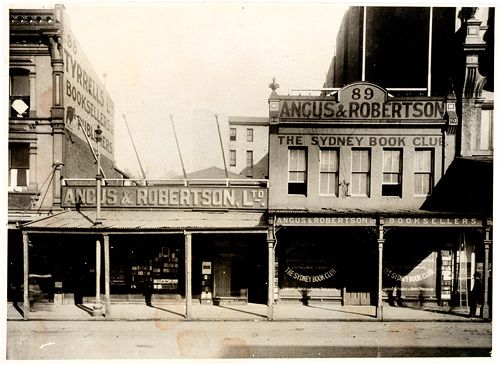
old Angus and Robertson

But there’s more to it than persistent nostalgia. It’s not just that people like going to physical bookshops, or buying physical books (often as presents for others), it’s that the guardians of Australian culture mounted an incredibly successful campaign against Amazon among booklovers. They were readily convinced that anything coming out of a corporate US giant like Amazon was automatically going to be a Bad Thing. This impression was shored up among the writers’ groups, in publishing circles, among academics and general literati, the local press, the network of book clubs and whatever other areas of public communication had anything at all to say about books and writing. Indie authors did not appear at Writer’s Festivals. Nobody mentioned them on the TV book shows (all now defunct); everybody interested in books and writing in Australia knew that good writing only appeared through a reputable publisher. The books by Australian authors hailed by the literati sold in modest to low numbers. Books written by Australian indie authors had to succeed in the US market, or not at all. There has never been an identifiable market for Australian independent authors in Australia.

Now things are even worse. Amazon won’t let Australians buy e-books – or any books for that matter – from it’s American site. This is supposedly because the Australian government didn’t like it that e-books were being bought by Australians who weren’t paying GST on them. Now the reader is forced back to the .au site, no option. Add the GST to the cost of the e-book and it looks a lot more expensive than when it was $2.99 on the US site. Previously, readers who wanted to order a print version could do so from the US site and pay horrendous postage. It seems that hardcover versions of Big Five published books are available through the Australian site, but still have to be sent at a high postage rate from the US. So guess what? You might as well buy a print copy of the book from your local bookshop, or by ordering online. Who needs Kindles and e-books after all? Somehow all this seems to have shored up the ultra-conservative elements in the Australian book world.

E-book author earnings are still very substantial, and when you consider that many authors identify themselves with a self-managed publishing imprint, the result is even more impressive. But of course this is happening in the US, not in Australia.

ebook-author-earnings-1m-201605

Australian authors often made print versions through CreateSpace and ordered fifty or a hundred or whatever copies to distribute themselves in Australia, sell through their own website or send out as freebies. Now CreateSpace has closed down and everyone is supposed to use KDP for their print books. But nobody, not even the author, can order print books from their US-based Amazon account, and Amazon is not going to be printing books in Australia anytime soon. You can’t even order a proof copy of your new e-book from KDP, apparently, because that would involve sending it at the US price. I believe this issue is currently being looked at by Amazon, but the bulk print copies will never be available again. So it’s back to the Australian traditional publishers.tradpub cartoon

Several correspondents have asked why authors don’t just have their own books printed locally, instead of worrying about the whole Amazon/e-book experience? Well, there are three good reasons. Firstly, local printers quote for a paperback version around two-three times the cost CreateSpace used to be able to supply them at, even with shipping from the US. They can look a lot better with much nicer paper but the price needs to be set very high if the bookseller gets the 40-50% discount they expect. The author may finish up getting even less than the miserable payout from a book priced at $2.99 on Amazon. Second, local bookshops are very reluctant to stock books from independent authors unless there is some local reason to do so – like a book about riding bicycles along back paths here in the Blue Mountains, which sells well from just two or three bookshops. The author supplies the copies personally when the bookshops run out. But if you are trying to sell more widely it means you have to keep stocks of your printed books somewhere – in your garage, or in your bedroom, or in a warehouse-type space, then you have to post or send or courier copies to whoever wants them, then pick them up again if they aren’t sold.

There is no simple answer, obviously.

BTW I  want to thank Anna Castleton for her recent comment (August 31st) which prompted me to write this post sooner rather than later. I also should mention that my e-books, such as they are to date, have been illustrated and cover-designed and the interiors formatted by a well-regarded professional (in Mexico, as it happens) and the colour shift problems  I had with my children’s book The Priceless Princess when print copies were made on Ingram Spark were the result of the Ingram Spark presses not “reading” the PDF files correctly.  Ingram Spark seems much more responsive these days and  is making a significant push into the space being vacated by Amazon. And it prints in Melbourne.  More on this in a later post.


A Kindle binge with Helen Garner …

Jenny Sages portrait

Jenny Sages Portrait of Helen Garner. National Portrait Gallery, Canberra.

The best thing about getting older is realising that others are getting older at the same rate, especially your favourite writers. They’ve been writing for years and years, and you’ve been reading away alongside. In traditional publishing it means that they write and you read at different moments of the Zeitgeist, so you experience them in different ways according to where you both are. Helen’s recent book of essays Everywhere I Look felt both familiar and dazzlingly fresh. Preoccupied with my current volume of memoirs, this and the publication of Bernadette Brennan’s study of Helen’s work (more on which in another post), sent me scurrying off to rediscover her work in the present moment, 2017.

A lot is now available on Kindle. I had purchased her print books over many years but most had gone off into the mysterious places books go when you move your stuff around a lot. Now I could repurchase and reread all at once. Yes, it is a Kindle binge. A wonderful short novella about a trip to the Antarctic was the first surprise: I had never heard of it before. I reread The First Stone and This House of Grief and The Spare Room and then I came to Joe Cinque’s Consolation, which I had never read before..

What can I say? Absolutely riveting, so moving, so saturated with a personal truth which is at the same time a collective experience of being “us”, people in Australia, experiencing things in different ways, and it is these differences which Helen tries to clarify and explore but in the end the mysteries of human behaviour defeat explanation or even understanding.It is great that Helen is getting the praise she deserves in the US at last. Reading some of the reviews on Kindle is sobering, though. They are not negative, rather, puzzled, a bit confused. Why is it that some writing travels seamlessly through English-language markets while other books falter? Why was The Dry such a hit in the US? Why does Liane Moriarty work everywhere?

I hope a lot of people discover and rediscover Helen Garner now. Nobody could have guessed back in Monkey Grip days what she would become. If you could give a medal to an Australian writer, Helen should be first on the dais.

everywhere_i_look

The Perils of Publishing

It’s been a while and I’ve gone through a lot in the writing and publishing world lately. I’ve been thinking about new strategies, doing a lot of re-editing, and working on the Memoirs. This has led to a long silence on the blog, for which I apologise.

But I was moved  to write today by yet another story about a writer who wanted to be published and parted with a lot of money thinking it was to a “real” publisher, only to discover that although her book – an illustrated children’s book – was lovely, no bookstores would stock it.

Ever since I launched myself into this world I have become aware of the many people who want to be writers and are determined to do it. Social media has made it so much easier to get in touch with these people and get to know them online. So many are looking for support and advice, but almost everything they can learn about the process leads them to part with their money. Advice to self-publishers is everywhere but so much of it is motivated by someone offering a service. It is obvious that a huge market exists and a lot of writers have discovered that there’s more money to be made by “helping” others publish their books than by publishing their own.

IF YOU ALREADY KNOW ALL ABOUT THIS STUFF, DON’T BOTHER READING ON. But if you are pretty confused about what is involved in getting your book out into the world, you might find a bit of clarity here. It is based in part on my own experience, as well as looking into the minefield of services on offer to would-be authors which are getting more difficult to understand by the day.

engraving publishing

You can get your book published entirely by yourself, if you have the skills. You start with a manuscript you have written. It will have to be written on a computer in a recognised program such as Word which is the standard. If you are still writing by hand on a yellow note-pad, you’ll have to pay to have it typed up.

What you need at the end of the day is a set of files in multiple formats. In theory you can do all of this yourself and it will cost you nothing, or almost nothing (some distributors such as Ingram Spark require a payment for each book being uploaded to your account). The files have to be laid out in particular ways and conform to certain requirements. If you only want ebooks they can be loaded one by one to different distributors or you can use an aggregator service. Your ebook can become a print book using Amazon’s Create Space or another print on demand service. Once the files are ready and in an acceptable form, you have a book all ready to go, it has cost you nothing to produce, you load your files onto the sales site and sit back and wait for someone to buy it online through Amazon, Kobo, I-Books or some other site.

You may have ordered some print copies for your friends and family and be happy to hold your real printed book in your hands. Does it look as good as the book you paid $30 for at the bookshop? Probably not. The paper will be thinner, the interior layout may be boring or clunky, and looking at the cover it doesn’t look quite how you expected. But still, it does look like a book and you know it’s great. But it won’t get into the bookshop, it won’t be reviewed in the paper, and nobody will get to hear about it unless you yourself undertake a crash course in Internet marketing because that is the only way it will actually exist for your readers.

Some people think that bookshops won’t take books printed by POD technologies. Print on Demand (POD) means a copy is made only when it is ordered. This is a huge advantage since there is no need to print multiple copies in advance, to store and ship them. Traditional publishers may use POD technologies for books which do go into bookshops, and it is not use of that technology which makes it unacceptable to bookshops.

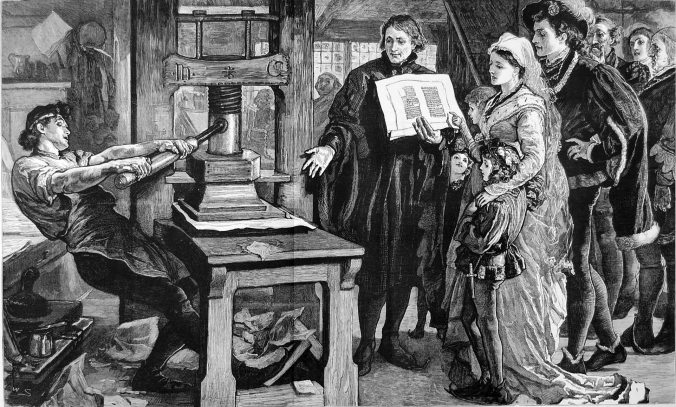
Caxton self publishing

It is the fact that the book has not entered the circulatory system of traditional publishing which was designed a hundred years ago and has hardly changed since.  This requires a manuscript to pass through multiple selection channels. Most publishers won’t take a book unless it has been referred to them by an agent. Even where they will accept a submission, it will be read by someone very low down the totem pole. Some say that 90% of manuscripts are rejected by the end of the first page, and 98% by the end of the first chapter. There is a network of connections which create mutually agreed standards or expectations for what kind of book is worth publishing, when and by whom.

Self-publishing has been seen as a way to get around the archaic and outdated structures which still prevail. But it’s damned hard to do on your own. Not surprisingly many authors seek help to get their manuscript into an acceptable form. There are all kind of services to help you. They may offer to edit, to create your book cover, get all the files into the correct formats and then they may actually upload the files for you. You can engage and pay a different professional to help with any of these tasks, or you can find a single company who outsources the work or does it in-house. Most of them offer several options, or packages, which get more expensive as they include more items. It’s easy to see why many choose to go with the company which offers a comprehensive service even if it costs them up to several thousands of dollars.

But when you do it this way, you are still a self-publisher.

Hang on! That’s not what you had in mind. You want a publisher! Here is where the real danger lies. There are an increasing number of organisations which call themselves publishers and will accept your manuscript for publication. They have a name, Suchansuch Publishers or Ifonly Books. They will produce print and often ebook versions as well. They advertise on the web, you will find them whenever you Google “Publishers”. Wow, you think, I have a publisher. The catch is, they will ask you for money. A lot of money. They may produce a near-perfect book, far better than the book you can produce on Create Space or through Ingram Spark. They may even offer to market your book for extra money. But still your book will not appear in the bookshops.

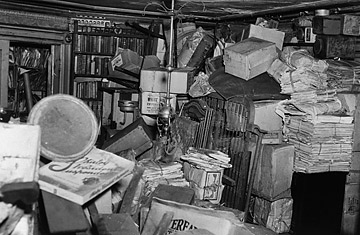
Because you paid for it. The entire structure of book publishing prevents these kinds of books from entering into commercial circulation. The publisher has to pay you – usually what’s known as an advance, which used to commonly be between $5000 and $10000 (if you are lucky). You don’t get any royalties back until that full cost has been recovered by the publisher. If a publisher offers to publish you for money they are by definition not a “real” publisher and you won’t ever get your money back. Most people who publish this way finish up with a garage full of printed books which they cannot sell.

360_hoarders_0423

The rise of self-publishing has meant that anybody who wants to publish a book can do so. But that does not mean that anybody can be a recognised author whose books will be found in a bookshop. The many inexperienced writers who don’t realise this are easy prey for those who can convince them otherwise. Almost all the books by self-published authors are sold on Amazon, mostly for $2.99 or less. Some cover their costs and make some profit but many don’t. Becoming a best-selling author on Amazon has become ever more difficult. There are two or more million titles now and each year thousands more are added.

A recent phenomenon is the way traditional publishers issue expensive ebook versions of their conventionally published books through Amazon Kindle and others. At one time, the Kindle versions only turned up a year or more after the print books came out. Now the are issued more or less at the same time, but the publishers set a very high price, way above anything normally found on Kindle. This happened after a bitter court case brought by international giant Hachette against Amazon. The authors of the books don’t make any more out of it than they do from the print book – say, 10% in royalty payments – and the publishers keep the rest. So a two-tier structure is emerging in the e-book market where self-published ebooks are super cheap, or even free, while Kindle versions of recognised publishers’ print books are available at grossly inflated prices, often around the same price as a paperback. Meanwhile buyers who go to bookshops or order through companies like Booktopia are purchasing conventionally published print books since the ebook version won’t be much of a saving. This reinforces the power of traditional publishers and makes self-published writers very much second (or third? or fourth?) class citizens.

Without extensive marketing using all the bells and whistles of the Internet (Facebook groups, Good Reads, BookBub, paid review sites, email groups, increasingly Twitter and Instagram) very few self-published authors make it. There are spectacular exceptions which I will write about in another post. But the thousands of would-be authors who don’t know better, especially older people who don’t have much idea of how the new digital landscape works, are easy marks for those who offer the hope of authorship, especially the dream of “real” publishing.

So no matter how much you want to be an author, don’t part with any money until you fully understand what is being offered. Just because someone says they are a publisher and can send you good quality printed copies of your masterwork does not mean you are on an even footing with those who have benefited from the system of preferment and patronage so common in the publishing world today. You still won’t get into the bookshops, or be distributed to libraries, or reviewed in the newspaper, or invited to speak at a Writer’s Festival. If you want to get your work into circulation somehow, anyhow, you’ll do best to DIY or find someone you can absolutely trust to do the technical stuff for you.


Nightmare on the Red Spectrum

Red Priceless Princess small

THE PRICELESS PRINCESS IS RED-FACED

The Priceless Princess has been available for sale through Amazon for several months now. It was my first venture into self-publishing and I knew it would be a learning experience. And how! As I lamented earlier, I enrolled it in KDP Select, which means the e-book can’t be distributed outside the Amazon Kindle environment. Because it was in Select it meant that people with a subscription could download it as part of their service. All good, except that now authors are paid by the page read and the book is only 106 pages long – it is after all a children’s book. Quite a few readers have chosen it but being paid by the page it’s made almost nothing in dollar terms. Books stay in KDP Select for 90 days and I missed the deadline to get it off there so now I’m stuck with it until June and can’t use any other e-book distributor.

What about a print book? Would anybody buy that? I had a Create Space version printed and it came out beautifully. No sales, because it was free in KDP Select I guess, or maybe it was too expensive. Nobody in Australia would pay the postage. I ordered 50 copies for my own distribution purposes but that cost a small fortune in freight from the US which is the only way to get the books to Australia.

Amazon’s Create Space has no presence in Australia: you can’t get books printed here. If Australian readers want a print copy they have to pay the exorbitant cost of postage from the US. Amazon’s Australian Site: Authors Beware

Why didn’t I know this? It is obvious that most people in Australia, especially when buying children’s books, only want printed copies. Nobody here buys their kids a Kindle for Christmas (they do in the US apparently). I wanted to be able to distribute the print version through my website, put copies into schools as donations and do various other things so people in Australia could buy it.

So I followed everyone’s advice and went with Ingram Spark since they print in Australia and I could get print copies from them in bulk for a lower freight cost. And they distributed everywhere. But they wouldn’t use the same Create Space PDF files, the files had to be saved in a different PDF form, the very early x-1A or whatever it is. Finally got Keith to redo/resave the files, they were accepted by IS, then I had to pay $15 to get one copy to examine (by courier – what is wrong with using Australia Post?) and then I discover that the front cover in printing has shifted to the red spectrum and the Priceless Princess’s gorgeous face is now extremely flushed.

So I ask IS why this is since the art work is identical with what went to CS and I receive a prompt reply saying all printing machinery is different and they cannot guarantee any particular colour outcome or that it will match that printed elsewhere and I have to get the files redone to compensate for their machines.

But how? Nobody can see what the problem is on the artwork files, which look identical on both PDFs.

So now I have a very red-faced Priceless Princess circulating around the world, a very frustrated illustrator who doesn’t know how to help, and a particularly irritated author who is now trying to find a local printer who can use the original Create Space files and hopefully provide a better quality paper at the same time for a reasonable price so I can do my own local distribution.

Online technology obviously doesn’t combine well with legacy printing. The online world doesn’t mesh with traditional reader behaviour. A lot more work needs to be done to find some better alternatives. Meanwhile everyone under 30 is reading free books on their mobile phones. Is this a losers’ game or what?

Authors, Editors and the Ethics of Publishing

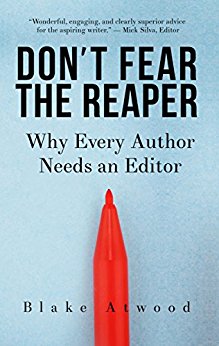
Came across a book yesterday which brought into focus something that has been bugging me for ages. Blake Atwood’s Don’t Fear the Reaper: Why every author needs an editor is squarely aimed at the new writer, especially the new Indie writer – although any writer who has an editor will be enlightened by it.

ReaperIt is a seriously good book, with lots of recommendations about how authors and editors can get on better together. But it made me feel very weird.
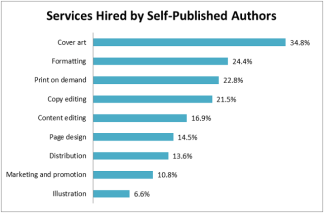
There are hundreds of books on Kindle right now and maybe thousands of blog posts directed at the emerging author who plans to self-publish. All this advice should help the publishing process and make the written work as good as it can be and therefore produce sales and success. Two recommendations stand out: get a professional cover designer! get a professional editor!

Cover designer, for sure. Unless you are great with Photoshop or comfortable with digital design software such as Canva, it’s not easy to get a great-looking cover. Of course there are now many automated genre cover services, where you buy a standard design and put your title and name on the front. Fair enough, as long as everyone else hasn’t chosen the same design. As time goes by and the competition on Kindle gets more intense, authors are feeling pressured to hire more and more services.  Is it really making a difference to the quality of self-published books?

services hired

Source: Digital Book World- Team Publishing 1

Editing? It’s obvious that many new indie writers haven’t followed that piece of advice. I download and read book after book by new or unknown (to me) indie authors. It’s pretty clear that the book hasn’t been edited properly or at all. My first reaction is always irritation, even exasperation. A good premise self-destructs in an incoherent plot. Not just one or a few but scores of grammatical errors make the book unreadable. A few typos? OK. But one or two on every page? No thanks. This book joins the others in my library with the dreaded “30%” score (or less). Just couldn’t be bothered finishing it. Why does this happen?

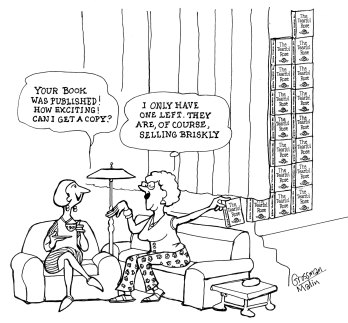
only one left

There are three kinds of editing: developmental, which picks up on structural flaws and can result in a total rewrite; copyediting, attending closely to grammar, expression and sentence structure to make the work “correct”; and proofreading to pick up those last typos or whatever. Great! But soon the penniless hopeful discovers that an editor expects to be paid separately for each of these and some only specialize in one. Atwood is mainly a copyeditor. Editing costs seem incredible. Over a thousand dollars for just one of these edits is common.

But hang on a minute. Why aren’t the authors writing their books properly in the first place? Why can’t they edit themselves? Is it that many writers can’t in fact write? And if editors do as much on a manuscript as they claim to do, who is really the author?

I was amazed when I realized the extent to which fiction was edited. Having published around one hundred academic papers, I was used to a certain level of editorial intervention, usually to provide clarity or reduce jargon or introduce some additional analytic viewpoint in a footnote. But the idea that someone would virtually re-write your whole paper, changing your intention, re-organizing the flow of argument, removing whole sections, deleting punctuation marks and in effect taking over the construction of your work was unthinkable. You were the writer. Anyone who hired someone else to do all that made the work fraudulent. It just wasn’t your work any more.  If your journal editor, having accepted your paper, chose to use an editor to make significant changes, that was an acceptable cost of being published in prestigious journals. But paying for it yourself?

The world of commercial publishing seems to take a high level of editorial intervention for granted. One of the first things in traditional publishing was to assign an editor to an author. Sometimes authors mention their editor by name, more often than not the existence of that person is completely hidden. Why? If an editor has had so much input into your work, then why isn’t that person acknowledged as a kind of author – if not a co-author, perhaps a writing associate? While it is obvious that proof-reading and minor corrections will always be required, how can the interventions of a copyeditor, let alone a developmental editor, entirely unacknowledged, be justified?

There are a set of conventions about writing which increasingly determine what will be accepted as “good” in its field. Genre fiction is one thing, literary fiction another. The hidden truth is that literary fiction is largely for people with a better education. Hundreds of Amazon reviews moan and whinge about “big words” or books being “too hard to read”. I just last night read a review which gave one star to a book because of the long words in it. The writer complained that it claimed to be a thriller but really it was a book for the “literary elite”.

literary cocktail party

A literary cocktail party at George Plimpton’s Upper East Side apartment, 1939.

Traditional publishing kept control over writing and reading by maintaining a reasonable level of quality control over what was published. And editing was key to this process. Even popular thrillers and romances were edited to maintain something like an acceptable standard of literacy. Indie publishing has thrown that out the window. Anyone can write and publish anything. This seems powerfully democratic. But is there a necessary standard for writing? Shouldn’t books be literate, even if they are not literary?

What if authors don’t agree with their editors? Blogs and forums are full of horror stories about new writers paying editors thousands of dollars only to find their recommendations unacceptable. If you have a contract with a publisher then the editors is likely to be the winner in a catfight. If the author is paying the editor directly, what then?

If you look closely at the advice to new writers, the people who write about how badly you need an editor are almost always editors themselves. It seems that they are right. Like Atwood, many have also published books on how to publish books. That is a good marketing strategy, especially with the bottomless pit of would-be authors filling up by the day. But new writers don’t want to spend money. They just want to write their books and publish them. Hmm. A problem: nobody wants to buy them. Read the forums where countless authors complain that nobody has bought their books. So they are encouraged to give their books away free, or almost so. What kind of product is this?

You can get ultra-cheap editing, of course. Thanks to the internet someone on the other side of the world can be your editor. So what if their English isn’t too great! They can do your “updation”, your Head-Noting and even write your blog!

sodhanis

It’s a minefied. I don’t want to read books which have been radically altered by an editor. I want to read what that particular author says, and to see exactly how she or he says it. It’s part of the fun of reading. If the writing is bad, so bad that I can’t enjoy the book, then I won’t buy anything from that author again. On the other hand, so many new authors write such bad books. They have awful holes in the plot or drag on too long or have blatant unexplained contradictions, and I know how much better the book could have been if someone had “edited” – in effect re-written – it.

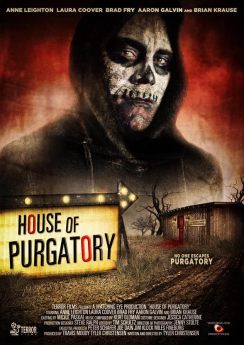
I feel sorry for these authors. I don’t want to discourage them, so I don’t leave negative reviews. Neither does anyone else. Without an editor, or some form of independent feedback, how are authors to know their books are just not good enough? Then again, I feel sorry for their editors, if they are eventually hired. Working on badly written manuscripts, toiling over silly or boring or pompous or pointless stories and trying to make them better must be one of the most soul-destroying forms of employment imaginable – a marriage made in purgatory. [Hey, there’s a concept: a writer and an editor locked up in some horrific warehouse, in a remote derelict landscape (think Tarkovsky), going to suffer a  gruesome fate if they can’t agree on final edits. If you want to develop it, let’s collaborate!]

House-of-Purgatory_03

Proofreading is another thing. Everyone needs a proof-reader. Errors creep in, typos happen and the malign influence of the spell-checker has to be remedied. I don’t know how necessary it is to hire a professional proof-reader. Maybe any two or three people who are good readers would do.

What do you think? Should editors be acknowledged, perhaps by name, when they have been hired to work on a book? Or should writers just learn to write better in the first place?


My new Kindle! Reading, writing and the transitional object (a brief diversion into psychoanalysis).

Well it took six long days but I finally unpacked my new Kindle Fire HD 2016 8 inch and after the usual struggles with passwords and buttons and chargers it lit up,  and what a pretty ***** it is.  Actually I am not sure what it is –  a thing? a device?  a machine?  Just another object? Yes, it is an object, but an object which reaches into the very depths of a writer’s being – this one’s, anyway.

Ridiculous, I know, but the whole time I didn’t have a  Kindle I couldn’t seem to write a word.  I carried around the print-out of latest version of Suburban Gigolo wherever I went, thinking I could start the next round of edits, but there was just something wrong. Didn’t even take it out of its brown paper bag. Night after night I re-tilted my bedside lamp and focussed my eyes on the printed pages of Emmanuel Carrere’s Liminov. I am really enjoying this book, in a strange abstract way, but the process of reading doesn’t feel the same. And if I can’t read, it seems I can’t write.

While I was recently in hospital I couldn’t read either, not because I didn’t have my Kindle – I did, it goes everywhere with me – but because I was so knocked out by the drugs and the pain and the numbing routine and the astonishing reality of having a metal knee now embedded and growing  in my bones and flesh there seemed no mind-space left over for reading books.

knee in hospital

New right knee is under there somewhere.

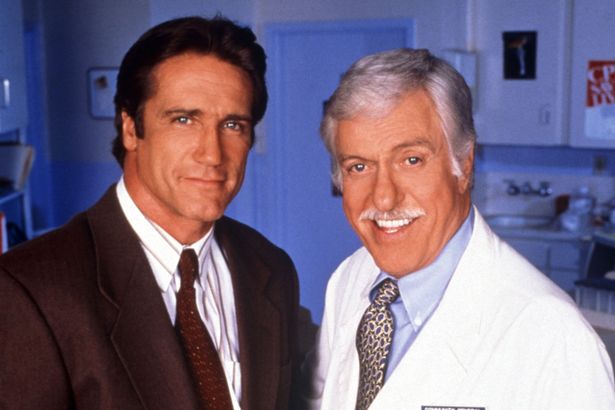
However  I became addicted to that enlightening TV show “Diagnosis Murder” about how a doctor (a spritely white-haired Dick van Dyke) helps his detective son (played by Dick van Dyke’s own real-life son Barry) solve strange criminal cases which embrace medical issues.

diagnosis-murder

Dick and Barry in Diagnosis Murder, 1994-5

This was on every afternoon and I lay on my back gazing at the TV screen up on the wall and felt both cheered and reassured by the ability of doctors and detectives to solve all human problems, as they were still able to do in the early 1990s, unlike today where the crimes are so much more hideous and the main role for the medical specialists is scraping up samples from torn fingernails and cutting cadavers open with wryly humorous remarks.

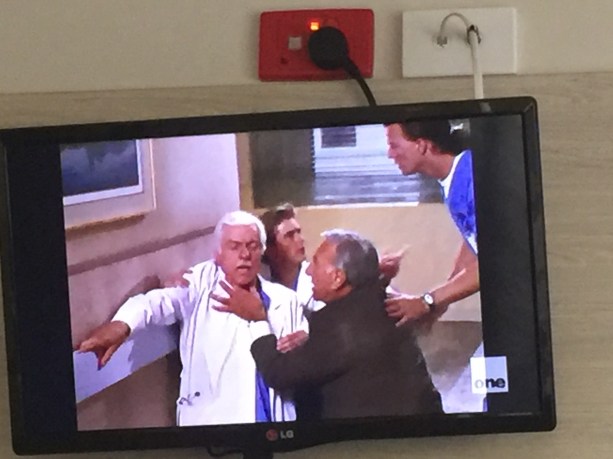
dick van dyke sick

Dick van Dyke falls victim to poison in his own hospital!

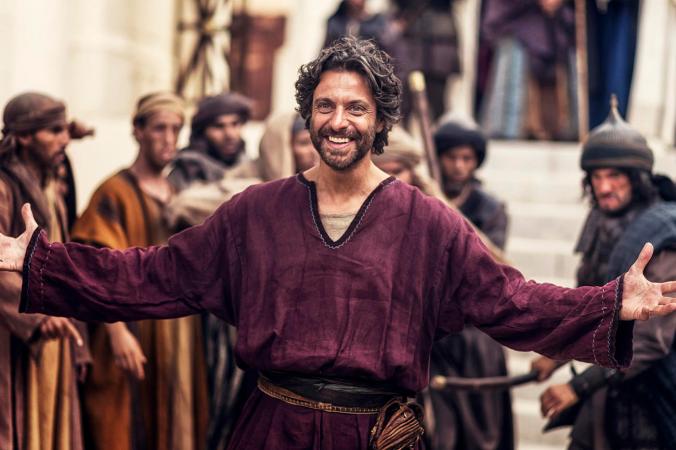
But TV in the end is no substitute for reading, and now I have a Kindle again I can read all the books I recently downloaded just before it finally died. These include the only book by Carrere which I can find on Kindle, The Kingdom, yet another excursus into the world of the first Christians, a theme which seems to have been trending recently, no doubt due to the near universal perception of imminent apocalypse. I even started watching A.D. the Bible Continues (2015)  on Stan but that otherworldly gleam in Peter’s eyes is really getting me down. Actually I thought the first three episodes were excellent, but it became a bit repetitive after that.

Peter in AD Bible

Adam Levy as Peter

The thing is,  you live with stories, and it matters how they reach you. TV has become a wonderful medium now that you can watch series the same way you read a book … you don’t have to wait until next week’s broadcast, you can just keep on and on and on until you absolutely have to get up and go to Aldi or clean up the cat vomit. Then the clever TV knows exactly where you got up to, and takes you directly back there. Just like the Kindle does.

I can feel myself falling in love with my new Kindle, even though I’ve hardly even turned it on yet. What creates this powerful attraction? A lot of people have it with their mobile phones, almost unable to be diverted from them even by great moments in the Real World such as picking up your children from school. The recent campaign in Britain to get parents to actually look at their child when they pick the poor little thing up at the school gate marks just one moment in the process of human alienation we are in the midst of.

Greet child

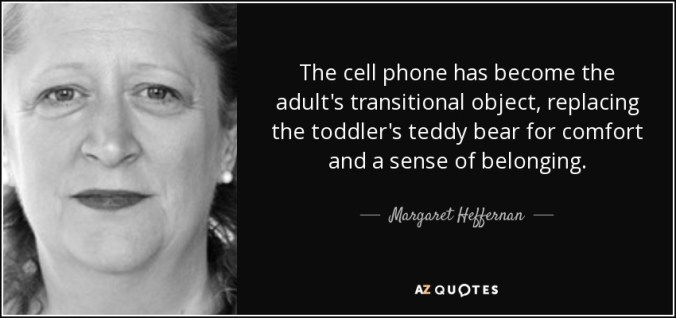
How to think about these object-obsessions? To cut a long psychoanalytic story short, it is a kind of transitional object. You know, the blanket the child carries around until it decays, the beaten up teddy bear, the Thing your little one just can’t be without. Some clever evil genius worked out that we never grow up, we humans, we go on looking for the comforts of childhood, and these days they’ve given us an electronic item instead of Blanky. I’m not the first to think of this, although I did feel disappointed when I found this quote:

quote-the-cell-phone-has-become-the-adult-s-transitional-object-replacing-the-toddler-s-teddy-margaret-heffernan-33-29-01

The thing about electronic objects though is that they just don’t feel the same . How about making Kindle or phone cases out of woven feathers? I had a kind of feathered scarf when I was a small child and yes, obviously it came from my mother, and I needed it in the same way I seem to need my Kindle now. I just can’t go to bed without it, and if that happens then I can’t seem to write anything the next day. What The ????

Kindle Interruptus

Regarding Kindle, I was a very early adopter. In spite of the endless anti-e-book raves from all sides in Australia when the first Kindles came on the market I couldn’t wait to get one. Even those old clunky grey things with weird counter-intuitive buttons here and there were just great. oldkindle 1I could take big chunks of my library anywhere. I was never without a book. I could buy something at 3.00 am in a steamy Bangkok hotel-room where the reading light was 30 watts or didn’t exist at all. I could read on a plane or in a restaurant. So what if every new and important “real” book didn’t exist on Kindle. It meant I would read things I otherwise would never even know about.

kindle-fire-lineup

And so it has been. Kindle #4  died and Kindle #5 has just arrived. All I have to do is set it up. I was really p****d off at the death of #4. It was still relatively new and in perfect condition but that stupid battery thing happened and after all kinds of different recommendations it was clear that the battery just wasn’t taking any new charges thank you very much. It had had it. Everything else is perfect, there isn’t a mark on it, and I just don’t know what to do with it – such a waste to just throw it away. Maybe there is a Kindle Re-Purposing program somewhere.

I dithered about what to replace it with. There are so many choices now and the latest and best seems to be incredibly expensive and it is a read-only device, it doesn’t operate as a tablet, which the Fire HD did perfectly well. What to do? The 2016 Fire model seems to be pretty much exactly the same as the old one which no doubt means it too will have the dead battery problem in no time. But if you get the read-only device you have to go to bed with an I-pad or use your I-phone to connect to the internet every time you want to find out what year some book by the same author was written, or whether or not some historical detail in your tartan romance is in fact true or even vaguely so. This is the kind of thing I do at 3.00 am most days.

bed book and kindle

And in my indecision I didn’t order anything and next thing I was ordering real actual books. In my Kindle Interruptus phase I bought a collector’s edition hardback of Marilla North’s Yarn Spinners (gorgeous, but big and fat and so heavy) and two paperbacks from new darling French literary figure, creative nonfiction writer Emmanuel Carrere. Had to order these from Book Depository, they got here in no time. Of course none of these books are available on Kindle. I probably would have ordered Carrere’s books anyway since he is said to be a pareil with Michel Houellebecq, supposedly a fiction writer, although the line between them is pretty fine. Started reading Limonov by the pale and feeble bed lamp and then I couldn’t put it down and finished up with a big headache and not enough sleep. This reminded me why I can’t stand “real” books. They are so hard to manage in bed and that is where I do all my reading.  But I’m glad I found Carrere. I’ll write something about his stuff shortly.

Meanwhile I ordered a 2016 Kindle Fire HD. Am about to set it up. It’s like the start of a whole new intimate relationship, and I feel quite scared about it. Not just because I hate setting up electronic gizmos anyway but mainly because I fear this might be my last Fire and soon ahead of me lies an even more bizarre tangle of chargers and wires as I go to bed each night with a read-only Kindle, a mobile phone and some kind of I-Pad device. Just as well I have a large bed!

wires-tangled


Create Space and Australian Authors: Amazon replies -“Expanded Distribution”

After finally getting that Australian author’s titles printed on Create Space would not be available in the Amazon Australian store, I decided to ask why not. Here’s the answer:

“We do not currently distribute to Amazon.au. We welcome future opportunities for new international marketplaces helping you reach more customers worldwide.

“We offer an option to enroll eligible titles in the Expanded Distribution Channel at no cost.  Enrolling can allow your book to appear on Amazon Australia or on any of the other sites not directly supported through us at the moment. The availability of your books on these sites is at the discretion of retailers who purchase your books through the Expanded Distribution Channel. We cannot guarantee your book(s) will appear on Amazon Australia.

Once you have successfully enrolled your title in Expanded Distribution, it may take up to six to eight weeks for your title to begin populating in the distribution channels you have selected.”

Right, so even if I do enrol in Expanded Distribution that doesn’t guarantee that my book will be on the Australian Amazon site, and it may take two months to turn up on any of the distribution channels which may decide to list the book.  WHAT???

I have read lots of threads on forums and blogs trying to explain what all this means and I already knew that there was a very important reason why you SHOULDN’T enrol your Create Space printed book with Amazon’s Expanded Distribution. No booksellers or libraries will buy it. I found some old notes I’d made to myself months ago explaining why you should print through Ingram Spark if you want to reach these wider channels. I already knew this was a recommended strategy but it still didn’t mean your book would be available at any booksellers in Australia. Ingram Spark doesn’t guarantee your print books will be on bookshelves. It does mean a reader who has already heard of your book can order it from a bookshop. But just in case a bookseller DOES want to stock it you have to set the price for all copies with around a 50% discount.

I someone has already heard of your book, why can’t they buy it from your author website? They can,  but you have to have a Paypal button and then post it to them. That’s a nuisance especially if the books start selling well. You should be so lucky!

The real problem is that most dedicated and enthuiastic Australian readers only find out about books from places like Arts TV shows (yes, Jennifer Byrne et al) or from national newspapers and magazines who only ever talk about trad pub books so they are not going to hear about your book or find your website in the first place. Unless you are writing about golf, or fishing, and advertise your book in specialist magazines. I hear that can work really well.

But if you are writing literary fiction or at least decent genre fiction you are out on a flimsy limb.hawk_out_on_a_limb_at_lake_woodruff_-_flickr_-_andrea_westmoreland Australian traditional publishers don’t want authors who haven’t gone through the secret accreditation process which dominates the business. Australian agents won’t represent them. They can write books and publish them on Amazon but Amazon won’t sell the print copies in Australia. Australian booksellers stick with the traditional imprints, mostly from the Big Five international houses. Many dedicated Australian readers can’t or don’t do e-books and/or hate Amazon because they’ve been told that Amazon is the enemy.
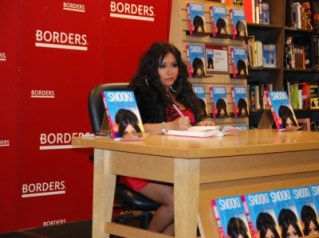
In the US, the large chain bookstores are in trouble: Borders closed, and Barnes and Noble is struggling. Lonely authors wait for someone – anyone – to come and buy their books.

borders

“Snooki” Polizzi: a reality TV star turned author – actually she is doing quite well even if Borders is no longer with us

Small independent publishing seems the way to go, but how to get the books into the bookshops where Australian readers still want to shop for books? Dedicated readers seem to love their bookshops here. But booksellers needs books which are in some way curated for quality:  you can be sure they don’t want badly written junk with naked alpha billionaires on the cover. Whichever way you look, it’s a minefield.