WHY PUBLISH? THE DASH AND DOLLY EFFECT.

I have reached a point in my writing and publishing activities where I must seriously ask: why publish at all? I haven’t published much yet but I have a lot of plans and proposals in the mix and several are at the point of fulfilment. Various things have held me up – some in the “real world” but others in that weird interior zone where the writer actually feels most alive but also most threatened and alarmed and fearful and excited, something which I suspect only other similarly benighted souls will understand. There really should be psychiatric services for writers, to help them work out what they are doing and why.

But as time passes, and especially with the impact of AI, the question becomes more acute than ever. There are 32.8 million published titles on Amazon now and more every day. It is possible that AI written books are flooding the market, although there seems to be no way to work out if this is true or not. Amazon now will only allow you to publish something like THREE BOOKS A DAY. Can this be true? Nobody can write three books a day. However the various online writers forums I participate in do seem to have members who think nothing of writing a book in two or three or four weeks: that is from start to finish, including editing, proofreading and maybe designing the covers as well. The fans of these writers are passionate and apparently faithful. They expect the writer’s new books ASAP and pre-order slavishly, or so it seems.

THE DASH AND DOLLY EFFECT

I just finished watching a mystery drama mini-series on Netflix, The Perfect Couple, starring Nicole Kidman as a popular writer, Greer Garrison Winbury, whose books are about the endless romance of Dash and Dolly. The readers imagine these are the writer herself and her husband Tag, played by Liev Schreiber, who in real life is alcoholic, louche, unfaithful and most unattractive. Based on a 2018 novel of the same name by Elin Hildebrand, the story is about the interpenetration of fictional and real life, and its negotiation in contemporary culture. [It’s what my favourite analytic writer of the moment, Hans-Joachim Maaz calls “Die Falsche Leben” – FALSE LIFE. If you speak German there are interviews with him on Youtube: https://www.youtube.com/watch?v=KN6i6MYBbjI but only one of his books has been published in English.]

A brilliantly disturbing scene takes place at the launch of Greer’s 32nd novel in the series, when the “real world” life of Dash and Dolly comes to a crashing end in a bookstore full of passionate fans. As the truth of their relationship emerges – and a horrible truth it is – the fans fall into despair and horror, worse than anything they ever imagined. The scenario of this story emerges from the very peculiar intersection right now between writers and readers, amidst the technical possibilities of rapid production where fictions drawn out into endless series of almost identical stories, become the source of recognition and success for glamorous lady writers in particular, and sites of identity for readers obviously deprived of whatever it is they crave in the way of success, love, happiness and recognition. Readers’ identification with fictional characters is at the heart of this process.

WHY DON’T I WANT TO WRITE BOOKS ABOUT DASH AND DOLLY?

It’s called “writing to market” in online writing circles, and ever since I was first introduced to this term around a decade ago at a seminar at the Australian Society of Authors I have been wrestling with the concept from many angles. It’s the baked beans problem again. The fact is, I want to use the agency and freedom of independent publishing but I don’t want to “write to market”.

I know this raises almost terminal issues. What I write isn’t any of the popular genres which work so well on Amazon. I can’t even work out what genre I am writing in. Some is memoir, yes, and maybe some is literary fiction. most of my books will appeal mainly to “classic” readers, that is, women of a certain age who buy books in book-shops and go to literary events and festivals, but they don’t buy independently published print-on-demand books and they all hate Amazon. My “take” on things doesn’t quite fit the mould either. My perspectives are too diverse, the experiences I draw on are far from the “normal” life, let alone the “false” one which prevails today. I will put a Paypal button on these books for Australian/New Zealand readers who want paperback versions and see if that works for those who don’t or won’t buy through Amazon. The independent bookshops’ prices are absurd: my book Revolutionary Baby finished up costing those who ordered it from their favourite independent bookshop over $30.00, even though I know the cost of production in Australia is in the order of $7.00.

Should I bother going on and publishing the other three novels I have written? They are all set in the 1980s which now feels like a hundred centuries ago. The memoirs are set even earlier: 1960s, 1970s. But I guess that makes them historical. There is a special category for that on Amazon.

As for doing something completely different: I have written the first volume of a series which I plan to publish under a pen name. It is a post-apocalyptic narrative set in 2050 and “stars” two female characters, young women with distinctive talents and histories. It needs a final edit. I don’t plan to spend money on Amazon or Facebook ads.

All I can be sure of is that the books I have written will exist in print and/or electronic copies in a few libraries, and a few will receive them as gifts from me and maybe want to pass them on. Is that enough?
Amazon and Reviewing.

[The first part of this post was published as part of the previous post: I have been thinking more about reviewing and republish it here as it prompted some more thoughts on this topic].

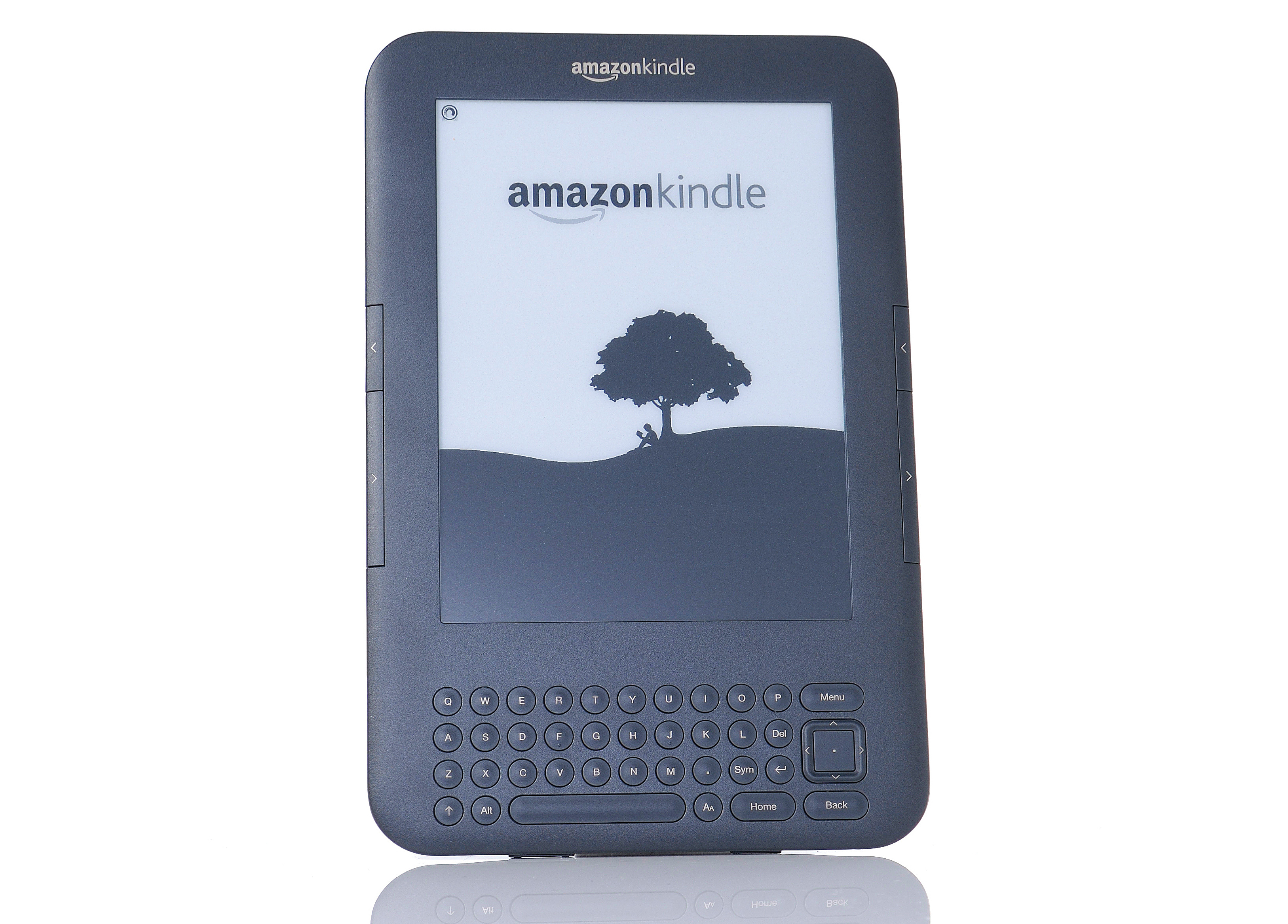
When Amazon Kindle was first a thing you had to buy the books you wanted to read and download them onto an early-generation e-reader, nothing else worked other than your actual computer. Take a look at one of the early Kindle versions here:

You couldn’t put them on your IPhone or on an I-Pad and there was no such thing as Kobo or Apple Books. This led me to feeling very enthused about reviewing. I love to read a well-crafted and considered review, and enjoyed the challenge of writing them myself. I knew an author’s success depended to a great extent on what the reviews said, and as a reader myself I read at least a good selection of reviews, both positive and negative. One’s reviewing name is not one’s own name, so there was some protection of identity when you didn’t like something. I felt it was a kind of community thing, to share views with others. I reviewed certain author’s books without fail. Then there was Goodreads, which at some point was taken over by Amazon, and that became overwhelming, so I stopped using it altogether, although they still send me emails all the time.

I don’t know when it dawned on me that the whole review process had become distorted and corrupt. Review-farming was a thing. Somehow authors could pay money – a lot of money, maybe hundreds of dollars – to have their books reviewed by a group of people who apparently got some reward for reviewing them, although I never knew how that worked, or how it met Amazon’s terms of service. The system became hyper-alert to reviews from anyone even vaguely connected to the author, relative, friend, Facebook contact, whatever and those reviews were banned. Other anonymous people however were free to say whatever they liked and post one star reviews because the book was delivered late, or was about something they hadn’t expected because obviously they hadn’t read the blurb.

Now I don’t review at all. I often feel I would like to comment on books I really like, or make suggestions to authors about something they could do to strengthen the work, or whatever. But I know now that the majority of successful Amazon authors are turning out books once every couple of months. Some are using ghost writers. Others treat writing as a kind of supermarket shelf-stocking – each book a basic product fitting a particular genre run through one or more editing programs to check for grammar and spelling, off to a human editor perhaps, covers designed strictly by genre convention which somehow everyone understands, and book is “launched” with money lavished on Amazon and/or Facebook ads and now Tik-Tok reels three times a day. Why bother reviewing? It is like reviewing cans of identical soup. And authors are devastated if the reviews they do get are not five-star.

This is clearly reflected in the command “Write to Market” which I will talk about in another post.

Why review? … and the Tentacle Romance.

Over the past several months – say, six or so – I have been reading an inordinate amount as I’ve been ramping up my production schedule. Not that I’ve met it, but I’ve been trying. Several almost complete works just waiting for that semi-final edit, two new stories from my Other Identity swirling around, and here I am in Paris struggling with what feels like a covid cough – oh, wait! Covid doesn’t exist any more … at least nobody tests for it and a whole plane load of coughing passengers on their way from Singapore (nobody masked) was just due to general unspecified viruses. Anyway when I finally called the brilliant SOS Medicins service – can you believe a doctor does a home visit at 11 at night after being called just an hour before ?- he didn’t express any interest in speculating about viral sources and was just very reassuring about cough mixture and the benefits of Paracetomol.

So, back to reading. As part of the effort to better define what ‘genre’ I am writing in, I have been gulping down all kinds of stuff. I joined Kindle Unlimited so I could read lots of books of completely unknown quality really quickly and send them back if I couldn’t stand them. And I did send back a lot. You can only have twelve out at one time. I was sending back two a day at one point. The contemporary writing and reading market is so peculiar. I discovered genres I could never have dreamt up. Well, maybe they are subgenres, whatever. Tentacle Aliens was pretty bizarre.

Their technical identity on Amazon is:
Tentacle Aliens and Monsters Erotic Short Stories

I really liked Rita Indiana’s book, although to be fair, it wasn’t a tentacle romance and it did not evolve within the Amazon ecosystem, being published as an actual book, ie a printed volume, by that excellent British publisher And Other Stories. Check them out!

Here’s what Rita’s blurb says: Plucked from her life on the streets of post-apocalyptic Santo Domingo, young maid Acilde Figueroa finds herself at the heart of a Santería prophecy: only she can travel back in time and save the ocean – and humanity – from disaster. But first she must become the man she always was – with the help of a sacred anemone. Tentacle is an electric novel with a big appetite and a brave vision, plunging headfirst into questions of climate change, technology, Yoruba ritual, queer politics, poverty, sex, colonialism and contemporary art. Bursting with punk energy and lyricism, it’s a restless, addictive trip: The Tempest meets the telenovela.

The real tentacle romances are a different kettle of fish, so to speak – slightly disguised erotic, but some weren’t bad.

I quite enjoyed

Nepenthe: A Tentacle Alien Space Fantasy (We Are Nepenthe Book 1)

by Octavia Hyde

I was cross that she had preempted my intended use of the name Nepenthe as a sub-division of Blackwing Press for experimental and off-the-wall writing. In the light of all this, I have cancelled Nepenthe Books as a concept altogether now. It seems far too tame, given what is out there already.
Moving on from Tentacles, I found that many male writers (at least persons writing under sturdy male-identified names) have been writing about catastrophic colonies on Mars or elsewhere in a decaying universe. Lots of (ditto) girl-sounding people are writing filth about billionaires and dom/sub desires, Mafia romances and Reverse Harem (that is when one woman has three or more men living/playing with her, some of them are bikies and some are cowboys, take your pick).

Paying special heed to post-apocalyptic themes I found a couple of (I think) young players writing not bad series. I downloaded a couple of Kyla Stone’s stories and followed on her blog-site and she was doing a very good marketing job. Sadly I just got completely bored with the stories which all seemed the same. Another was a New Zealand writer who seemed appealing when I watched her on one of the many talk programs run by one of the various online “how to be an author” groups, but I lost interest after realising that although she seemed like a very nice young lady, what she was writing was just too horrible for me.

So these are low-budget Kindle ebooks designed for the Amazon ecosystem. In most cases I didn’t have any compunction about returning the books with only a few pages read. (On Kindle Unlimited the author is paid according to how many pages are read). In a couple of others I could sense a good writer struggling to come out. One in particular was writtten by a Melbourne person (girl/woman self-presentation) and it was very well written and quite gripping in places although the key plot element was obvious from early on and in my view rather ridiculous. I finished it, and for a brief moment considered writing a proper actual review with real words – as against the silly five stars which now appear at the end of each Amazon ebook, uselessly as far as I can see – I never ever click them. But I hesitated. It’s a slippery slope.

Experiments in AI: A+ Content files for Revolutionary Baby on KDP: the Thumbnail Narrative.

Although I share the general anxiety in the publishing world about the impact of AI, I have to say experimenting with AI images has been rewarding. Amazon’s KDP allows authors/publishers to include quite expansive materials on their book pages. The question is, what to use as the basis for the content?

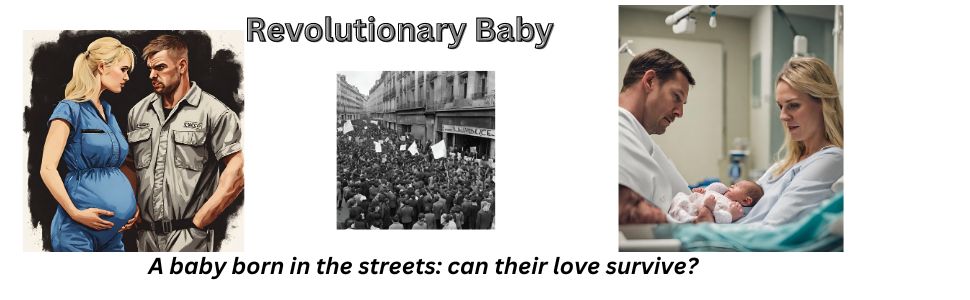
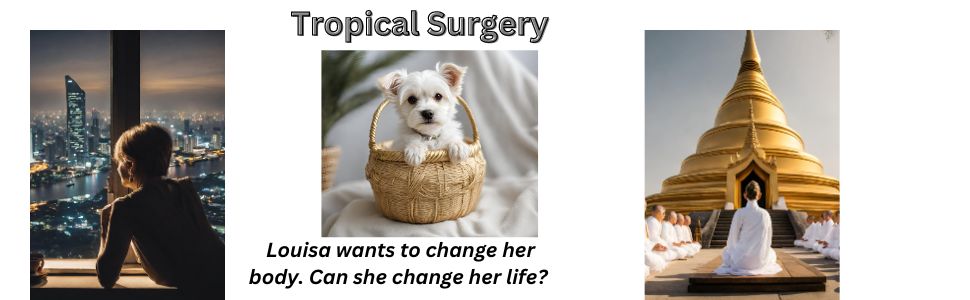
When the book is a collection of short stories, like Revolutionary Baby, this give an opportunity to give some visual clues as to what some of the stories are about. Brief text-based summaries on the back of the book amount to not much more tha a Table of Contents. In an experimental spirit, I spent a lot of time this week seeing what I could come up with to give some better visual presentation of the narratives. The A+ content also allows the creation of one kind of module with text to go with a set of images, so that is what I have submitted. Whether or not it is accepted is another matter.

Meawhile, here are the three examples I am hoping to use as the visual clues on the book page. They seem to have transferred well using the preferred pixel size recommended by KDP.

If it works out on the Amazon book page each image will have a brief text below it. I chose to paraphrase some of the actual writing from the stories. Some of it could be used verbatim but with condensation and re-expression it became a lot better. It called for a different kind of editing.

Now to find some other ways to circulate these thumbnail narratives.