ARE YOU IN THE AI MASH-BUCKET YET?
I have struggled so much this year just to keep going that I haven’t really been following the AI horrorshow and the latest madness of late modernity, or whatever/wherever this is. But now I am paying attention.
I subscribe to The Atlantic magazine because very little published in Australia can now be regarded as well-informed or useful. The Atlantic has just published an accessible search engine for the new generative AI programs being developed by Apple and Anthropic, listing all the published works currently being “scraped”. So simple. I put my name in and in seconds up came the answer. Thirty six of my published academic articles and reviews, and two other fictional works, were already in the data-base. This led me to check the work of a couple of others close to me. My daughter Obelia Modjeska had been scraped for her main true crime series and one other book. I checked other writers I knew – Australian authors, with no US registered copyright, unless the publishers had filed for copyright on behalf of the authors. Had they? Did it matter? How would you know? And what about everyone who had published in journals or magazines or even online on their own websites?
I have used Chat-GPT several times, mostly about factual things, because its information is more comprehensive than what comes from a Google search. The personalised aspect of it is intriguing, and its responses to weird queries are pretty amazing. In less than a minute I learned all about the history of commercial rolled oats in Australia. It told me things in greater detail than I could have found out by myself without wasting many hours. The information seemed to be coming from other sources on line, including Wikipedia, company statements, newspaper articles and ephemeral sources. Fair enough. Seems helpful.
On the other hand I knew AI had been exploiting the work of creative writers. I had heard about the class action suit in the US to gain compensation for the thousands of writers whose works had already been used by LIBGEN. People in the class action suit were only eligible to participate if their works had been formally recognsed by the US Copyright Office. Australian writers are not eligible to register.
Some comments I have read by disgruntled authors suggest they think it means the companies can publish their books without attribution or payment. No, that is just piracy, which is prevalent and bad enough. It is not the books/stories as such but the actual inner structures of them, sequences of words and phrases for instance, which are fed into some kind of mish-mash machine and then used to generate something “else”, some other written piece.
I began to realise what this means when I asked Chat-GPT if it could write a fictional text for me. Sure, it said, and gave me a few suggestions for guidelines. It could even write a novel. I recollected the many howls of protest from self-published authors on various Facebook chat groups who noted some authors were publishing three books a day or something like that. I didn’t take it any further, obviously, but I am trying to understand what this means for writers currently trying to publish their works, whether fiction or non-fiction. Will everything immediately be fed back into the AI interface/program/platform? Has copyright now disappeared? The Australian Society of Authors is making submissions on this at present and has published Guidelines with clauses to use in publishing contracts. This covers AI licensing and use as well as advice for web content and self-published work. But it seems from some recent decisions or assertions that powerful companies are arguing against the imposition of any such controls. Is there any point in writing anything any more?
I ‘m only writing this to register the existential shock I felt when I realised that so much of the work which I and others close to me have been doing for years and years as writers and researchers and creators and knowledge synthesisers now has no actual protection. But it goes far beyond that. Generative AI is now transforming the idea of “writing” and “creation” and “authorship”. Everything is available for access in an automated mashup bucket which anyone at all can use to produce something else under their own name. Although, ironically, if you get ChatGPT to write your novel for you, it does not have any copyright protection because ChatGPT is not a person. Go figure.
A PERSONAL NOTE FROM ME WHO IS A REAL PERSON AND IS ACTUALLY WRITING THIS:
The Generative AI program now attached to WordPress asked me if I’d like it to create an image for me to use in this post. I said yes. I didn’t tell it what to create, it read my post and then described what it thought I wanted it to do.
Create a highly detailed, sharp-focused image illustrating the theme of “Understanding Generative AI’s Effects on Writers.” Feature a distressed writer surrounded by stacks of books and a glowing laptop displaying generative AI text. The setting should be a dimly lit, cluttered home office with a window showing a blurry modern cityscape outside, symbolizing the clash between traditional writing and technological advancements. Use soft, dramatic lighting to highlight the writer’s expressions of concern and contemplation. Ensure the image is high resolution and captures the intricate details of the environment and the emotional weight of the subject.
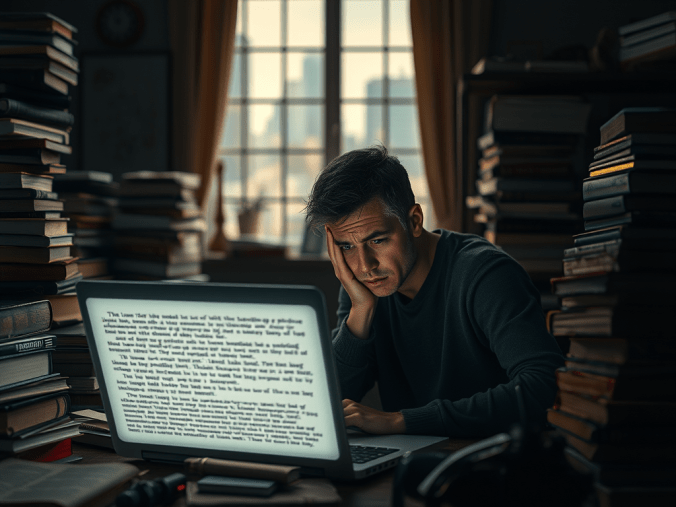
So AI now understands what kind of image I might like to use to illustrate my thoughts on this topic, complete with setting, environment, gender of writer, and even “his” emotional weight. Had I asked AI to write the piece in the first place it would have been able to construct the illustration at the same time. I might try to do my own description and have the image created by Canva, which also has a visual generative AI program.
The Register of the Real seems to have evaporated almost entirely.
 Annette Hamilton - Writer