INTRODUCING THE FEIULLETON
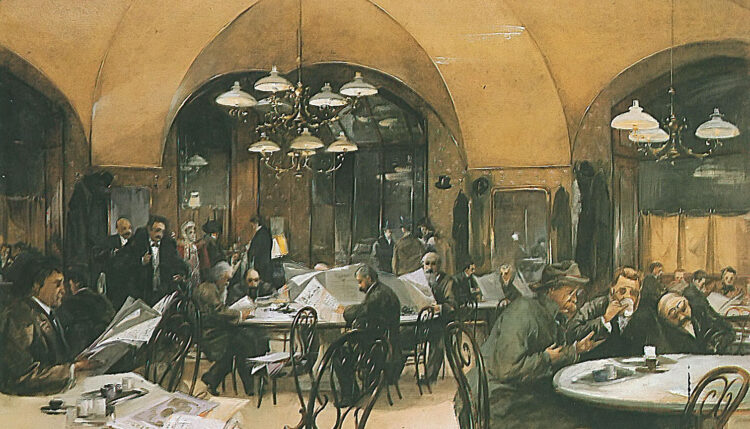
Literary Journalism In Fin-De-Siècle Vienna
(From International Association of Literary Journalism Studies)
As mentioned I have been thinking about inserting the odd Feuilleton here, mainly because I keep finding myself contemplating some strange or remarkable facet of contemporary culture and society which defies inclusion into any other kind of writing I do. By calling it a Feuilleton I hope to indicate that it is a passing phenomenon not of any great social or political importance in itself, although I may be flirting with the Zeitgeist or capturing the temper of the times. My Feuilletons are not about literary culture or contemporary writing or the Kindle or the role of reviewers in the Internet age. But they are not entirely frivolous or meaningless either.
The term Feuilleton comes from French and means something like “little leaf”. Originally it was a small item at the bottom of the literary section of a newspaper, often providing a critique of popular theatre, but in many cases it grew to have its own page. By the 1840s the term roman-feuilleton described a serialized novel published in newspapers, something like today’s internet novelizations, but paid for, not for free. I mean the readers bought the newspapers and the newspapers paid the writers. [Now we barely have newspapers and people publish their writing for free all the time, which seems counterproductive]. The term was used in English by 1845, in the Atheneum.
The term was also handy to refer to small one-page advertisements, like handbills, which might be handed out in the street to encourage consumers to visit suppliers, as in this advertisement for a delicious lunch venue the like of which sadly no longer exists.

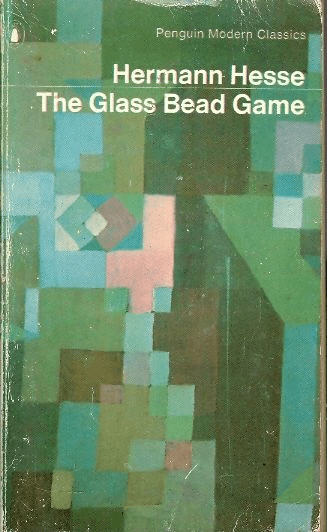
If that all sounds cheery and familiar, we must pause at what Hermann Hesse had to say about it in The Glass Bead Game, regarded as the first and only science fiction novel to win the Nobel Prize (in 1946). He was writing against the decline of humanistic culture brought about by “feuilletonism”, which he saw as the antithesis to true writing, and lampooned viciously. His master-work, The Glass Bead Game, was on the Must-Read list of myself along with almost every other proto-boho-intello in the 1960s, and describes the life of future intellectuals living in a cloistered community trying to circumvent the excesses of the age. Thanks to Huxley for bringing the Feuilleton into the present time as another object of knowledge. (https://huxley.media/en/the-feuilleton-era-we-live-in/)
Hesse described the Feuilleton, printed widely in newspapers and magazines, as a source of “mental pabulum” for readers hoping to soak up culture but unable to actually do so due to the lack of education and motivation, and of course being too busy and far too important to sit down and read actual books.
He said:
Among the favorite subjects of such essays were anecdotes taken from the lives or correspondence of famous men and women. They bore such titles as «Friedrich Nietzsche and Women’s Fashions of 1870,« or «The Composer Rossini’s Favorite Dishes», or «The Role of the Lapdog in the Lives of Great Courtesans» and so on.
Another popular type of article was the historical background piece on what was currently being talked about among the well-to-do, such as «The Dream of Creating Gold Through the Centuries» or «Physico-chemical Experiments in Influencing the Weather» and hundreds of similar subjects… we feel surprise that there should have been people who devoured such chitchat for their daily reading; but what astonishes us far more is that authors of repute and of decent education should have helped to «service» this gigantic consumption of empty whimsies. Significantly, «service» was the expression used; it was also the word denoting the relationship of man to the machine at that time.”
Good heavens! This is exactly the flavour of the endless parade of pablum from our own Machine, the Internet, much of which we now call “clickbait”. But Feuilletonism goes so much deeper than trying to persuade people to buy stuff they don’t need from people they don’t know manufactured by unspecifiable techniques at places which don’t exist. The Age of the Feuilleton is completely dominant today, ever more so with the consequences of AI development and universal internet access on every phone – the mastery of the Machine indeed.
I don’t see my contributions to the Age of the Feuilleton as necessarily despicable, as Hesse might have done. By proposing to include a few remarks under the heading of a Feuilleton, I am going with the diverse flow of contemporary knowledges, and playing a little with the scary bizarritude of the fragments flowing through the ever-open channels of our time. It is true that there may be an academic flavour to the analysis, but maybe that is a necessary correlate of talking about anything in modern culture at all, rather than just participating in it. And a rich and full array it is.
So in my occasional Feuilleton I will remark on various ephemeral incidences, moments or events, usually conveyed in media, sometimes in performance. I notice things as I trawl through my reading and writing. Someone, generally much younger than myself, draws my attention to something I have never thought of before, and didn’t know existed. Or I am struck by some change in the discourse and behaviour in the everyday world around me. Often these moments are so peculiar in flavour and signification that I am reminded of my old father’s frequent exclamation: “Well blimey, you just wouldn’t read about it”. Now, these days, it turns out he was plain wrong. We can read about it, and moreover see it, all the time, every hour of every day. By adding a little more to it I hope to do no harm. I will identify those pieces which belong in the Feuilleton category, so you can skip over them altogether if you like.
Check out Stoddard Martin’s essays, with insights from the old and new literatures of several countries – aesthetics, musicology, mythology, philosophy, poetry, politics, and psychology.
Monstrous Century: Essays in ‘the Age of the Feuilleton’ Paperback – October 15, 2016
Insights from the old and new literatures of several countries jostle for space in this work – not to mention aesthetics, musicology, mythology, philosophy, poetry, politics, and psychology. The subjects, even when unsympathetic in themselves, are viewed in the round, and judged with humanity (from the publisher’s blurb).

«THE GLASS BEAD GAME». FRAGMENT FROM THE WORK
«We must confess that we cannot provide an unequivocal definition of those products from which the age takes its name, the feuilletons. They seem to have formed an uncommonly popular section of the daily newspapers, were produced by the millions, and were a major source of mental pabulum for the reader in want of culture. They reported on, or rather «chatted» about, a thousand-and-one items of knowledge. It would seem, moreover, that the cleverer among the writers of them poked fun at their own work. Ziegenhalss, at any rate, contends that many such pieces are so incomprehensible that they can only be viewed as self-persiflage on the part of the authors.”

 Annette Hamilton - Writer