We are able to find everything in our memory, which is like a dispensary or chemical laboratory in which chance steers our hand sometimes to a soothing drug and sometimes to a dangerous poison.
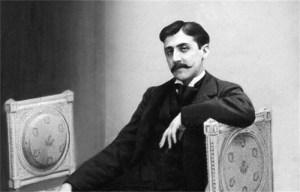
Marcel Proust.
The way memory and history work in the act of writing becomes ever more absorbing. For some time now I have been writing books toward a memoir series Outside the Frame. Read more details about the series and some of its components on the subtag attached to this page.
The title comes from a little ditty, or maybe doggerel, which I seem to have written at a time I now don’t recall. I was trying to express my sense of never quite being there, never quite making it, never being fully included, never falling entirely inside some hallowed zone where others found praise and acceptance and were reassured of their importance. I was always at the edge.
Anyone analytically inclined will see the sources of this in my early life experience where I was the only child for five years in a family torn apart by wartime trauma, misery, discord, illness and death. Nothing unusual for the times, or for millions of children in many parts of the world today. Such children do not have the experience of being at the centre of their family life, even for a short while. If they are anything like me, they grow up longing for recognition and inclusion, but their resentments and uncertainties and sense of injustice and sometimes anger mean they never quite fit in.
I have also long been interested in the idea of framing in art. The frame creates the picture, cuts it off from its continuity with the wall, with the room, with the space enclosing the room, and thus with the world outside the wall. It’s part of what Siri Hustvedt calls “The Mystery of the Rectangle”. The rectangle, the frame, encloses the image and makes it secure in two dimensions. It can’t leave, we can’t claim it. There it is for ever, unless it is erased. I imagine myself looking at the viewer from across a transverse edge, sliding in or perhaps it’s really out of the viewing space. I can’t seem to get fully inside that frame, or maybe I just can’t stay there.
The artist might put you there, but if he chooses he can remove you. The idea of the Great Illustrator is powerful and scary.
I supposed I might be no more than an illustration, a product of someone else’s concept, someone else’s idea, an idea which has its own existence and mobilises me as its exemplar. The attribution of will or intention to ideas makes a weird sense today in the light of the memetic world replete with interpretation …. of what though? Do ideas really care?
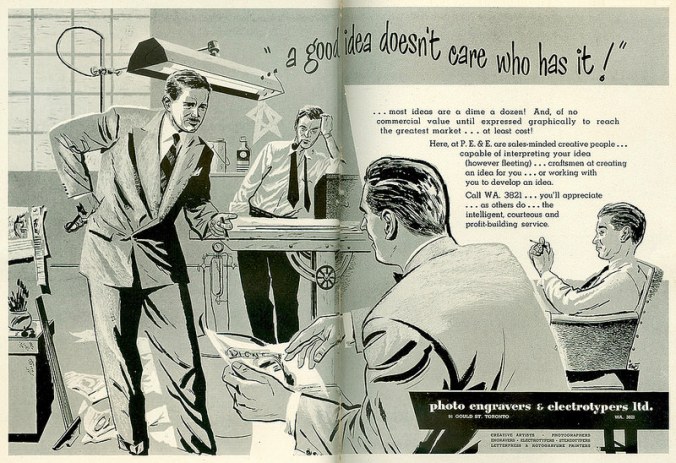
“A Good Idea …” Unknown illustrator for the 1949 Toronto AD Advertising annual.
So far I’ve finished two volumes, although they still being edited, half-written a third and have started on a fourth. I have no idea how many others there will be.
 Annette Hamilton - Writer