I love this piece. It seems like a simple narrative but there is so much deepwork here. He writes about his own writing. He knows his topic. He is trying to write something that doesn’t want to be written. He is in a Citadines apartment in Paris, near Les Halles, all set to direct his errant creativity, until the occurrence of an inexplicable body horror: an eruption, a carbuncle, a papule which swells and grows without explanation on his inner thigh. He describes his confusion, trying to seeking medical care in a place where you don’t have the normal supports. You can feel his rising anxiety as the Thing throbs and expands until it bursts in a surge of blood and pain. And pus no doubt.
It was 2023. He was trying to finish a novel which he had been writing and rewriting, each time reaching a certain length (137 pages) until he had to throw it away and start again. Only after his grisly wound was drained was he able to return to his writing which suddenly became something different. His novel, Minor Black Figures, emerged,due to be published in October 2025.
I spent six weeks in Paris in 2024, staying in an old rental apartment. The entire city was going mad in preparations for the Olympics. I was working on a half-drafted novel, a kind of auto-fiction about my experiences in Paris in the early 1980s. It was about woman stuff and the post 70s painting scene and the rise of anti-theory and the “New Philosophers”. But I was too sick to write it, or it was making me sick. I was dizzy all the time and felt constantly confused. I couldn’t manage the stairs and corridors of the metro. The book I had planned refused to co-operate. Too many characters appeared and kept on doing contemporary things, like try to work out how to buy a travel pass from a digital dispenser in an apparently abandoned metro station. Instead of writing my novel I had a major panic attack in Le Petit Palais, a glorious art gallery full of lesser known paintings from the past three centuries.
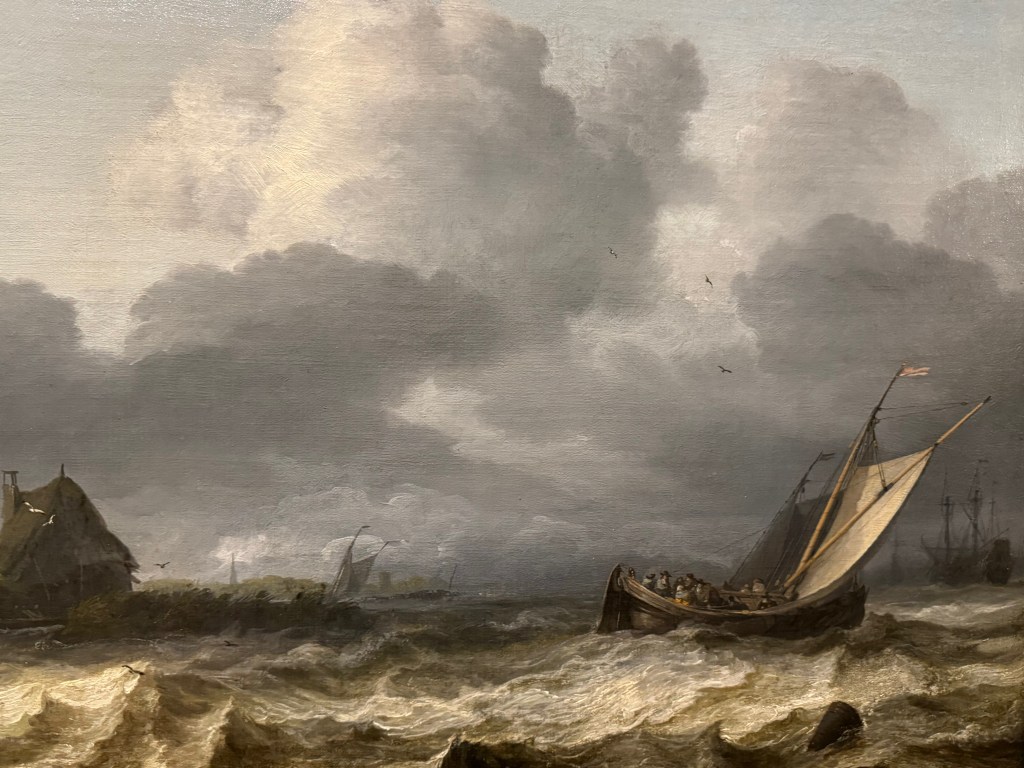
Le Petit Palais, Paris, May 2025.
There were endless corridors of incredible old paintings. This was one of my favourites. I stood in front of it, wondering at how in the 17th century a virtually unknown painter had produced this picture from his own imagination (since there were no photographs then, remember, no image libraries, no Pixabay) and here it was four centuries later in Paris and so was I, and I couldn’t step away from it.
Allaert van Everdingen. L’Orage (The Storm): oil on linen, 1650.
But suddenly I knew I had to lie down, and there is nowhere to do that in Le Petit Palais. I started to panic. My partner shepherded me around with rising anxiety. I said we had to leave at once. Outside, a set of metal barriers had appeared and no vehicles were allowed to stop in front of the building, or anywhere near it. Police were patrolling up and down. Where to go? What to do? I panicked even more. After what seemed like hours we managed to get back to the apartment. I decided I had to just stay home for a while and not go near that book I had come here to write.
It definitely did not want to be written. It was full of my usual preoccupations about mothers and daughters and trauma and inter-generational rivalries. After a time I decided I had to find a doctor. It was so easy! An amazing midnight home visit by a local doctor provided a diagnosis of a mystery virus and consequent high blood pressure. He gave me a script for some magic pills which were procured next morning from the Green Cross pharmacy across the square. I felt better but still couldn’t write anything other than my diary.
After that, I went back to Sydney and thought maybe my book should be about having a panic attack in Paris. It could still be about that early 1980s era, but instead of a “normal” novel it would be a memoir of the present superimposed on a certain past which may, or may not, have existed in its recollected form. I realised I could salvage my original title, Paris Vertigo, which was perfect for this purpose. It could be any length: a Substack piece, a novella, a novelistic memoir. Not a poem, though.
It would probably push aside my daily diary writing, which in any case is no longer daily, and never has anything very interesting in it because I never have time to write it properly. I am so over-committed. So why not add one more probably unachievable task? Brandon Taylor’s Paris story inspired me to think it might be possible.
BELOW: The lobby of the Hotel de Nice, where some of PARIS VERTIGO takes place.
I have been struggling for years with a problem which has held me back from my literary destiny (ha ha). Fortunately, Joan Didion suddenly if posthumously stepped onto the dancefloor of the writers’ parlour. She died in December 2021, aged 87. Her raw diaries are about to be cooked in April. A segment of her unpublished work, consisting of journal entries addressed to her late husband John Gregory Dunne, will be published. There is a history to the discovery of these diaries and the decision to publish them without further edits but I won’t go into it here. The book titled Notes to John include reflections on her experiences as she attempts to make sense of her husband’s sudden death, her weird and frustrating relationship with her daughter Quintana Roo and her difficulties with work, alcohol, depression and anxiety. Her interactions with her psychiatrist reflect on this.
She left these diaries perfectly arranged so it is reasonable to assume she wanted them to survive and therefore to be read. Don’t we all who keep diaries secretly hope there is some enduring place for them? For many writers, especially women, diaries have been an inseparable part of their identity. Quite a few writers now publish their own diaries, or extracts from them, or cite them in their memoirs.
I know there are “issues” with Joan Didion. She is seen as conservative, pro-Republican, reliant on men, ideologically suspect. I’ve been seeing her more clearly through Lili Anolik’s book Didionand Babitz (2024) and will probably write more about it shortly. For now, though, it is something in Joan Didion’s early work that is on my mind – something I read once and then forgot about, which has just resurfaced.
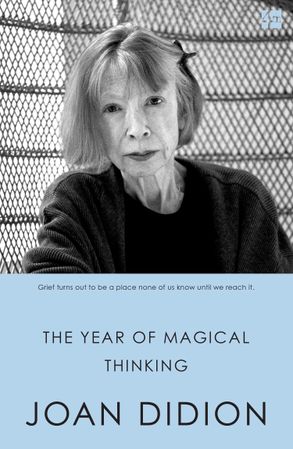
Mostly it was her book The Year of MagicalThinking (2005) which became important to me. She wrote it after the sudden death by heart attack of her husband, at a time when her adult daughter was suffering a severe illness. The atmosphere of her book enfolded me when I first began to write my own mortality memoir Regret Horizon (still unpublished). My mother died in 2008. She didn’t die suddenly but weakened slowly and defiantly until passing away in hospital at 93 after an accident with her dentures. My book turned out nothing like Didion’s: I surprised myself by writing an almost ethnographic account of my mother’s final year of life, my own mismanagement of it, and the immediate consequences of her death.
Later her book Blue Nights (2011) reflected on her life with her daughter, who was born at almost exactly the same time as my first child (in early 1966) and died in 2005 aged 39. I was still trying to draft my book. I didn’t want to go into my relationship with my own children, although that necessarily suffused the story and I couldn’t repress it altogether.
In the recent burst of pre-publicity surrounding her diaries I came across reference to something which hit me with one of those “OMG yes” moments.
Her first collection, Slouching Towards Bethlehem, was published in 1968. In her essay “On Keeping a Notebook” she talked about writing not as a means of recording facts but a way of capturing moments in all their specificity, giving a kind of enduring existence to the flickering and pulsing of emotion and impression before they disappeared altogether. She wrote about the need to recognize the people we used to be.
I read that essay around 1970 while trying to deal with the notebooks I had written while “in the field” doing research in First Nations communities in remote Arnhem Land, carrying out a project for a higher degree. The topic of my research was supposed to be “the women’s point of view” in an indigenous community still closely embedded in the pre-invasion way of life. I tried to do the right thing, to keep accurate accounts of behaviour and conversation, to find out what women thought about traditional marriage arrangements and social organization and struggled to find a way to write that was somehow scientific and objective and academically acceptable. Given that there were no existing examples of such a project that I knew of, I had no guidelines to follow.
I very soon discovered I could not possibly write this kind of thing. Instead, I was writing notes which were more like diaries because of the way I experienced the events I needed to write about. My two-year-old son was with me. I was a mother. There was no way around that, no “objective” position available. The things that happened as day followed day and the dry season became the wet season and I slowly learnt the indigenous language and spent most of my time with other mothers and children created a personal life for us in that community, and outside it as well. This existence seemed to have nothing to do with the “professional” persona through whom I was supposed to be demonstrating my academic and objective research capacities which was the reason for us being there in the first place.
Any anthropologist who did old-school fieldwork in those times experienced something like this, but it was particularly powerful for me, a very young woman, a mother with a small child. Moreover not long I arrived “in the field” I discovered I was pregnant with a second child, conceived just before I left Sydney where my husband was pursuing his own activities. In “researching” women’s lives in that community I became a different self. I was given an identity, with people assigned as my kinfolk and expectations of my behaviour arising from those relationships. My “fieldnotes” became more and more a diary, and I realised that the writer was neither the person living in that community in those moments, nor the person who came from a prestigious University far away in the city. The actual writer was an intermediary being who came into existence at night as the cockroaches scuttled across the concrete floor in the flickering light of a kerosene lamp and my son slept in the old caravan next door.
Time passed, my pregnancy progressed, I had to go back to Sydney for the birth.
Later, trying to make sense of this writing which was neither and both field-notes and diary, a new and different writer emerged. This person had to reflect on the embodied feelings, the conditions of daily existence, the conversations, the rituals shared, the moments remembered, an entirely discontinuous reality which now lay bizarrely in the past. It seemed almost impossible that this was the same person now writing an academic thesis in sunny Sydney, a new baby in a basket and a husband dealing with his own traumas.
What I finally wrote was very distant from the original research proposal. It turned out to be about child-bearing and child-rearing, something most professional anthropologists were completely uninterested in. It was published to almost complete silence. In the confusing times which followed, I wrote academic works. I went to a different “field”, this time with my husband and two young children, and the problem of writing and identity was even worse, capped off by the fact that my son set fire to our tent and caravan, thus incinerating eight months of fieldnotes and diaries.
Much much later my academic career was nearing its end. My mother was dying, and so was my ex-husband. I had to write about, that year and its aftermath. I wrote bits and pieces, draft after draft, various chapters, discarded, rewrote, but couldn’t bring the project to an end. I began a final edit and still didn’t like it. I needed the book to change. I didn’t know who this writer was either and didn’t like any of the versions of her who came forward as “author”.
Then suddenly I rediscovered this quote from Joan Didion’s “On Keeping a Notebook”, from the 1968 collection Slouching Towards Bethlehem.
“I think we are well advised to keep on nodding terms with the people we used to be, whether we find them attractive company or not. Otherwise, they turn up unannounced and surprise us, come hammering on the mind’s door at 4 a.m. of a bad night and demand to know who deserted them, who betrayed them, who is going to make amends.”
I’d had so many bad nights but had not considered that it was those irritating people I used to be hammering at the door. These entities all seemed to have a hand in my book, toiling over paragraphs, edited out superfluities, then put more in. They were all trying to write my book. Outlook and expression and desire, indeed the very reasons for the writing, seemed to be constantly changing. All writers understand that the “author” is not the ”writer”, but what if there are several of them vying for dominance? Perhaps all “authors” suffer from MPD. Except for writers of rapid release genre fiction, who will now be the instruments of AI. But that is another topic.
I had turned it all outwards: I thought it was the real people in my life making demands on me, and I was trying to write this memoir to make amends to them. But it wasn’t them I had to make amends to, it was the old entities who had occupied the placeholder “me”. How Joan Didion, at such an early age (she would she would have been 34 in 1968), could have come to this blasting insight seems amazing. Now Joan is back in my life I am re-reading her with different ears and eyes and maybe I will find out. And if I can keep on good enough terms with those other denizen/components of the authorial entity, I will be able to finally let the book go – publish it, or let it perish.
Some recent notes on Joan Didion:
Nathan Heller. “What we get wrong about Joan Didion”. The New Yorker, 25 Jan 2021.
Karina Longworth (Substack podcast): “Lili Anolik on Joan Didion + John Wayne”. 30Jan 2025.
Cerys Davies. “Joan Didion’s diary of post-therapy notes is going to be published”. LA Times, 5 February 2025.
Daniel Lavery. “A Sneak Peek at the Upcoming and Never-Before-Read Joan Didion Diaries”. The Chantner. Substack. 18 February 2025.
Marissa Vivian. “Hemingway: What Her Words Reveal About the Ethics of Publishing her own Diary”. Substack. 8 February 2025.
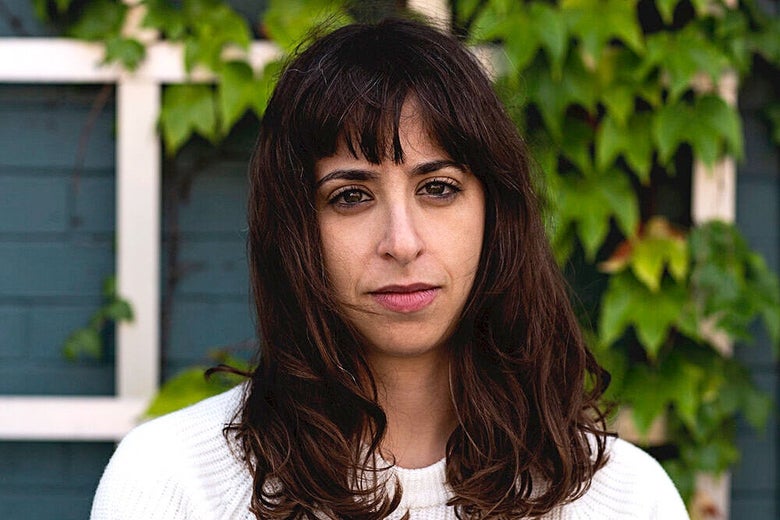
Dear Readers, this is just a quick note to let you know that if you looked me up on Google you very likely came across a compelling photo of a stunning women with a penetrating, somewhat sad gaze. As the text below it says “Annette Hamilton” you may have been misled into thinking either that I was committing a very heinous sin of disguise, presenting my persona in an entirely misleading way, or that somehow I had undertaken a full head and neck transplant which as far as I know even Drs Dubrow and Nassif could not manage (if you are a fan of Botched you will know who I am talking about).
No, this is a photo of writer Anna Wiener (37) author of Uncanny Valley, a book I strongly recommended in a post in March 2020 (see Posts).
I still recommend her book as a wonderful example of auto-ethnography, but with everything that has happened in the US over the past 4-5 years it can’t help being a bit past-the-moment. She now writes for the New Yorker as a tech correspondent – her latest pieces are “On video game engines” for The New York) and “On office memoirs” for The New Yorker. The photo above comes from her website.
There are plenty of photos of Annette Hamilton on this site and I think you’ll agree there is no mistaking the two.
As a possibly irrelevant aside, you may come across reference to an Annette Weiner (note different spelling). Annette and I did in fact share a number of elements of personal experience which would make this mistaken identity far more cogent.
Annette Weiner, former Dean of the Faculty of Arts, NYU
Annette Weiner was an outstanding and well-known anthropologist; born 1933 in Philadelphia, she died in 1997 in Greenwich Village, of cancer, at the age of 64. She had an extraordinary career, as Kriser Distinguished Professor of Anthropology, chair of the department and dean of the Graduate School of Arts and Sciences at New York University. She wrote a dissertation on the contribution of women to the economy of Trobriand society.
Annette Weiner was a very generous, kind and fun-loving soul who allowed me to stay in her New York apartment on several occasions. We also met up in Paris, but things did not go well between us there and our friendship collapsed under the weight mainly of my bad behaviour. But, as they say, that’s another story! Perhaps to be told in an upcoming auto-fictional memoir, Paris Vertigo, although that’s not on the immediate writing horizon. I have always regretted what happened between us, although it was probably inevitable. How much of “the truth” I can tell in that book remains to be seen. But please do not mistake me for Annette Weiner either!
I have reached a point in my writing and publishing activities where I must seriously ask: why publish at all? I haven’t published much yet but I have a lot of plans and proposals in the mix and several are at the point of fulfilment. Various things have held me up – some in the “real world” but others in that weird interior zone where the writer actually feels most alive but also most threatened and alarmed and fearful and excited, something which I suspect only other similarly benighted souls will understand. There really should be psychiatric services for writers, to help them work out what they are doing and why.
But as time passes, and especially with the impact of AI, the question becomes more acute than ever. There are 32.8 million published titles on Amazon now and more every day. It is possible that AI written books are flooding the market, although there seems to be no way to work out if this is true or not. Amazon now will only allow you to publish something like THREE BOOKS A DAY. Can this be true? Nobody can write three books a day. However the various online writers forums I participate in do seem to have members who think nothing of writing a book in two or three or four weeks: that is from start to finish, including editing, proofreading and maybe designing the covers as well. The fans of these writers are passionate and apparently faithful. They expect the writer’s new books ASAP and pre-order slavishly, or so it seems.
THE DASH AND DOLLY EFFECT
I just finished watching a mystery drama mini-series on Netflix, The Perfect Couple, starring Nicole Kidman as a popular writer, Greer Garrison Winbury, whose books are about the endless romance of Dash and Dolly. The readers imagine these are the writer herself and her husband Tag, played by Liev Schreiber, who in real life is alcoholic, louche, unfaithful and most unattractive. Based on a 2018 novel of the same name by Elin Hildebrand, the story is about the interpenetration of fictional and real life, and its negotiation in contemporary culture. [It’s what my favourite analytic writer of the moment, Hans-Joachim Maaz calls “Die Falsche Leben” – FALSE LIFE. If you speak German there are interviews with him on Youtube: https://www.youtube.com/watch?v=KN6i6MYBbjI but only one of his books has been published in English.]
A brilliantly disturbing scene takes place at the launch of Greer’s 32nd novel in the series, when the “real world” life of Dash and Dolly comes to a crashing end in a bookstore full of passionate fans. As the truth of their relationship emerges – and a horrible truth it is – the fans fall into despair and horror, worse than anything they ever imagined. The scenario of this story emerges from the very peculiar intersection right now between writers and readers, amidst the technical possibilities of rapid production where fictions drawn out into endless series of almost identical stories, become the source of recognition and success for glamorous lady writers in particular, and sites of identity for readers obviously deprived of whatever it is they crave in the way of success, love, happiness and recognition. Readers’ identification with fictional characters is at the heart of this process.
WHY DON’T I WANT TO WRITE BOOKS ABOUT DASH AND DOLLY?
It’s called “writing to market” in online writing circles, and ever since I was first introduced to this term around a decade ago at a seminar at the Australian Society of Authors I have been wrestling with the concept from many angles. It’s the baked beans problem again. The fact is, I want to use the agency and freedom of independent publishing but I don’t want to “write to market”.
I know this raises almost terminal issues. What I write isn’t any of the popular genres which work so well on Amazon. I can’t even work out what genre I am writing in. Some is memoir, yes, and maybe some is literary fiction. most of my books will appeal mainly to “classic” readers, that is, women of a certain age who buy books in book-shops and go to literary events and festivals, but they don’t buy independently published print-on-demand books and they all hate Amazon. My “take” on things doesn’t quite fit the mould either. My perspectives are too diverse, the experiences I draw on are far from the “normal” life, let alone the “false” one which prevails today. I will put a Paypal button on these books for Australian/New Zealand readers who want paperback versions and see if that works for those who don’t or won’t buy through Amazon. The independent bookshops’ prices are absurd: my book Revolutionary Baby finished up costing those who ordered it from their favourite independent bookshop over $30.00, even though I know the cost of production in Australia is in the order of $7.00.
Should I bother going on and publishing the other three novels I have written? They are all set in the 1980s which now feels like a hundred centuries ago. The memoirs are set even earlier: 1960s, 1970s. But I guess that makes them historical. There is a special category for that on Amazon.
As for doing something completely different: I have written the first volume of a series which I plan to publish under a pen name. It is a post-apocalyptic narrative set in 2050 and “stars” two female characters, young women with distinctive talents and histories. It needs a final edit. I don’t plan to spend money on Amazon or Facebook ads.
All I can be sure of is that the books I have written will exist in print and/or electronic copies in a few libraries, and a few will receive them as gifts from me and maybe want to pass them on. Is that enough?
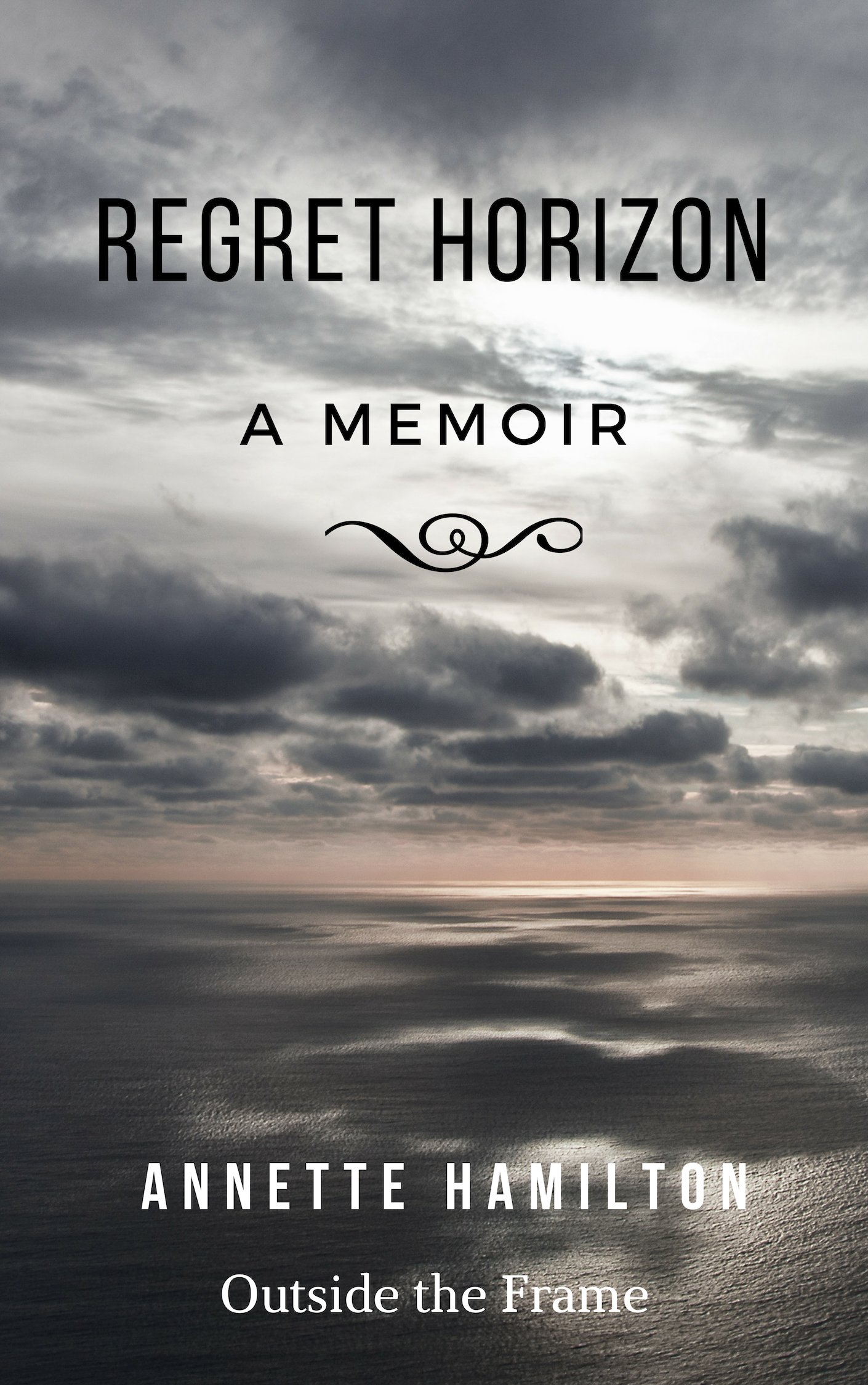
Things have changed for Regret Horizon, so long delayed, yet again. It is hard to explain briefly, but I have put the publication, due originally for November 2023, on hold again, as some re-edits have led to the need to consult again with some of those appearing in the book. Also, I have realised it is a memoir, not the first in the Outside the Frame series, so that leads to some different authorial comments. There has even been a strong suggestion that I shouldn’t publish it at all, which forced me to think again about why I wanted to do so in the first place. What a series of twists and turns all this leads to! Anyway, a possible publication date has now been pushed out to early next year, and we will see what other options may come up in the meantime.
I’ve attached myself to a number of author’s groups lately, a couple on Facebook and some semi-professional commentary services (which you pay for). To my surprise the Facebook groups have been a great source of interest and support, in a strangely tangled way. One of the groups often publishes reports by Amazon authors showing how much money they have made in the past few months while the world goes completely insane. This is amazing but also galling when you realise that what is now selling so hugely is aimed at highly specific genre audiences of which the average literary author would not have heard in a million years. My latest find is Reverse Harem Romance (RHR). Wait a bit and I will write more about it soon. What a discovery!
However this morning – a beautiful cool spring morning in the blossoming Blue Mountains, I started thinking about how the various levels of lockdown and state-mandated or recommended forms of isolation have affected the average writer and reader. Thinking of an image, I recalled Caspar David Friedrich’s famous painting, Wanderer Above the Sea of Fog, 1818, whch seemed to represent exactly the way things seem to be right now. I have used a bit of it in the banner headline above.
Over the next few weeks I thought of writing about this strange reality, the sense of being stranded before an unknown world which swirls upwards and threatens to engulf you even while you are still thinking and working and trying to ignore it.
Certainly working: I am struggling to finish the editing, organisation and fussbudgeting involved in publishing my two books of short stories and the memoir, all in the genre of semi-auto-ethno-fiction. Not to mention the putting together and final editing of two other semi-ethno-factual projects, a cookbook based on Australia history and a personal narrative/collection about the Hawkesbury River, my heartland place.
The intensity of work that has been going on as COVID-19 stretches on and bids fair to hit the twelve month mark (or more) has raised some deeply personal issues about retreat, aloneness, isolation, the loss of family, solitude in loved places, and a state of enthusiastic defiance which says: no, even now, with a horrendous potential death drowning in my own fetid lung juices clearly a possibility, even so, I won’t stop, I won’t stop writing and I won’t stop reading and I hope you won’t either.
The last time I saw my lovely granddaughter Lily Luna was in Melbourne in June 2019, when I took many photographs, none so prescient as the one below, a representation of the future which is now with us, the Melbourne Lockdown. Meanwile Lily is stranded in Thailand with her fiance Alfie and we have no idea when we will see each other again.
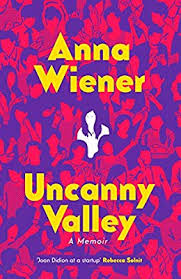
Uncanny Valley: a Memoir. Anna Wiener. Farrer, Straus and Giroux. New York, 2020.
I’ve been trawling through the world of memoir for several years now, with degrees of determination. I’ve written a lot about it in various posts on this blog. I have issues around “truth”, pretence and ethics. So many novels are memoirs in disguise. I love the sense of unvarnished, or at least only once coated, reality that comes with an honest-to-goodness memoir, as far as that can ever really exist. This feels like one. So unexpected, so immediate, so funny, so intelligent, so scary. Yes, sure, names have been changed … places disguised … the usual drill. But the feeling is real.
It’s strange how some books seem to get a buzz right away, you don’t know where it comes from or how it has reached you but there it is, and my favourite New York literary magazine says to click if you want a special deal so you click and a very short time later in the Blue Mountains near Sydney (late ravaged with fire, flood, storm, power and phone outages – we struggle to survive as if in some archaic era) you open a parcel and there is this book, so beautifully produced in pale blue hardback, a sensational cover with raised embossing, you can’t stop touching it, title and author’s name look as if they have been stuck on with labelling tape and you open it and you CANNOT PUT IT DOWN. (Note however there is a hardback edition with a truly horrible cover, don’t bother buying that one! See below)
This is even stranger when you realize what it is about. OK, it’s a memoir about a woman living her life today, right now, she is in her twenties and young and gorgeous, she should be having it all but it turns out her world is every bit as bizarre as the neo-Jurassic which seems to be enfolding us at an ever- increasing rate. And although you would think someone like me would have nothing in common with her, in fact she conveys so wonderfully what it is like to be in a world which itself does not exist, the same fantasmagoria I and thousands, millions, of others have been experiencing for some time and suspect might be one of the main reasons why everything is so decisively ****** up.
So she starts her story as a publishing assistant in New York, a familiar territory even if you have never been there. If you watch a lot of streaming TV you will recognize it from Younger, the show about an “old woman” of forty who tries to pass herself off as a groovy literary publishing assistant in her twenties. I loved that show, at least until it got unbearably soppy, but I love this book a lot more and it would make a far better TV series. Although turns out there is a TV series called Silicon Valley, but I haven’t seen it so don’t know how the two would compare. It was released in 2014, a comedy about a bunch of young guys who go into a tech start-up. Sound familiar?
She likes her New York publishing life just fine, but the writing (“ha-ha”) is on the wall, the wheels are coming off, and the entity she refers to as an online superstore is, by the early 2010s, destroying the existing publishing industry. She avoids ever mentioning a “brand name” throughout this book. I guess that’s to avoid being sued. But we know exactly who she is talking about. Anyway, like all humanist literary types she loathes the very thought of that entity as well as the anonymous other tech giants which have taken over our lives and expresses indignation about it to all her right-on friends like everyone in Australia still does. Meanwhile many of her former friends and schoolmates were making their first millions, hiring wealth advisers and taking out time-shares in Bali.
Something happened to her, mainly being broke. So, hopeful but ignorant, she joined a new e-book start-up based in a loft in NYC. With woefully little knowledge or experience, she became a “techie”. It didn’t work out. It was 2015. Various people told her to go to San Francisco, where she had friends. She didn’t know they too were struggling with the late-capitalist hellscape, rents were spiking, dating websites were flooded with business-management guides and heterosexual digital marketers shared their existential philosophies. Strangely, she was hired by a data-analytics start-up in a customer-support position even thought she had absolutely no background in data-analytics. The main reason they hired her seems to be that she read books, which none of them ever did
This is an auto-ethnography of start-up culture through the brilliant, funny, candid, intelligent gaze of a remarkable young woman. You don’t need to hear the whole story. Well, you do, but buy the book. You can get it on Kindle and in paperback from the US but this is one book I think is really worth buying in hard-back, it just feels so nice to touch and the print is lovely too. It’s what a book used to be. Try to find it in the original cover. The other cover, all red and purple squiggles, is unredeemably naff, which is what you get from the Amazon Australia site (see below).
Check out the various offers. Book Depository seems the best. Angus and Robertson for some unknown reason wants $47.75 for it. I will never understand the logic of book pricing in Australia these days or how it is that international publishing has reverted to an almost identical version of everything the tech revolution was supposed to disrupt. [‘Disruption’ is a big thing in Anna Wiener’s book, everything is supposed to be directed toward it, including camp-ground booking arrangements in US national parks].
This is a gripping tale of a young woman’s adventures in employment, twenty-first century style. It’s not just her story, it’s the story of a generation, of a cultural shift, of the tentacles of invisible industries we can hardly imagine spreading out across the cyberworld and dragging everything into their maw. Of a lifestyle with no people in it, or hardly any. A world where young women earn spectacular salaries and bonuses but spend an awful lot of their time drinking tequila shots and wondering about the current Insta algorithms.
Anna Wiener is a contributing writer for The New Yorker. She has also written for n+1, my favourite magazine, as well as The Atlantic. She still lives in San Francisco. I long to know what she is doing now. I hope she is writing more books. I don’t care if they are memoirs, biographies, essays, short stories. This is a voice so worth hearing and here is a writer engaging with what books can should and ought to be as she drags us with power and humour into the rest of this zany crazy probably insane and possibly terminal century.
PHOTO BELOW: The Author, Anna Wiener. (A google search for my website may make it look like this is me, Annette Hamilton, but it definitely is not, although I wish I shared her lovely deep sad gaze and dark hair).
NOTE: The image used as the banner of this post is a Wikipedia photograph of Silicone Valley.
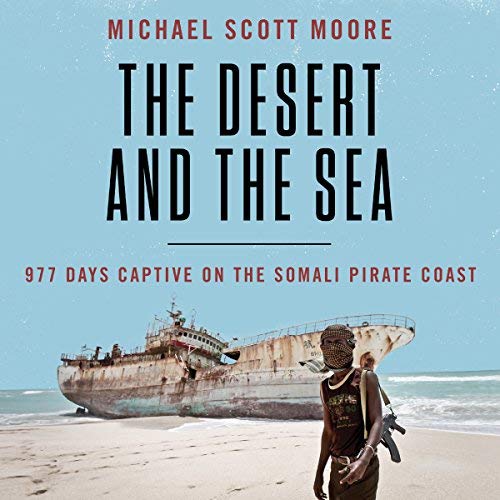
German/American journalist and writer Michael Scott Moore had authored a novel and a history of surfing, Sweetness and Blood, when he received a grant from the Pulitzer Center for Crisis Reporting to carry out research for a book on Somali piracy in late 2011.
Somali Pirates use bizarrely wrecked boats
This is the kind of thing even a truly daft anthropologist wouldn’t try, but he seems to have had an even greater degree of belief in his own invulnerability.
Since Somali pirates are famous for capturing Westerners and holding them for ransom it is hardly surprising that it happened to him. He got there around November and was abducted in January 2012. The pirates posted video clips which you can still find on Youtube. He was kept in isolation, virtually blind without his contact-lenses, half-starved and increasingly desperate.
The pirates said if the ransom wasn’t paid
he would be sold to Al-Shabab. Nobody could come up with the $20 million they
wanted, not even his mother, his only
real advocate and supporter. They settled in the end for $1.6 million and to
his own amazement he was released.
Not surprisingly he wrote a memoir about his experience. The English version, The Desert and the Sea, published in July 2018, became a Nielsen best-seller.
It has just been published in German as Wir Werden Dich Toten: 977 Tage in der Hand von Piraten (“We Will Kill You: 977 Days Held by Pirates”). Scott Moore lives in Berlin and holds dual US/German citizenship. I caught his interview on Deutsche Welle in February 2019 where he appears incredibly normal and unaffected – cool, calm, handsome, unlined, slightly grey, smiling.
Scott Moore interview
In the first months he believed that the ransom would be paid. As time passed he realized this was not going to happen. He was deeply scarred by the ordeal, which dragged on and on, as he was held sometimes on land and sometimes at sea on a beaten-up tuna boat along with other unfortunate captives mostly impoverished fishermen.
I liked his views on hope. We are always
being told to stay hopeful, that hope is a positive and beneficial state of
mind. Scott Moore concluded otherwise. As
things unfolded his early optimism was destructive, making everything later
more terrible.
Writing his book made him feel much much
better. He was able to stand back and understand himself as an object. One
might say he was able to observe himself as a participant. He didn’t experience Stockholm Syndrome, where
captives come to identify with their captors. Nevertheless he had to forgive
them which is another thing we are always being told to do to have a happier
life. He finished up running a yoga class for selected pirates and yes, he’s
originally from California.
Captivity memoirs can have a strange
effect. We are invited to identify with the captive, to share an unbearable
experience where everything a person has known and been suddenly is taken away
and turned upside down, where their comfortable former existence is overthrown.
But you have to ask why the writer or journalist or researcher deliberately
goes into such danger. Is it his/her own deluded sense of self? It’s not quite
the same as someone kidnapped and imprisoned for political reasons, say, or as part
of some psychopath’s personal fantasy.
But in another way, everybody’s life can at
times feel like sudden (or slowly developing) captivity. How much memoir-writing is really therapy?
All of it? The more I have been reading, thinking about and writing memoirs,
the more the link between writing and trauma has come into focus. Maybe if
writing is an attempt at trauma recovery it explains why it’s so damned
difficult.
Mostly older people write memoirs. Apart
from politicians and a few captains of industry there aren’t that many of them,
and I am beginning to see why. If life itself is a traumatic experience,
beginning full of hope and happy expectation but declining into failure and disappointment
as the end looms, writing about it may only make you feel even more sorry for
yourself. No wonder young people prefer
fantasy and adventure.
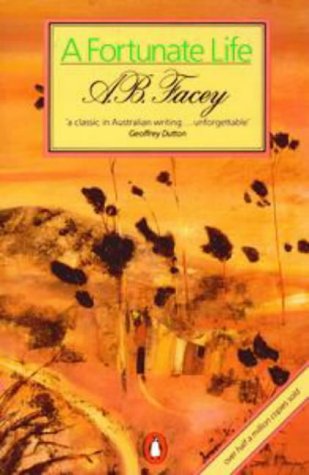
On the other hand, I recall reading Bert
Facey’s recollection, AFortunate Life, published in 1981 when
he was 86. It has been a best-seller in Australian writing, with almost a
million copies sold. His early life was traumatic beyond any contemporary
imagining, but he came out of it with nothing but gratitude and peace and wrote
a wonderful book. A great role model, almost completely forgotten today. That’s
a memoir to remember!
For reasons only a psychoanalyst could clearly state, I don’t seem able to get this book finished. I have promised to send it out to the family members who are mentioned in it for their comments and permission to use their real names. I have asked the designer to stand by to do the covers. I have promised myself it is #1 on the priorities list. But no matter what I do I just can’t get it to a point where I can send it out.
The biggest issue has been endlessly rewriting the first chapter. I realise this is because I don’t really know what I want to project in this so-important introductory bit. I have been struggling between two positions: a kind of grovelling excuse-seeking for having been such a dreadful mother and partner and sister and daughter (and probably everything else) all my life and not having realised it, and the desire to say look here, you guys, I was doing my best! I came from another era! I had a miserable confused childhood just like everybody else who was born close to World War 2! And I think I worked incredibly hard and tried everything to keep the show on the road. If it didn’t turn out so well for you all, I am sorry, but I can’t go to my afterlife taking all the blame! I couldn’t be a perfect person. What a surprise! But I guess I am still regretting that.
If my emotions throughout 2018 seemed unstable, the beginning of 2019 has been even worse. Maybe writing a memoir was not the best idea, under the circumstances. A part of me wants to just forget about it right now, today, put the project aside and go back to painting my landscapes and writing about art. Of course none of it makes the slightest bit of difference and it is dawning on me that nobody, I mean nobody, cares in the least what I write or don’t write. It is, to follow my perpetual aqua-marine metaphorical inclination, all just water under the bridge. Or to quote my recent favourite ballad:
And instead of being someone with the world to win I’m just driftwood on the river of regret.
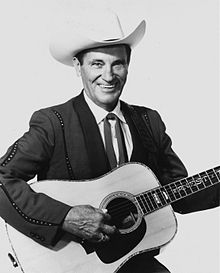
This is from a song sung by Ernest Tubb in 1959. The original version is on Youtube here – I think I worked out how to embed a song in a post – always something new to learn!
As this song seems so completely apposite to my memoir I set about finding out how to get permission to use these two lines as opening quote in Regret Horizon. What a fascinating business this copyright stuff is. I will write a post about it when I have an outcome.
Meanwhile I’ll just keep on drifting with Ernest Tubb and try to take the deeper philosophical meanings on board.
So my memoir of the year my mother and my ex-husband died is almost finished. Procrastinating about sending it out to the family and trying to do the final edits. Every time I open the file I find myself making changes, not just a few, but a lot. I still don’t feel clear about it. And the question of the title has been holding things up. From the start, the working title was A Dying Year. Feedback? Oh, that sounds so sad/distressing/upsetting. And who is dying? Is it you? Is this yet another PityParty by someone on the way out? No, no, not that! Well, what then?
So it got a new title, and a new slant, because I realised by the time I had finished the penultimate draft that my main feeling about everything was my awfulness, and how much I still don’t understand, and how much I feel regret for what I had done and not done in those last few months.
Somehow water, rivers and seas, threaded through everything I felt throughout the process of writing this book. So when I found Jordan Cantelo’s wonderful photograph, “Ocean Horizon”, it spoke to me profoundly. Jordan gave me permission to use it for the cover, and asked for no payment, which was truly generous of him. I love his work. I will write something more about it later.






 Annette Hamilton - Writer