Pabulum in Literary Critique

PABULUM FOR THE PEOPLE: FEUILLETON Dec 2024

A lovely comment from Andrew Blackman on my Feuilleton musings came in this week. Andrew is a literary fiction writer and blogger, a highly engaging homme de lettres, check out his reading roundup for 2024 (Andrewblackman.net).

Andrew used the word pabulum, which describes so much of what passes for literary and cultural commentary today. My brain cells lit up in that mysterious region wherever spelling is stored (what a weird cupboard of miscellanies that must be) delivering one of those sudden jolts where one thinks one has made a damnable spelling error. Hadn’t I called it “pablum”? Which was it? Google’s AI overview was unequivocal. “The correct spelling is pablum” it said.

Turns out there is a history. In the US it’s pablum, in Britain it’s pabulum, which was originally Latin for “food” or “fodder”. It was first used in English in the 17th century.

Pabulum did not always have a negative connotation. In botany it can still be used to describe nutrients in a state suitable for absorption by plants. In religious circles it describes material appropriate for presentation in a sermon. But in common contemporary usage it is something offered for consumption which is simplistic, bland, or insipid, intended to offend no one.

Herman Hesse, in his scathing assessment of the Feiulleton, probably was unaware of the product. Horkheimer and Adorno, those early titans of cultural critique, would probably have known it, but maybe the modern connotation had not yet developed. It certainly would have suited their views on the culture industry. “The consumers are the workers and employees, the farmers and lower middle class. Capitalist production so confined them, body and soul, that they fall helpless victims to what is offered to them”. [Theodor Adorno and Max Horkheimer, Dialectic of Enlightenment, New York, Continuum, 1994 p. 142.*

A Feulleton about the spelling and meaning of Pablum or Pabulum; and an accompanying cocktail recipe

I was intrigued by the idea that what was once a useful descriptor for a valuable aspect of nutrition had been downgraded to a neat way of  passing scathing remarks about other people’s cultural production and consumption. So what was pablum’s story?

 If you start with Youtube’s definition, you won’t be much the wiser. The instant AI translation that appears in the black box is particularly confusing since it spells the word “Babylon”. I don’t think this has anything to do with reggae culture but it’s a serendipitous fit since “Babylon” is the term for western capitalist culture in Jamaica. Pab(u)lum is Babylon’s product, so to speak.

Further exploration revealed that the common US spelling for the word arose from the name of a pre-cooked and fortified baby cereal developed in the late 1920s by three Canadian paediatricians. PABLUM was designed to combat nutritional deficiencies, particularly rickets, in children, and contained a great array of very good things. These included wheat meal, oatmeal, cornmeal, bone meal, dried brewers’ yeast, powdered alfalfa leaf, and iron. It was one of the first commercial uses of additives to support human nutrition in manufactured foods. Babies needed this food because their diets were so appallingly limited in eras of food shortage notably during the Depression.

Horkheimer and Adorno were writing at a time when Pablum was well-established in the US market, but perhaps they weren’t all that familiar with baby food.

The negative connotations arose from the fact that the cereal was pre-cooked and easy to digest. From that point of view, then, the Feuilleton might indeed be usefully described as “pab(u)lum”: it contains plenty of valuable stuff, but in a simple form suitable for the unsophisticated. Is that necessarily a bad thing?

*(The book was first published as Philosophische Fragmente in New York in 1944, by the Institute for Social Research. A revised version was published as Dialektik der Aufklärung in Amsterdam by Querido in 1947).

COCKTAIL OF THE POST:

In the process of thinking about how to use the Feuilleton as a means of offering digressions on the theme of contemporary culture, I decided that each Feuilleton deserved its own cocktail. I will be writing more on the cocktail shortly. However to launch the series I offer here this recommendation:

Malted Brandy Alexander:

Everyone knows that brandy is good for you. When I was growing up there was always a bottle of brandy in the house: it was called “medicinal” and people certainly felt better when they drank it. I was a very sickly baby and my father attributes my survival to the several drops of brandy he added to the goat’s milk on which I subsisted for many months of my early life.

Malt, and malt products, likewise are well known for their health benefits. Exactly what these are is not scientifically proven, but there are no doubt very valuable vitamins and minerals in malt, being derived from malted barley, a whole grain with natural enzymes. There are various malt products suitable for this cocktail. Thick malt syrup can be drizzled over the cream, or a product such as Ovaltine can be dusted over the tip instead of, or along with, the grated nutmeg. This will give a crunchy quality to the drink which is not to everyone’s taste.

One of the earliest known printed recipes for the Alexander can be found in Hugo Ensslin’s 1916 book Recipes for Mixed Drinks. The cocktail, according to historian Barry Popik, was likely born at Hotel Rector, New York City’s premier pre-Prohibition lobster palace. The bartender there, a certain Troy Alexander, created his eponymous concoction in order to serve a white drink at a dinner celebrating Phoebe Snow. [for more information, see https://www.liquor.com/recipes/brandy-alexander/]

The cocktail graces several well-known novels of an earlier era. In Evelyn Waugh’s Brideshead Revisited (1945) Anthony Blanche, an eccentric decadent friend of Captain Charles Ryder was at the George Bar, where he ordered ‘Four Alexandra [sic] cocktails please,’ ranged them before him with a loud “Yum-yum’ which drew every eye, outraged, upon him. ‘I expect you would prefer sherry, but, my dear Charles, you are not going to have sherry. Isn’t this a delicious concoction? You don’t like it? Then, I will drink it for you. One, two, three, four, down the red lane they go. How the students stare!’…

Poor-man’s Brandy Alexander, such as my father sometimes served to my mother on a special occasion, was made with the usual brandy we had in the back of the cupboard for medicinal purposes. Once he made it with Nestle’s Condensed Milk instead of cream, which was a bit sweet, but interesting.

The use of a decent cognac lifts this recipe to great heights.

This recipe for Brandy Alexander (without the fortifications) was originally published on Liquor.com in 2011.

Ingredients

  • 1 1/2 ounces cognac
  • 1 ounce dark creme de cacao
  • 1 ounce cream
  • Garnish: grated nutmeg

Steps

  1. Add cognac, dark creme de cacao and cream into a shaker with ice and shake until well-chilled.
  2. Strain into a chilled cocktail glass or a coupe glass.
  3. Garnish with freshly grated nutmeg.

FOR THE FORTIFIED PABLUM SPECIAL VERSION, drizzle one or two teaspoonsful of malt extract over the top of the cream before sprinkling with nutmeg and/or Ovaltine. Slightly heating the malt extract will make it more liquid. To compensate, ensure the cream is very cold. To really ramp up the nutritional benefits, top the drink with a scoop of  quality ice cream.

Understanding the Feuilleton: A Reflection on Modern Culture

INTRODUCING THE FEIULLETON

Literary Journalism In Fin-De-Siècle Vienna

(From International Association of Literary Journalism Studies)

As mentioned I have been thinking about inserting the odd Feuilleton here, mainly because I keep finding myself contemplating some strange or remarkable facet of contemporary culture and society which defies inclusion into any other kind of writing I do. By calling it a Feuilleton I hope to indicate that it is a passing phenomenon not of any great social or political importance in itself, although I may be flirting with the Zeitgeist or capturing the temper of the times. My Feuilletons are not about literary culture or contemporary writing or the Kindle or the role of reviewers in the Internet age. But they are not entirely frivolous or meaningless either.

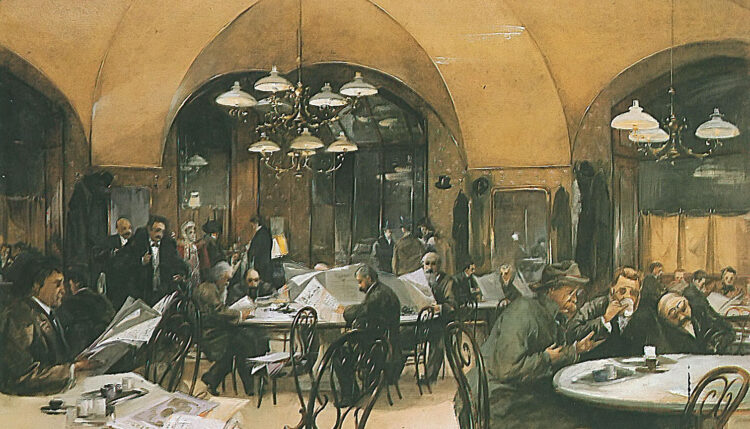
The term Feuilleton comes from French and means something like “little leaf”. Originally it was a small item at the bottom of the literary section of a newspaper, often providing a critique of popular theatre, but in many cases it grew to have its own page. By the 1840s the term roman-feuilleton described a serialized novel published in newspapers, something like today’s internet novelizations, but paid for, not for free. I mean the readers bought the newspapers and the newspapers paid the writers. [Now we barely have newspapers and people publish their writing for free all the time, which seems counterproductive]. The term was used in English by 1845, in the Atheneum.

The term was also handy to refer to small one-page advertisements, like handbills, which might be handed out in the street to encourage consumers to visit suppliers, as in this advertisement for a delicious lunch venue the like of which sadly no longer exists.

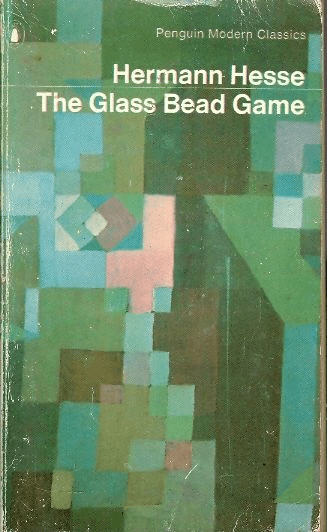
If that all sounds cheery and familiar, we must pause at what Hermann Hesse had to say about it in The Glass Bead Game, regarded as the first and only science fiction novel to win the Nobel Prize (in 1946). He was writing against the decline of humanistic culture brought about by “feuilletonism”, which he saw as the antithesis to true writing, and lampooned viciously. His master-work, The Glass Bead Game, was on the Must-Read list of myself along with almost every other proto-boho-intello in the 1960s, and describes the life of future intellectuals living in a cloistered community trying to circumvent the excesses of the age. Thanks to Huxley for bringing the Feuilleton into the present time as another object of knowledge. (https://huxley.media/en/the-feuilleton-era-we-live-in/)

Hesse described the Feuilleton, printed widely in newspapers and magazines, as a source of “mental pabulum” for readers hoping to soak up culture but unable to actually do so due to the lack of education and motivation, and of course  being too busy and far too important to sit down and read actual books.

He said:

Among the favorite subjects of such essays were anecdotes taken from the lives or correspondence of famous men and women. They bore such titles as «Friedrich Nietzsche and Women’s Fashions of 1870,« or «The Composer Rossini’s Favorite Dishes», or «The Role of the Lapdog in the Lives of Great Courtesans» and so on.

Another popular type of article was the historical background piece on what was currently being talked about among the well-to-do, such as «The Dream of Creating Gold Through the Centuries» or «Physico-chemical Experiments in Influencing the Weather» and hundreds of similar subjects… we feel surprise that there should have been people who devoured such chitchat for their daily reading; but what astonishes us far more is that authors of repute and of decent education should have helped to «service» this gigantic consumption of empty whimsies. Significantly, «service» was the expression used; it was also the word denoting the relationship of man to the machine at that time.”

Good heavens! This is exactly the flavour of the endless parade of pablum from our own Machine, the Internet, much of which we now call “clickbait”.  But Feuilletonism goes so much deeper than trying to persuade people to buy stuff they don’t need from people they don’t know manufactured by unspecifiable techniques at places which don’t exist. The Age of the Feuilleton is completely dominant today, ever more so with the consequences of AI development and universal internet access on every phone – the mastery of the Machine indeed.

I don’t see my contributions to the Age of the Feuilleton as necessarily despicable, as Hesse might have done.  By proposing to include a few remarks under the heading of a Feuilleton, I am going with the diverse flow of contemporary knowledges, and playing a little with the scary bizarritude of the fragments flowing through the ever-open channels of our time. It is true that there may be an academic flavour to the analysis, but maybe that is a necessary correlate of talking about anything in modern culture at all, rather than just participating in it. And a rich and full array it is.

So in my occasional Feuilleton I will remark on various ephemeral incidences, moments or events, usually conveyed in media, sometimes in performance. I notice things as I trawl through my reading and writing. Someone, generally much younger than myself, draws my attention to something I have never thought of before, and didn’t know existed. Or I am struck by some change in the discourse and behaviour in the everyday world around me. Often these moments are so peculiar in flavour and signification that I am reminded of my old father’s frequent exclamation: “Well blimey, you just wouldn’t read about it”. Now, these days, it turns out he was plain wrong. We can read about it, and moreover see it, all the time, every hour of every day. By adding a little more to it I hope to do no harm. I will identify those pieces which belong in the Feuilleton category, so you can skip over them altogether if you like.

Check out Stoddard Martin’s essays, with insights from the old and new literatures of several countries – aesthetics, musicology, mythology, philosophy, poetry, politics, and psychology.

Monstrous Century: Essays in ‘the Age of the Feuilleton’ Paperback – October 15, 2016

by Stoddard (Chip) Martin 

Insights from the old and new literatures of several countries jostle for space in this work – not to mention aesthetics, musicology, mythology, philosophy, poetry, politics, and psychology. The subjects, even when unsympathetic in themselves, are viewed in the round, and judged with humanity (from the publisher’s blurb).

«THE GLASS BEAD GAME». FRAGMENT FROM THE WORK

«We must confess that we cannot provide an unequivocal definition of those products from which the age takes its name, the feuilletons. They seem to have formed an uncommonly popular section of the daily newspapers, were produced by the millions, and were a major source of mental pabulum for the reader in want of culture. They reported on, or rather «chatted» about, a thousand-and-one items of knowledge. It would seem, moreover, that the cleverer among the writers of them poked fun at their own work. Ziegenhalss, at any rate, contends that many such pieces are so incomprehensible that they can only be viewed as self-persiflage on the part of the authors.”

SUBSTACK OR FEUILLETON?

Remember back in digital prehistory when Facebook was first a Good Thing? You had “friends” and you could post stuff and they could see it and vice-versa, and as I recall it lasted on your feed for longer than five minutes. It was great for groups interested in the same subject, yes, but it was also great for whatever circles of people you were connected to or inserted in. I don’t know exactly when that changed but now, apart from a couple of still-effective writers groups and one or two painting sites, most of the time all I seem to get is ads for bunion treatments and dodgy looking products introduced by persons in white coats who drone on at length about one of the many infirmities you share. Of all my “friends”, most of whom were actual real people who I knew, and/or relatives, I hear little or nothing. Maybe they have defriended me. I know some of the relatives did. Or maybe they just don’t use Facebook any more.

So when I began to hear about Substack I thought well maybe this was a good way to keep in touch with people you knew, or would like to know, or who knew you, and I imagined lively discussion groups focussing on the usual weird stuff I enjoy thinking about but find it hard to share in the normal run of things lined up at the supermarket or chatting to some bored relative, if you can still find one willing to talk on the phone (therefore must be over 60). So I joined up and only later realised that the primary intention is to get people to pay money to read whatever the writer is wittering on about. Perhaps I haven’t gone into it enough, and perhaps I am not sufficiently committed to supporting the writing of others, but I really can’t see paying regular monthly subscriptions for the privilege. I know this shouldn’t have anything to do with television or streaming services but I can’t help reflecting that I already have to pay dollars and dollars to access Netflix, Stan, Binge etc. and they are seemingly limitless. And the Substack feeds seem limitless but all the same somehow. While I sympathise with the writers for wanting to be paid, I can’t help thinking there is a more important need for places to talk to each other. Sadly, Substack is not it.

Although I mistakenly signed up for two different Substacks with two different email addresses, I am now trying to cancel them. I didn’t sign up to any paid subscriptions so that’s good. But I did want to write things people might read, outside the strict limits of what this blog and site are about, so I thought I would make up my own little Substack thingie and call it a FEUILLETON and put it in my regular POSTS every once in a while. And it will of course be absolutely free to anyone who goes to this website. I haven’t set up a Newsletter so maybe this will do.

The next post will give more on the history and context of the FEUILLETON. Introduced into popular cultural circuits via Herman Hesse’s book The Glass Bead Game, very influential among proto-intellos in the 1950s and 60s, it turns out to be a very powerful way to think about the effects of contemporary information circuits. More soon.

He’s a miserable looking fellow, unfortunately. Likewise so many of those serious Germanic thinkers. But they do seem to dominate the philosophy of the last century.

Hermann Hesse, 1877-1962

I like to think of that Monty Python sketch where they are all playing football.

https://en.wikipedia.org/wiki/The_Philosophers%27_Football_Match

Watch the match here: https://www.youtube.com/watch?v=8KX-ZFfCn6s