Dear Readers, this is just a quick note to let you know that if you looked me up on Google you very likely came across a compelling photo of a stunning women with a penetrating, somewhat sad gaze. As the text below it says “Annette Hamilton” you may have been misled into thinking either that I was committing a very heinous sin of disguise, presenting my persona in an entirely misleading way, or that somehow I had undertaken a full head and neck transplant which as far as I know even Drs Dubrow and Nassif could not manage (if you are a fan of Botched you will know who I am talking about).
No, this is a photo of writer Anna Wiener (37) author of Uncanny Valley, a book I strongly recommended in a post in March 2020 (see Posts).
I still recommend her book as a wonderful example of auto-ethnography, but with everything that has happened in the US over the past 4-5 years it can’t help being a bit past-the-moment. She now writes for the New Yorker as a tech correspondent – her latest pieces are “On video game engines” for The New York) and “On office memoirs” for The New Yorker. The photo above comes from her website.
There are plenty of photos of Annette Hamilton on this site and I think you’ll agree there is no mistaking the two.
As a possibly irrelevant aside, you may come across reference to an Annette Weiner (note different spelling). Annette and I did in fact share a number of elements of personal experience which would make this mistaken identity far more cogent.
Annette Weiner, former Dean of the Faculty of Arts, NYU
Annette Weiner was an outstanding and well-known anthropologist; born 1933 in Philadelphia, she died in 1997 in Greenwich Village, of cancer, at the age of 64. She had an extraordinary career, as Kriser Distinguished Professor of Anthropology, chair of the department and dean of the Graduate School of Arts and Sciences at New York University. She wrote a dissertation on the contribution of women to the economy of Trobriand society.
Annette Weiner was a very generous, kind and fun-loving soul who allowed me to stay in her New York apartment on several occasions. We also met up in Paris, but things did not go well between us there and our friendship collapsed under the weight mainly of my bad behaviour. But, as they say, that’s another story! Perhaps to be told in an upcoming auto-fictional memoir, Paris Vertigo, although that’s not on the immediate writing horizon. I have always regretted what happened between us, although it was probably inevitable. How much of “the truth” I can tell in that book remains to be seen. But please do not mistake me for Annette Weiner either!
(From International Association of Literary Journalism Studies)
As mentioned I have been thinking about inserting the odd Feuilleton here, mainly because I keep finding myself contemplating some strange or remarkable facet of contemporary culture and society which defies inclusion into any other kind of writing I do. By calling it a Feuilleton I hope to indicate that it is a passing phenomenon not of any great social or political importance in itself, although I may be flirting with the Zeitgeist or capturing the temper of the times. My Feuilletons are not about literary culture or contemporary writing or the Kindle or the role of reviewers in the Internet age. But they are not entirely frivolous or meaningless either.
The term Feuilleton comes from French and means something like “little leaf”. Originally it was a small item at the bottom of the literary section of a newspaper, often providing a critique of popular theatre, but in many cases it grew to have its own page. By the 1840s the term roman-feuilleton described a serialized novel published in newspapers, something like today’s internet novelizations, but paid for, not for free. I mean the readers bought the newspapers and the newspapers paid the writers. [Now we barely have newspapers and people publish their writing for free all the time, which seems counterproductive]. The term was used in English by 1845, in the Atheneum.
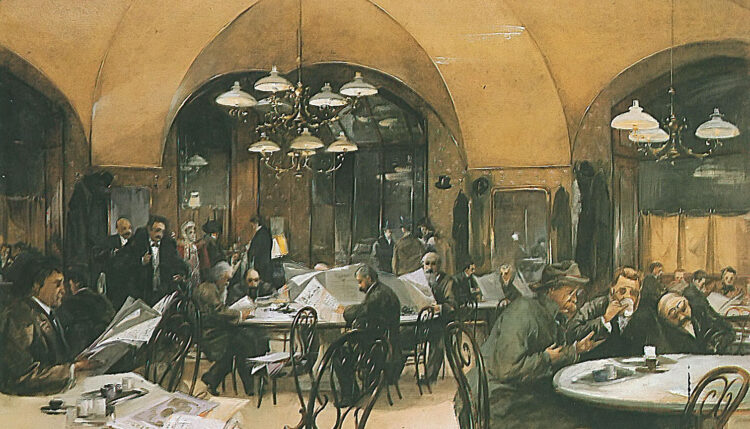
The term was also handy to refer to small one-page advertisements, like handbills, which might be handed out in the street to encourage consumers to visit suppliers, as in this advertisement for a delicious lunch venue the like of which sadly no longer exists.
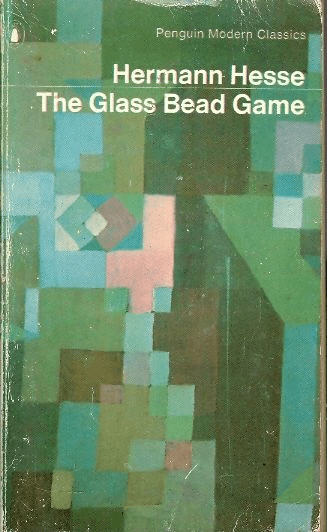
If that all sounds cheery and familiar, we must pause at what Hermann Hesse had to say about it in The Glass Bead Game, regarded as the first and only science fiction novel to win the Nobel Prize (in 1946). He was writing against the decline of humanistic culture brought about by “feuilletonism”, which he saw as the antithesis to true writing, and lampooned viciously. His master-work, The Glass Bead Game, was on the Must-Read list of myself along with almost every other proto-boho-intello in the 1960s, and describes the life of future intellectuals living in a cloistered community trying to circumvent the excesses of the age. Thanks to Huxley for bringing the Feuilleton into the present time as another object of knowledge. (https://huxley.media/en/the-feuilleton-era-we-live-in/)
Hesse described the Feuilleton, printed widely in newspapers and magazines, as a source of “mental pabulum” for readers hoping to soak up culture but unable to actually do so due to the lack of education and motivation, and of course being too busy and far too important to sit down and read actual books.
He said:
Among the favorite subjects of such essays were anecdotes taken from the lives or correspondence of famous men and women. They bore such titles as «Friedrich Nietzsche and Women’s Fashions of 1870,« or «The Composer Rossini’s Favorite Dishes», or «The Role of the Lapdog in the Lives of Great Courtesans» and so on.
Another popular type of article was the historical background piece on what was currently being talked about among the well-to-do, such as «The Dream of Creating Gold Through the Centuries» or «Physico-chemical Experiments in Influencing the Weather» and hundreds of similar subjects… we feel surprise that there should have been people who devoured such chitchat for their daily reading; but what astonishes us far more is that authors of repute and of decent education should have helped to «service» this gigantic consumption of empty whimsies. Significantly, «service» was the expression used; it was also the word denoting the relationship of man to the machine at that time.”
Good heavens! This is exactly the flavour of the endless parade of pablum from our own Machine, the Internet, much of which we now call “clickbait”. But Feuilletonism goes so much deeper than trying to persuade people to buy stuff they don’t need from people they don’t know manufactured by unspecifiable techniques at places which don’t exist. The Age of the Feuilleton is completely dominant today, ever more so with the consequences of AI development and universal internet access on every phone – the mastery of the Machine indeed.
I don’t see my contributions to the Age of the Feuilleton as necessarily despicable, as Hesse might have done. By proposing to include a few remarks under the heading of a Feuilleton, I am going with the diverse flow of contemporary knowledges, and playing a little with the scary bizarritude of the fragments flowing through the ever-open channels of our time. It is true that there may be an academic flavour to the analysis, but maybe that is a necessary correlate of talking about anything in modern culture at all, rather than just participating in it. And a rich and full array it is.
So in my occasional Feuilleton I will remark on various ephemeral incidences, moments or events, usually conveyed in media, sometimes in performance. I notice things as I trawl through my reading and writing. Someone, generally much younger than myself, draws my attention to something I have never thought of before, and didn’t know existed. Or I am struck by some change in the discourse and behaviour in the everyday world around me. Often these moments are so peculiar in flavour and signification that I am reminded of my old father’s frequent exclamation: “Well blimey, you just wouldn’t read about it”. Now, these days, it turns out he was plain wrong. We can read about it, and moreover see it, all the time, every hour of every day. By adding a little more to it I hope to do no harm. I will identify those pieces which belong in the Feuilleton category, so you can skip over them altogether if you like.
Check out Stoddard Martin’s essays, with insights from the old and new literatures of several countries – aesthetics, musicology, mythology, philosophy, poetry, politics, and psychology.
Monstrous Century: Essays in ‘the Age of the Feuilleton’ Paperback – October 15, 2016
Insights from the old and new literatures of several countries jostle for space in this work – not to mention aesthetics, musicology, mythology, philosophy, poetry, politics, and psychology. The subjects, even when unsympathetic in themselves, are viewed in the round, and judged with humanity (from the publisher’s blurb).
«THE GLASS BEAD GAME». FRAGMENT FROM THE WORK
«We must confess that we cannot provide an unequivocal definition of those products from which the age takes its name, the feuilletons. They seem to have formed an uncommonly popular section of the daily newspapers, were produced by the millions, and were a major source of mental pabulum for the reader in want of culture. They reported on, or rather «chatted» about, a thousand-and-one items of knowledge. It would seem, moreover, that the cleverer among the writers of them poked fun at their own work. Ziegenhalss, at any rate, contends that many such pieces are so incomprehensible that they can only be viewed as self-persiflage on the part of the authors.”
In my previous post I raised the question of the apparently miserable visages of great German writers/thinkers/philosophers. When is a writer a philosopher, and vice-versa? I think of both Hermann Hesse and G. W. Sebald as philosophers. They are more often described as “novelists”. There’s something so wrong with these genre-based descriptions.
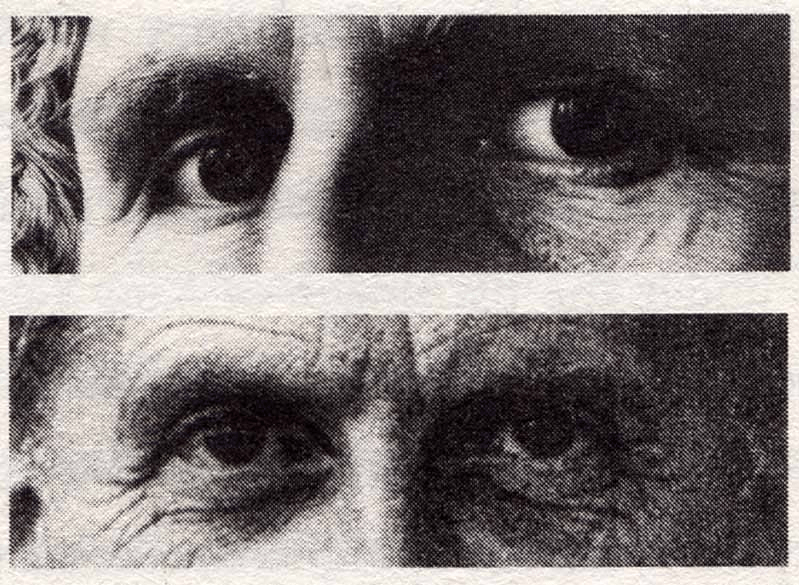
In any case, thinking of philosopher’s faces reminded me of the question of Wittgenstein, more particularly his eyes. I hasten to add that Wittgenstein is Austrian, not German, by birth but whether that makes a difference or not is too much to consider here. My fascination with Wittgenstein’s eyes arose originally from those mystifying photographs in G. W. Sebald’s book Austerlitz.
Sebald’s book resurfaced throughout my writing Regret Horizon, which is now finished but not really ready – like so many of my books. One of its main chapters is titled “Austerlitz”, where I try to connect the dots of history, memory, family, loss, fiction, past and present.
I need to go back to Wittgenstein’s eyes before finalising my chapter.
Was I looking at Wittgenstein, or was he looking at me? And what to make of the non-human eyes in that sequence of images? Is that a key to the relationship between writer and reader? I am trying to traverse these ideas in my memoir, clumsily and faintly. That’s why the book probably needs to be rewritten again, and again.
If you fancy dense academic critical commentary, there’s a great paper published a while ago about aspects of this topic.
Nina Pelikan Strauss. “Sebald, Wittgenstein and the Ethics of Memory.” Comparative Literature, vol 61, No 1, Winter 2009.
“Austerlitz’s narrator insists on his hero’s ‘personal similarity to Ludwig Wittgenstein,’ noting the ‘horror-stricken expressions on both their faces'”.
Remember back in digital prehistory when Facebook was first a Good Thing? You had “friends” and you could post stuff and they could see it and vice-versa, and as I recall it lasted on your feed for longer than five minutes. It was great for groups interested in the same subject, yes, but it was also great for whatever circles of people you were connected to or inserted in. I don’t know exactly when that changed but now, apart from a couple of still-effective writers groups and one or two painting sites, most of the time all I seem to get is ads for bunion treatments and dodgy looking products introduced by persons in white coats who drone on at length about one of the many infirmities you share. Of all my “friends”, most of whom were actual real people who I knew, and/or relatives, I hear little or nothing. Maybe they have defriended me. I know some of the relatives did. Or maybe they just don’t use Facebook any more.
So when I began to hear about Substack I thought well maybe this was a good way to keep in touch with people you knew, or would like to know, or who knew you, and I imagined lively discussion groups focussing on the usual weird stuff I enjoy thinking about but find it hard to share in the normal run of things lined up at the supermarket or chatting to some bored relative, if you can still find one willing to talk on the phone (therefore must be over 60). So I joined up and only later realised that the primary intention is to get people to pay money to read whatever the writer is wittering on about. Perhaps I haven’t gone into it enough, and perhaps I am not sufficiently committed to supporting the writing of others, but I really can’t see paying regular monthly subscriptions for the privilege. I know this shouldn’t have anything to do with television or streaming services but I can’t help reflecting that I already have to pay dollars and dollars to access Netflix, Stan, Binge etc. and they are seemingly limitless. And the Substack feeds seem limitless but all the same somehow. While I sympathise with the writers for wanting to be paid, I can’t help thinking there is a more important need for places to talk to each other. Sadly, Substack is not it.
Although I mistakenly signed up for two different Substacks with two different email addresses, I am now trying to cancel them. I didn’t sign up to any paid subscriptions so that’s good. But I did want to write things people might read, outside the strict limits of what this blog and site are about, so I thought I would make up my own little Substack thingie and call it a FEUILLETON and put it in my regular POSTS every once in a while. And it will of course be absolutely free to anyone who goes to this website. I haven’t set up a Newsletter so maybe this will do.
The next post will give more on the history and context of the FEUILLETON. Introduced into popular cultural circuits via Herman Hesse’s book The Glass Bead Game, very influential among proto-intellos in the 1950s and 60s, it turns out to be a very powerful way to think about the effects of contemporary information circuits. More soon.
He’s a miserable looking fellow, unfortunately. Likewise so many of those serious Germanic thinkers. But they do seem to dominate the philosophy of the last century.
Hermann Hesse, 1877-1962
I like to think of that Monty Python sketch where they are all playing football.
I have reached a point in my writing and publishing activities where I must seriously ask: why publish at all? I haven’t published much yet but I have a lot of plans and proposals in the mix and several are at the point of fulfilment. Various things have held me up – some in the “real world” but others in that weird interior zone where the writer actually feels most alive but also most threatened and alarmed and fearful and excited, something which I suspect only other similarly benighted souls will understand. There really should be psychiatric services for writers, to help them work out what they are doing and why.
But as time passes, and especially with the impact of AI, the question becomes more acute than ever. There are 32.8 million published titles on Amazon now and more every day. It is possible that AI written books are flooding the market, although there seems to be no way to work out if this is true or not. Amazon now will only allow you to publish something like THREE BOOKS A DAY. Can this be true? Nobody can write three books a day. However the various online writers forums I participate in do seem to have members who think nothing of writing a book in two or three or four weeks: that is from start to finish, including editing, proofreading and maybe designing the covers as well. The fans of these writers are passionate and apparently faithful. They expect the writer’s new books ASAP and pre-order slavishly, or so it seems.
THE DASH AND DOLLY EFFECT
I just finished watching a mystery drama mini-series on Netflix, The Perfect Couple, starring Nicole Kidman as a popular writer, Greer Garrison Winbury, whose books are about the endless romance of Dash and Dolly. The readers imagine these are the writer herself and her husband Tag, played by Liev Schreiber, who in real life is alcoholic, louche, unfaithful and most unattractive. Based on a 2018 novel of the same name by Elin Hildebrand, the story is about the interpenetration of fictional and real life, and its negotiation in contemporary culture. [It’s what my favourite analytic writer of the moment, Hans-Joachim Maaz calls “Die Falsche Leben” – FALSE LIFE. If you speak German there are interviews with him on Youtube: https://www.youtube.com/watch?v=KN6i6MYBbjI but only one of his books has been published in English.]
A brilliantly disturbing scene takes place at the launch of Greer’s 32nd novel in the series, when the “real world” life of Dash and Dolly comes to a crashing end in a bookstore full of passionate fans. As the truth of their relationship emerges – and a horrible truth it is – the fans fall into despair and horror, worse than anything they ever imagined. The scenario of this story emerges from the very peculiar intersection right now between writers and readers, amidst the technical possibilities of rapid production where fictions drawn out into endless series of almost identical stories, become the source of recognition and success for glamorous lady writers in particular, and sites of identity for readers obviously deprived of whatever it is they crave in the way of success, love, happiness and recognition. Readers’ identification with fictional characters is at the heart of this process.
WHY DON’T I WANT TO WRITE BOOKS ABOUT DASH AND DOLLY?
It’s called “writing to market” in online writing circles, and ever since I was first introduced to this term around a decade ago at a seminar at the Australian Society of Authors I have been wrestling with the concept from many angles. It’s the baked beans problem again. The fact is, I want to use the agency and freedom of independent publishing but I don’t want to “write to market”.
I know this raises almost terminal issues. What I write isn’t any of the popular genres which work so well on Amazon. I can’t even work out what genre I am writing in. Some is memoir, yes, and maybe some is literary fiction. most of my books will appeal mainly to “classic” readers, that is, women of a certain age who buy books in book-shops and go to literary events and festivals, but they don’t buy independently published print-on-demand books and they all hate Amazon. My “take” on things doesn’t quite fit the mould either. My perspectives are too diverse, the experiences I draw on are far from the “normal” life, let alone the “false” one which prevails today. I will put a Paypal button on these books for Australian/New Zealand readers who want paperback versions and see if that works for those who don’t or won’t buy through Amazon. The independent bookshops’ prices are absurd: my book Revolutionary Baby finished up costing those who ordered it from their favourite independent bookshop over $30.00, even though I know the cost of production in Australia is in the order of $7.00.
Should I bother going on and publishing the other three novels I have written? They are all set in the 1980s which now feels like a hundred centuries ago. The memoirs are set even earlier: 1960s, 1970s. But I guess that makes them historical. There is a special category for that on Amazon.
As for doing something completely different: I have written the first volume of a series which I plan to publish under a pen name. It is a post-apocalyptic narrative set in 2050 and “stars” two female characters, young women with distinctive talents and histories. It needs a final edit. I don’t plan to spend money on Amazon or Facebook ads.
All I can be sure of is that the books I have written will exist in print and/or electronic copies in a few libraries, and a few will receive them as gifts from me and maybe want to pass them on. Is that enough?
[The first part of this post was published as part of the previous post: I have been thinking more about reviewing and republish it here as it prompted some more thoughts on this topic].
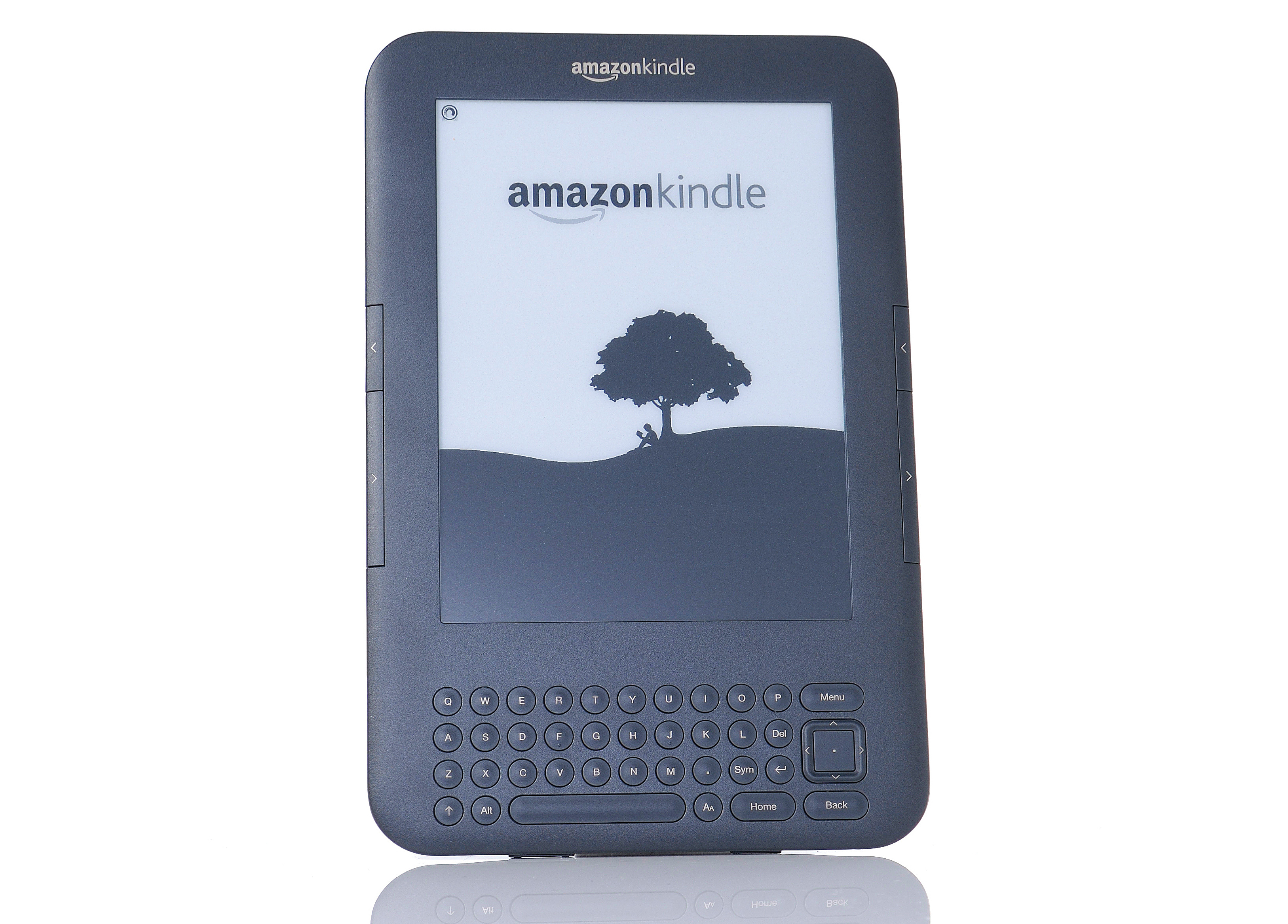
When Amazon Kindle was first a thing you had to buy the books you wanted to read and download them onto an early-generation e-reader, nothing else worked other than your actual computer. Take a look at one of the early Kindle versions here:
You couldn’t put them on your IPhone or on an I-Pad and there was no such thing as Kobo or Apple Books. This led me to feeling very enthused about reviewing. I love to read a well-crafted and considered review, and enjoyed the challenge of writing them myself. I knew an author’s success depended to a great extent on what the reviews said, and as a reader myself I read at least a good selection of reviews, both positive and negative. One’s reviewing name is not one’s own name, so there was some protection of identity when you didn’t like something. I felt it was a kind of community thing, to share views with others. I reviewed certain author’s books without fail. Then there was Goodreads, which at some point was taken over by Amazon, and that became overwhelming, so I stopped using it altogether, although they still send me emails all the time.
I don’t know when it dawned on me that the whole review process had become distorted and corrupt. Review-farming was a thing. Somehow authors could pay money – a lot of money, maybe hundreds of dollars – to have their books reviewed by a group of people who apparently got some reward for reviewing them, although I never knew how that worked, or how it met Amazon’s terms of service. The system became hyper-alert to reviews from anyone even vaguely connected to the author, relative, friend, Facebook contact, whatever and those reviews were banned. Other anonymous people however were free to say whatever they liked and post one star reviews because the book was delivered late, or was about something they hadn’t expected because obviously they hadn’t read the blurb.
Now I don’t review at all. I often feel I would like to comment on books I really like, or make suggestions to authors about something they could do to strengthen the work, or whatever. But I know now that the majority of successful Amazon authors are turning out books once every couple of months. Some are using ghost writers. Others treat writing as a kind of supermarket shelf-stocking – each book a basic product fitting a particular genre run through one or more editing programs to check for grammar and spelling, off to a human editor perhaps, covers designed strictly by genre convention which somehow everyone understands, and book is “launched” with money lavished on Amazon and/or Facebook ads and now Tik-Tok reels three times a day. Why bother reviewing? It is like reviewing cans of identical soup. And authors are devastated if the reviews they do get are not five-star.
This is clearly reflected in the command “Write to Market” which I will talk about in another post.
Over the past several months – say, six or so – I have been reading an inordinate amount as I’ve been ramping up my production schedule. Not that I’ve met it, but I’ve been trying. Several almost complete works just waiting for that semi-final edit, two new stories from my Other Identity swirling around, and here I am in Paris struggling with what feels like a covid cough – oh, wait! Covid doesn’t exist any more … at least nobody tests for it and a whole plane load of coughing passengers on their way from Singapore (nobody masked) was just due to general unspecified viruses. Anyway when I finally called the brilliant SOS Medicins service – can you believe a doctor does a home visit at 11 at night after being called just an hour before ?- he didn’t express any interest in speculating about viral sources and was just very reassuring about cough mixture and the benefits of Paracetomol.
So, back to reading. As part of the effort to better define what ‘genre’ I am writing in, I have been gulping down all kinds of stuff. I joined Kindle Unlimited so I could read lots of books of completely unknown quality really quickly and send them back if I couldn’t stand them. And I did send back a lot. You can only have twelve out at one time. I was sending back two a day at one point. The contemporary writing and reading market is so peculiar. I discovered genres I could never have dreamt up. Well, maybe they are subgenres, whatever. Tentacle Aliens was pretty bizarre.
I really liked Rita Indiana’s book, although to be fair, it wasn’t a tentacle romance and it did not evolve within the Amazon ecosystem, being published as an actual book, ie a printed volume, by that excellent British publisher And Other Stories. Check them out!
Here’s what Rita’s blurb says: Plucked from her life on the streets of post-apocalyptic Santo Domingo, young maid Acilde Figueroa finds herself at the heart of a Santería prophecy: only she can travel back in time and save the ocean – and humanity – from disaster. But first she must become the man she always was – with the help of a sacred anemone. Tentacle is an electric novel with a big appetite and a brave vision, plunging headfirst into questions of climate change, technology, Yoruba ritual, queer politics, poverty, sex, colonialism and contemporary art. Bursting with punk energy and lyricism, it’s a restless, addictive trip: The Tempest meets the telenovela.
The real tentacle romances are a different kettle of fish, so to speak – slightly disguised erotic, but some weren’t bad.
I quite enjoyed
Nepenthe: A Tentacle Alien Space Fantasy (We Are Nepenthe Book 1)
by Octavia Hyde
I was cross that she had preempted my intended use of the name Nepenthe as a sub-division of Blackwing Press for experimental and off-the-wall writing. In the light of all this, I have cancelled Nepenthe Books as a concept altogether now. It seems far too tame, given what is out there already.
Moving on from Tentacles, I found that many male writers (at least persons writing under sturdy male-identified names) have been writing about catastrophic colonies on Mars or elsewhere in a decaying universe. Lots of (ditto) girl-sounding people are writing filth about billionaires and dom/sub desires, Mafia romances and Reverse Harem (that is when one woman has three or more men living/playing with her, some of them are bikies and some are cowboys, take your pick).
Paying special heed to post-apocalyptic themes I found a couple of (I think) young players writing not bad series. I downloaded a couple of Kyla Stone’s stories and followed on her blog-site and she was doing a very good marketing job. Sadly I just got completely bored with the stories which all seemed the same. Another was a New Zealand writer who seemed appealing when I watched her on one of the many talk programs run by one of the various online “how to be an author” groups, but I lost interest after realising that although she seemed like a very nice young lady, what she was writing was just too horrible for me.
So these are low-budget Kindle ebooks designed for the Amazon ecosystem. In most cases I didn’t have any compunction about returning the books with only a few pages read. (On Kindle Unlimited the author is paid according to how many pages are read). In a couple of others I could sense a good writer struggling to come out. One in particular was writtten by a Melbourne person (girl/woman self-presentation) and it was very well written and quite gripping in places although the key plot element was obvious from early on and in my view rather ridiculous. I finished it, and for a brief moment considered writing a proper actual review with real words – as against the silly five stars which now appear at the end of each Amazon ebook, uselessly as far as I can see – I never ever click them. But I hesitated. It’s a slippery slope.
Having a kind of fun experimenting with different ways to let people know this book is out now and available to buy as a paperback or download as an e-book. Experimented with making reels or vdos using the images above which were AI generated. Seems lie MP4s using AI images on Canva won’t download to Instagram. No idea why.
Turns out also that Amazon reviews written by readers in the UK don’t show up on the Amazon pages for other Amazon sites. To get a review to show up on Amazon.com it needs to be loaded by someone in the US using a .com account, The whole Amazon ecosystem is so US focussed. I suppose we shouldn’t be surprised, there isn’t anywhere else in the world really. I don’t think my video can be posted here either, but I’ll give it a try.
Feeling super frustrated about the use of social media as it is now. Used to be people following you saw whatever you posted. Now algorithms determine everything and each individual gets things the algorithm thinks they want. Presumably this is to encourage paid advertising on the social sites, which has now become a deluge. There doesn’t seem to be any community or collective environment left any more except in Groups, and there you get kicked out if you try to “advertise” without a commercial account. The immutable logic of the system forces everyone into a straitjacket with $$$$$$$ signs on all sides.
Reviews can be posted on websites, but then only those following the website already can see them. But if you’d like to post a review anyway, positive or otherwise, use the Contact form on this site and I’ll put it up on the Book page.
Although I share the general anxiety in the publishing world about the impact of AI, I have to say experimenting with AI images has been rewarding. Amazon’s KDP allows authors/publishers to include quite expansive materials on their book pages. The question is, what to use as the basis for the content?
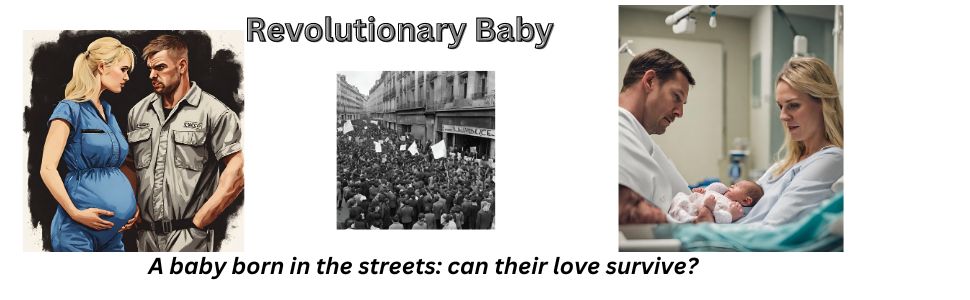
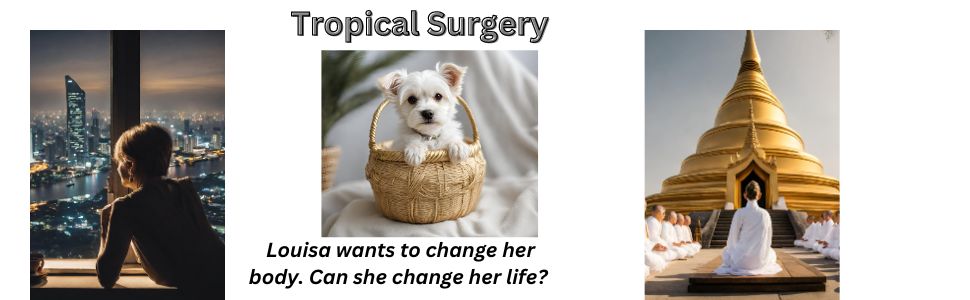
When the book is a collection of short stories, like Revolutionary Baby, this give an opportunity to give some visual clues as to what some of the stories are about. Brief text-based summaries on the back of the book amount to not much more tha a Table of Contents. In an experimental spirit, I spent a lot of time this week seeing what I could come up with to give some better visual presentation of the narratives. The A+ content also allows the creation of one kind of module with text to go with a set of images, so that is what I have submitted. Whether or not it is accepted is another matter.
Meawhile, here are the three examples I am hoping to use as the visual clues on the book page. They seem to have transferred well using the preferred pixel size recommended by KDP.
If it works out on the Amazon book page each image will have a brief text below it. I chose to paraphrase some of the actual writing from the stories. Some of it could be used verbatim but with condensation and re-expression it became a lot better. It called for a different kind of editing.
Now to find some other ways to circulate these thumbnail narratives.
REVIEW: REVOLUTIONARY BABY:Strange Tales from the Twentieth Century
Born in the same year as the author I found some of these stories echoed my own confusion when the personal coincided with the political. These “strange tales” are sometimes gripping, at times nostalgic and always thought-provoking.
Women’s liberation is just one of the “revolutions” addressed in Revolutionary Baby. The author is careful not to side with women only. When Max in the first story attempts to seduce an unwilling young Judith, she is rescued by Gabro who is, perhaps unsurprisingly, European.
As the first female in my family to attend university, I recognised Judith’s mother’s description of university study as “sham-work, not real work” in the first story, “Beyond Engagement”.
Having participated in the anti-Vietnam protest marches, I particularly enjoyed the second story “Revolutionary Baby”. The single-mindedness of a heavily pregnant woman’s insistence on taking part in a violent demonstration is counterpointed by the confusion of her solicitor husband contending with different voices: his father “you can’t let women talk to you like that” or his mother “you shouldn’t have married her, she’s a slut” (p. 42). Hamilton is empathetic with the perspective of both genders ensuring that her book will appeal to both male and female readers.
Locations for the stories are varied and vitally important to the narrative. Hamilton describes the jacarandas “bursting into purple on the Birchgrove waterfront” (p. 68). And evoking Bangkok in another story, “Rain falls in October, the gutters fill, the laneways overflow”. (p 145).
The stories that are most poignant are those set in various Sydney suburbs – or is this bias on my part because I grew up in Sydney? The following passage encapsulates an attitude shared by many women of my generation: “She wanted a revolution all right but it wasn’t one with slogans and arguments and men fighting each other over who was top dog in the park. She wanted a revolution where people looked out for each other … where people took care of the weak … gave each other what they needed”. (p. 37).
I strongly recommend this book to the Baby Boomer generation and the one following it. I’d like to think that the next generation would appreciate learning more about the revolutions both in Australia and abroad that simultaneously stimulated and confused the generations of their parents.








 I was cross that she had preempted my intended use of the name Nepenthe as a sub-division of Blackwing Press for experimental and off-the-wall writing. In the light of all this, I have cancelled Nepenthe Books as a concept altogether now. It seems far too tame, given what is out there already.

 Annette Hamilton - Writer